Audio By Vocalize
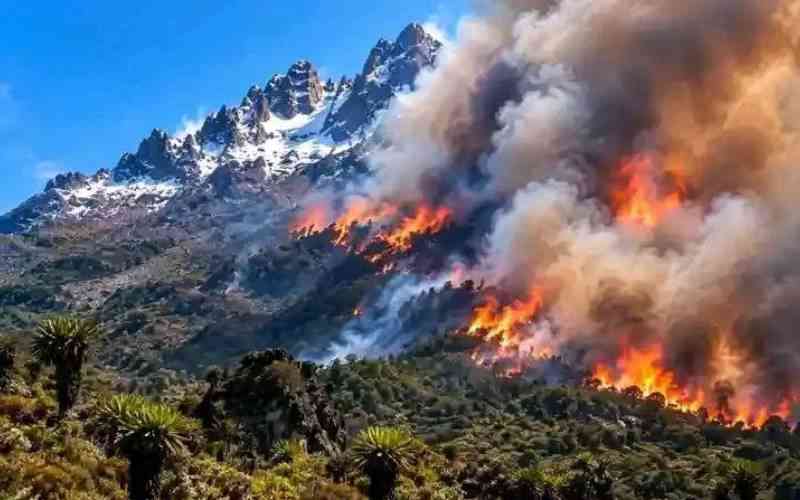
More than 3,000 hectares of Mount Kenya Forest have been affected by a wildfire that has burned since September 1, exposing gaps in Kenya’s ability to fight fires in remote forest areas.
Environment, Climate Change and Forestry Cabinet Secretary Deborah Barasa said about 85 per cent of the fire had been contained by Monday, with teams focusing on hotspots and smouldering areas that could trigger new outbreaks.
The fire began near Rutundu Lodge on September 1 and is the largest of five incidents reported in the Mount Kenya ecosystem since August 12.
“The moorland is a grassland which is full of… which is very dry. So that one would propagate,” Barasa explained during a tour of Meru on Tuesday.
Dry moorland, strong winds and invasive plant species have helped the flames spread across the rugged terrain. Barasa identified Erica, an invasive plant found in the affected areas, as one factor driving the fire’s intensity.
However, conservation organisation Rhino Ark estimated that about 8,700 hectares of moorland had burned by Sunday, September 6, more than twice the government’s initial assessment.
One fire front has moved towards Marania Forest while another has spread south-west towards Chogoria. Authorities contained the northern section by Monday but continued operations in the southern areas.
More than 400 personnel have joined the firefighting operation, including about 144 Kenya Defence Forces (KDF) officers and 100 Kenya Forest Service (KFS) personnel.
Community members, conservancies, National Government Administration Officers and development partners have also taken part.
Mount Kenya Trust, Kenya Wildlife Service, Rhino Ark and Lewa Wildlife Conservancy are among organisations supporting the operation.
The KFS, which leads the incident management team, has mapped hotspots and monitored the fire’s intensity and direction. Aerial reconnaissance has also helped teams identify hotspots and direct ground operations.
“We have managed to suppress about 85 per cent of the fire and repress its intensity, but we are not yet out of the woods,” the KFS noted.
Authorities reported no significant losses of large wildlife, saying most animals had moved away from the affected areas.
“There are no wild animals so far; just the small animals like the rabbits have been affected. Most of them have moved away,” Barasa observed.
The scale of the fire has also exposed challenges in reaching high and remote sections of Mount Kenya, prompting calls for more investment in firefighting infrastructure.
Stay informed. Subscribe to our newsletter
Barasa called for resources to be set aside for forest protection, including improving roads and establishing an airstrip to allow faster deployment of equipment and personnel.
“There is a need to ring-fence resources for forest protection because these resources are critical. More resources are needed to improve access to high and hard-to-reach areas through expansion of roads,” she noted.
She added that an airstrip would support conservation work, including the movement of biodiversity and transportation of injured wildlife during emergencies.
Investigations are underway to establish the causes of the fires and identify measures to prevent similar incidents.
The KFS says fires commonly occur during dry seasons in the Mount Kenya region, including between July and September.