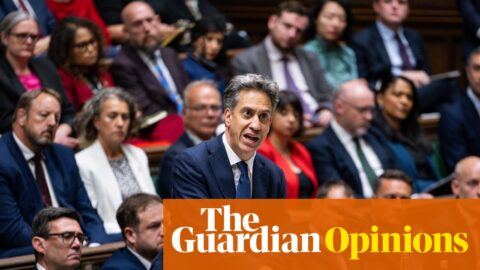
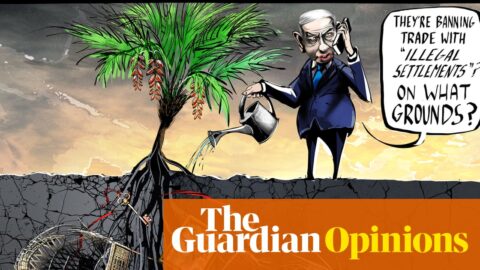
The British foreign secretary, Ed Miliband, has announced plans for an import ban on goods for illegal settlements in occupied Palestine and sanctions for companies that “finance or facilitate” the construction, infrastructure and marketing of illegal settlements.
He also said “settler terrorists” were perpetrating ethnic cleansing in the occupied West Bank, while the government turned a blind eye and some members of the government supported it.
Britain’s argument was with the government of Israel, not its people, Miliband said. The new measures would target only the expansion and entrenchment of Israel’s illegal occupation of Palestine, not Israel inside the green line – the 1949 armistice boundary, once seen as a possible template for Israel’s border with a future Palestinian state.
The measures were prompted in part by Israel’s decision to press ahead with a vast new settlement in the heart of the West Bank, in an area known as E1. The project is designed to “bury the idea of a Palestinian state”, the far-right Israeli minister Bezalel Smotrich has said, and Miliband described the issuing of construction tenders in August as a “red line”.
He told parliament of his family ties to Israel, including joyful childhood memories of visiting his grandmother, who found a home there after Nazis murdered her husband and 60 other relatives.
By acting against ethnic cleansing and settlement expansion, Britain is standing up for its core values, including “rule of law, freedom and self-determination”, and the future of both Israelis and Palestinians, he said, adding that the new measures were designed to “salvage the only course for peace and security for Israelis and Palestinians, the two-state solution”.
Why is going after E1 settlement financing a big deal?
The trade in goods grown or produced in settlements is relatively small part of Israel’s export economy, although its exact scale is obscured by a lack of Israeli statistics.
Miliband highlighted that the Israeli settler population in occupied Palestine had almost tripled over the past three decades, from 270,000 in 1993 to 770,000 today.
That expansion is underpinned by massive government subsidies. A trade ban alone would be unlikely to have much impact on the viability of construction that is a government priority, or on the broader Israeli economy.
However, plans to place sanctions on any company that finances or facilitates settlement expansion could force Israel’s main banks and insurance companies to chose between their business interests in the UK and those in occupied Palestine.
Miliband has not provided details of the new measures, which he said would take six- to nine months to put in place. But they have the potential to slow or stop construction.
The activist Yehuda Shaul wrote in a social media post about new building projects: “Companies that bid for tenders on government-led projects, including settlement expansion, must have a financial guarantor. Without the backing of Israeli financial institutions, these projects cannot occur.”
What is the status of Israeli settlements and the settler economy?
Miliband said Britain recognised Israel’s occupation of Palestine as unlawful, in line with a landmark 2024 ruling from the UN’s international court of justice (ICJ). The UK had previously recognised settlements as illegal, but remained silent on the occupation overall.
The ICJ ordered Israel to end its occupation “as rapidly as possible” and make full reparations for its “internationally wrongful acts”.
Israeli supporters of the UK measures say they redraw the line between Israel proper and illegally occupied territory, and are a much-needed response to Israeli government policies that are undermining the country.
Michael Sfard, one of Israel’s leading human rights lawyers, said: “(These measures) are enormously important. It redraws the green line and provides a recommitment to international law. Every cent that goes from the UK or other countries to support the economy of settlements is a cent that allows violation of international law.”
The former Israeli prime minister Ehud Olmert, who Miliband quoted in his speech, said: “The British government decision became unavoidable as a result of a continuous effort of ethnic cleansing perpetrated by a large group of Jewish terrorists in the West Bank … Sanctions are directed against the terrorists, not against Israel, and as such they are unavoidable.”
What does Miliband’s intervention mean for UK-Israel relations?
Israel’s foreign minister, Gideon Sa’ar, responded rapidly with a series of measures, including closing Britain’s diplomatic mission to occupied Palestine, the consulate in Jerusalem.
There was fierce condemnation from other Israeli politicians, including the far-right minister Ben Gvir who called for Israel to recognise Argentinian sovereignty over the Falklands – even before Miliband made his speech.
However, Israel holds elections in six weeks, and for months polls have shown Benjamin Netanyahu and his coalition stuck below the threshold needed to form a new government.
Although none of the leading candidates to replace him oppose the occupation, there has been growing condemnation of violence in the West Bank. A new government would mean a chance to reset ties.
Israel may be seeking to deter others from following the UK’s lead, but a dozen countries have already said they are planning similar restrictions on settlement trade, among them Israel’s historical allies Canada and France. A joint statement from the UK prime minister, Andy Burnham; the Canadian prime minister, Mark Carney; and the French president, Emmanuel Macron, said the action marked “a further turning point in our approach to protecting the two-state solution”.
Netanyahu’s policies have already pushed Israel into a position of unprecedented international isolation, and taking similar punitive action against all these countries would only deepen that.
What other pressure could be applied?
The measures unveiled by Miliband mark the most serious step yet to impose a political and economic price on Israel for settlement expansion.
The Israeli government’s furious response belies growing support both inside Israel, and among some of the country’s staunchest supporters abroad for stronger action to halt violence against Palestinians in the occupied West Bank.
This summer dozens of Israelis from the country’s security, political and cultural elite threatened legal action against their government over support for “Jewish terrorism” and an “ideology of ethnic cleansing” in the occupied West Bank.
Trump’s ambassador to Israel, Mike Huckabee, and some Republicans in Congress attacked Miliband before his speech. But the US also has elections this autumn. The Democrat Rahm Emanuel, a former Chicago mayor whose father fought in the Israeli military, used a speech in Tel Aviv to call for broad sanctions on Israel’s financial sector to stop violence against Palestinians.
Pressed on the implications of placing sanctions on banks with branches in settlements – which is all of Israel’s major institutions – he told the Jerusalem Post: “America uses its tools to achieve its policy goals. We believe in a two-state solution. You want to pursue a greater Israel? You pay full price for it. Everything. That’s a choice you make.”