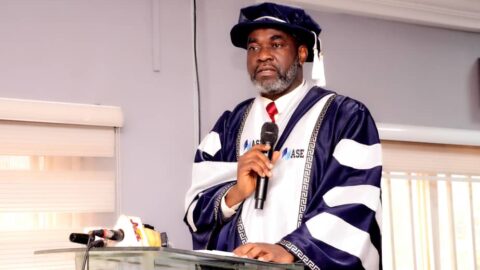
The Minister of Marine and Blue Economy, Adegboyega Oyetola, has said the Institute of Maritime Studies, University of Lagos, will advance Nigeria’s blue economy ambitions.
Speaking on Thursday at the commissioning of a multi-purpose building at the Institute of Maritime Studies, UNILAG, Oyetola described the project as a significant step towards strengthening human capital and institutional capacity in the sector.
“I am deeply honoured and delighted to join you today for the commissioning of this land-grant project by the NIMASA/University of Lagos Institute of Maritime Studies multifaceted building. The facility represents a milestone in advancing Nigeria’s blue economy ambitions,” he said.
“This auspicious occasion is a defining milestone in our collective resolve to strengthen institutional capacity, advance innovation, and deepen the human capital base required to produce an ingenious maritime and blue economy as a cornerstone of national prosperity,” he stated.
He added that the building reflects the government’s commitment to knowledge-driven development.
“This state-of-the-art facility is a testament to the Federal Government’s commitment to knowledge-driven development. It reflects our belief that the future of the blue economy will be shaped not just by natural endowments, but by the quality of minds we nurture within institutions such as this,” the minister said.
Highlighting the importance of the sector, Oyetola stressed that maritime activities remain central to Nigeria’s economy.
“In a country where over 90 per cent of our trade is conducted via maritime channels, the blue economy is not just another sector; it is a national economic lifeline,” he said.
On policy direction, Oyetola said the government, through the Nigerian Maritime Administration and Safety Agency, is strengthening the implementation of the Coastal and Inland Shipping Act.
Also speaking, the Director-General of NIMASA, Dayo Mobereola, described the project as a reflection of the agency’s commitment to capacity development.
“This project stands as a clear testament to our shared vision for a stronger, more competitive maritime sector,” he said.
Mobereola emphasised that human capital remains central to the industry’s growth.
“The true strength of any sector lies not only in its infrastructure or policies, but in the quality, competence, and preparedness of its human capital.
“Furthermore, this collaboration strengthens our collective ability to generate data-driven insights, support policy development, and address emerging challenges within Nigeria’s maritime domain. It also positions Nigeria as a hub for maritime education and research within the region,” he added.
In her remarks, the Vice-Chancellor of the university, Folasade Ogunshola, said the institute has played a key role in developing maritime expertise in Nigeria and across Africa.
“This building represents the first phase of the Institute of Maritime Studies complex… and a major investment in human capital development,” she said.
Ogunshola added that the facility would enhance research, training, and innovation, positioning the university as a key driver of Nigeria’s blue economy.
“We are beginning a journey with immense potential. Our university is poised to be the engine room of the blue economy in this country. We are confident that, with the Memorandum of Agreement between UNILAG and NIMASA, with objectives to develop academic and research capacity for the maritime industry, we can achieve this. We count on the continued partnership and collaboration with the International Maritime Organization and other organisations for which the oceans are a source of livelihood to ensure Nigeria will continue to excel in this space,” she stated.
She added, “Distinguished ladies and gentlemen, at the University of Lagos, our vision for the institute is clear, the potential for sustainable impact on the economy of this country is immense, and its capacity for advancing world-class research for growth in Africa and the global maritime community is limitless.
“So, as we commission this facility today, we assure you that the necessary sustainability plan has been put in place to ensure the optimal efficiency of our mission in training, research and community service to create the Africa we want—an Africa that contributes meaningfully to shaping the future of global shipping and the blue economy.”
The new facility features modern lecture rooms, laboratories, and administrative spaces designed to support advanced learning and research in maritime studies.