Audio By Vocalize
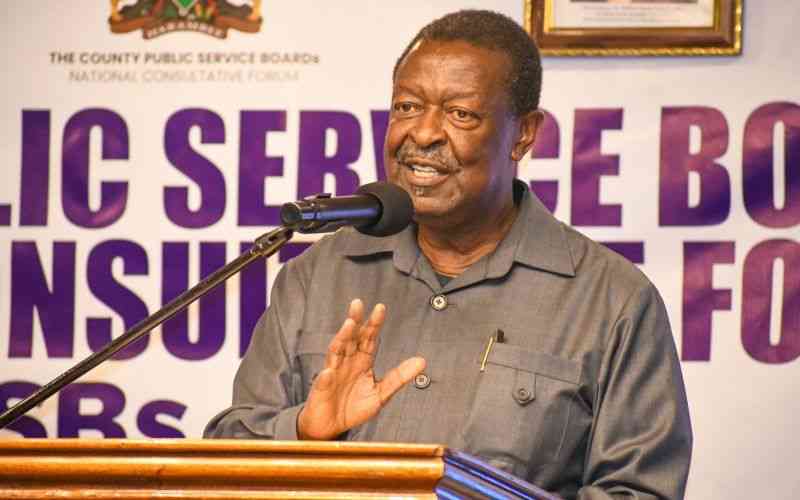
After years of what appeared to be his political comfort zone, Prime Cabinet Secretary Musalia Mudavadi is facing questions about his influence in Western Kenya and ability to rally the region behind President William Ruto’s re-election bid.
His efforts to mobilise support for Ruto are meeting resistance from an opposition movement led by Nairobi Senator Edwin Sifuna.
During a United Democratic Alliance (UDA) delegates’ meeting in Shitoto village, Mumias East, Kakamega county, Mudavadi revisited the resistance he faced when he endorsed Ruto ahead of the 2022 General Election.
“When I told you that Ruto was going to win, you thought it was a joke. Now you say, ‘Let’s blame Musalia; where is the 30 per cent of the road?’. Where were you when I was going there? When I asked you to join me, you refused; now you want free things from me,” he said.
The remarks reflected frustration within the region’s political establishment over demands for development, appointments and greater representation, even as some voters remain detached from the ruling coalition.
Mudavadi urged Western Kenya to elect more UDA legislators in 2027, arguing that parliamentary numbers determine access to influential committee positions and national resources.
He expressed confidence that Ruto would win a second term, declaring: “We want Ruto to win without a petition. We want to thrash them in the first round.”
In Vihiga, Mudavadi appealed to religious leaders to discourage residents from joining Sifuna’s Linda Mwananchi movement, questioning its leadership structures and capacity to mount a nationwide presidential campaign.
He also announced plans for a major Western Kenya rally in December alongside Central Organisation of Trade Unions (COTU) Secretary General Francis Atwoli, in what appears to be an effort to consolidate support for Ruto.
“In December, we will have a very big meeting. You will help us to mobilise because we want to make a clear statement that Western Kenya cannot be taken for granted,” Mudavadi said.
But Mudavadi’s biggest challenge may be Sifuna’s emergence as an alternative political voice in a region where the former Sabatia MP has traditionally wielded considerable influence.
The Bungoma-born senator has attracted support from political veterans, youth and leaders opposed to the broad-based arrangement between UDA and ODM. His Linda Mwananchi movement has held rallies in Kakamega, Bungoma, Busia, Trans Nzoia and Vihiga counties, challenging the political establishment associated with Mudavadi and National Assembly Speaker Moses Wetang’ula.
Sifuna’s call for the region to stop postponing its presidential ambitions until 2032 has complicated the strategy advanced by Mudavadi and Wetang’ula. The two have urged the region to support Ruto in 2027, hoping to secure stronger bargaining power in the next succession race.
Mudavadi and Wetang’ula have positioned themselves as the region’s principal voices in government, arguing that backing Ruto offers an opportunity to negotiate greater inclusion. But sections of the political class and electorate question whether the arrangement has delivered enough to justify continued loyalty.
Stay informed. Subscribe to our newsletter
Having dissolved ANC to join UDA, Mudavadi risks further losing leverage if Western Kenya rejects Ruto.
Political analyst and lawyer Moses Ombayo says the contest reflects a deeper struggle over leadership, regional unity and succession, rather than simply a disagreement over which presidential candidate Western should support.
He says the strategy by Mudavadi and Wetang’ula to back Ruto in 2027 in anticipation of a Western Kenya presidential bid in 2032 is facing resistance from politicians who believe the region should no longer defer its ambitions.
“The growing pressure is coming not only from established politicians but also from a new crop of leaders who argue that Western Kenya should stop postponing its presidential ambitions, and even the dangling of the Deputy President slot is not enough,” Ombayo says.
“The elusive Luhya unity may remain just that if we have multiple camps, each supporting their own candidate. It can only be achieved if the region unites behind a single contender, and this time in 2027 might just happen for Sifuna,” he says.
The dilemma is rooted in Western Kenya’s voting patterns and fragmented leadership. In 2022, Mudavadi and Wetang’ula broke ranks with Azimio and backed Ruto through Kenya Kwanza, surprising sections of the Luhya political establishment.
Despite their endorsement, a significant section of voters remained behind the late Raila Odinga, while ODM won several elective seats. Vihiga, Mudavadi’s home county, also elected an ODM governor and senator, exposing the gap between its senior leaders’ political choices and those of voters.
Mudavadi had argued that joining the winning coalition would give Western access to national leadership and resources. He was appointed Prime Cabinet Secretary and Cabinet Secretary for Foreign and Diaspora Affairs, while Wetang’ula became National Assembly Speaker.
Vihiga Woman Representative Beatrice Adagala, a Mudavadi ally, says the focus in 2027 should remain on development, infrastructure and economic opportunities.
“For us in Vihiga and neighbouring Kakamega, these are priorities that cannot be pushed aside whenever new political interests emerge. We must be careful not to allow emerging political formations, some claiming to advance the interests of our people, to divert attention from these priorities,” she said.