The wheelchair is part of Harun Maalim Hassan. He controls it with the ease of a person putting one foot in front of the other. He then fiddles with something, and it understands it as a command to stand still.
The wheeled machine then becomes his chair behind a massive table in his office at Commission House, Nairobi.
In 2027, Harun will mark his 20th year as a disabled person. He was involved in a road accident at 28, while driving his car towards his rural home in Mandera.
The accident happened when Harun was a district officer. He was then a sprightly young man who even nursed political ambitions. The crash forced him to recalibrate his life, and it took lots of adjusting.
Between December 2020 and January 2025, he was the CEO of the National Council for Persons with Disabilities, steering the State agency that registers the disabled and coordinates efforts to improve their welfare.
From January 2025 to date, Harun has been a commissioner with the Public Service Commission.
Harun is also an author of two books. His first book, Behind the Wheels, told his story from birth to the time he got in an accident and what followed. He confesses that he was speeding and not wearing a seatbelt at the time the crash happened. His second, Beyond the Horizon, looks back at his time at the council and the changes he instituted.
“It’s good to document your journey,” he says. “Americans have documented their bad side, their good side, everything. And every information is useful.”
He loves capital letters, this Harun. In his first book, he wanted the world to know about the DRSABCD formula for rescuing people who have just been involved in an accident. He theorised that the fact that his rescuers just made him sit on the way to the hospital may have been the fatal blow to his spine. In the second, he speaks of the 5Ps of transforming institutions.
What is the saddest story involving a disabled person that you encountered during your time as CEO of the National Council of Persons with Disabilities?
My biggest challenge was the expectation of disabled people about that institution: that [it is there] to solve all their problems.
I carried the hopes and aspirations of the most marginalised and poor people. Yet we were often underfunded and the laws that created that office never gave it the teeth, so to speak, to bite, like the enforcement capability.
And that office, much as it is a regulatory office, is also a kind of service provider by law. But because of the financial issues, it doesn’t really work as is hoped. That was my biggest problem: you see someone in need, but you can’t help.
You once wrote about how you learnt to drive as a person with a disability. How has your experience been on the road through the years?
Kenyan roads are crazy. Adherence to traffic rules is a problem for everyone. You know, matatus come from this end; another crazy driver can come from the other end.
It’s not easy for even a normal person, but as a disabled person, my fear has always been: what if your car is hit and you’re driving alone? What if you get a puncture on the street?
In Nairobi, I avoid some streets entirely because they are very chaotic. You’ll be sandwiched between two crazy matatus and my friend [you’ll suffer]. There are streets where you feel much safer and at home.
Overall, I’m also a little bit of a crazy driver. I don’t know how to drive slowly. When you’re behind the steering wheel, you sometimes forget [your condition]. I drive to faraway places like Garissa, Mombasa…
By law, you’re supposed to have stickers on your car so that you can identify yourself on the street [as someone with a disability]. But the problem is: how many people know what those stickers communicate? Some people think it is an NGO sticker because it’s blue, and blue is associated with the UN.
NTSA needs to sensitise the public on disability and driving, do something about the craziness on Kenyan roads, improve roads signage and such things.
You grew up in a polygamous family of more than 30 children. How did that shape you?
It shaped me into a communal or social person. Having a large closely knitted family, you are assured htat your problem is their problem. Similarly, their problem is your problem. There are always people around you. You even heal faster because you have people sharing stories with you.
So, there’s that feeling of belonging, and I think that is true for many pastoral communities or many African polygamous families.
That does not mean that there are no ups and downs; that there are no divergent views. But ultimately, what prevails is the oneness of the family. When I got in an accident, my family stood with me. And they still do todate.
What’s the one life lesson you picked from your parents?
My parents never had a formal education. But in their own unique ways, they’ve inspired me to be who I am. My dad made me believe that I’m smart.
My mum made me see that if I don’t work hard, I will fall behind my peers, and the world will not be my friend. I believe the world is my friend.
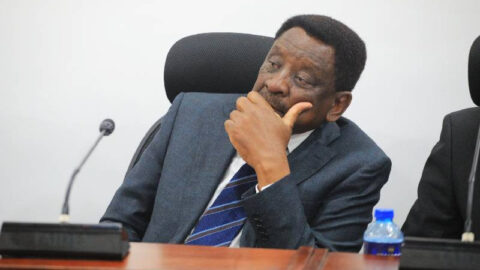
Public Service Commission Commissioner Harun Maalim Hassan during the interview at his office in Nairobi on November 5, 2026.
Photo credit: Lucy Wanjiru | Nation Media Group
Artificial Intelligence is now influencing many aspects of our lives. How do you think it can help disabled people?
I think the best thing that has happened in this decade is technology and, by extension, AI, and more specifically for people with disabilities. It has become their best companion. If someone is blind, technology becomes their best ally. It’s an eye for them.
If someone is deaf, there are AI apps that mimic…You don’t need a sign language interpreter in front of you. So, you just put it there, and it tells you what’s going on.
For a wheelchair user, you have chairs that have AI that regulates your pressure, or if you are going up and down, it detects the inclination level and adjusts, miminising the risk of falling.
So, much as AI has transformed the world, for disabled people, technology is an eye; it is a leg. It’s everything, literally. It’s the best companion that has happened, and it minimises dependency.
There are relatively few dasabled people in senior leadership positions. What has serving as a PSC commissioner meant to you, and how has your presence influenced the commission’s approach to disability inclusion?
My environment is fairly adaptive. It’s been modified in terms of washrooms and meeting places, because here it’s all about meetings, interviews and stuff like that. We sit either to create an office or to abolish an office, to promote people, to recruit people, or even to sack people.
I’m glad that the commissioners are also getting more sensitised on disability matters through interacting with me. This has enabled us to advance some of the issues we have long championed at the council, particularly those relating to employment and disability.
New buildings are now required to meet accessibility standards such ramps or lifts for someone using a wheelchair . But how well are those standards being enforced?
Approval is one thing, but the enforcement of an adjustment order is a different matter altogether.
To be fair, through it is difficult to modify the old buildings that predate these standards because of the way they are structured, most owners are making efforts [to redo them] right now.
Yes, now it’s a requirement for authorising new structures. The people who approve building codes and architectural design stipulate that accessibility must be part of it. That’s why modern buildings are now accessible, whether it is shopping malls or new offices. But at the county level, it can still be a challenge, especially considering that awareness is not so high.
You enjoy visiting museums. What draws you to history, and how does understanding the past influence the way you see the world today?
One of the things that, of late, I’ve developed an interest in is watching more global news. I’m not a TV guy- I used to prefer reading- but these days I watch what’s happening around the world.
I love going to historically important places like museums and old towns, getting to know the history of the world and how that has shaped our presence and how that will help us to shape the future.
Having published two books and gained some experience of the local market, what lessons have you learnt about Kenya’s publishing industry?
I had never imagined that publishing locally would be as difficult as I have found it. Convincing publishers to take on your work is not easy because they are in business. They want to know its economic value, the potential audience and whether the subject is interesting enough to attract readers.
My first book is about my experience living with disability. But how palatable or readable is a book about disability to the general public? Naturally, you are dealing with a smaller niche.
Perhaps what helped my first book secure the interest of KLB (Kenya Literature Bureau) was that it offered a lived experience. People are curious about what it means to live with a disability, particularly when they have not experienced it themselves.
My second book is about leadership. It focuses more on documenting one’s journey, the experiences along the way and the lessons learnt.