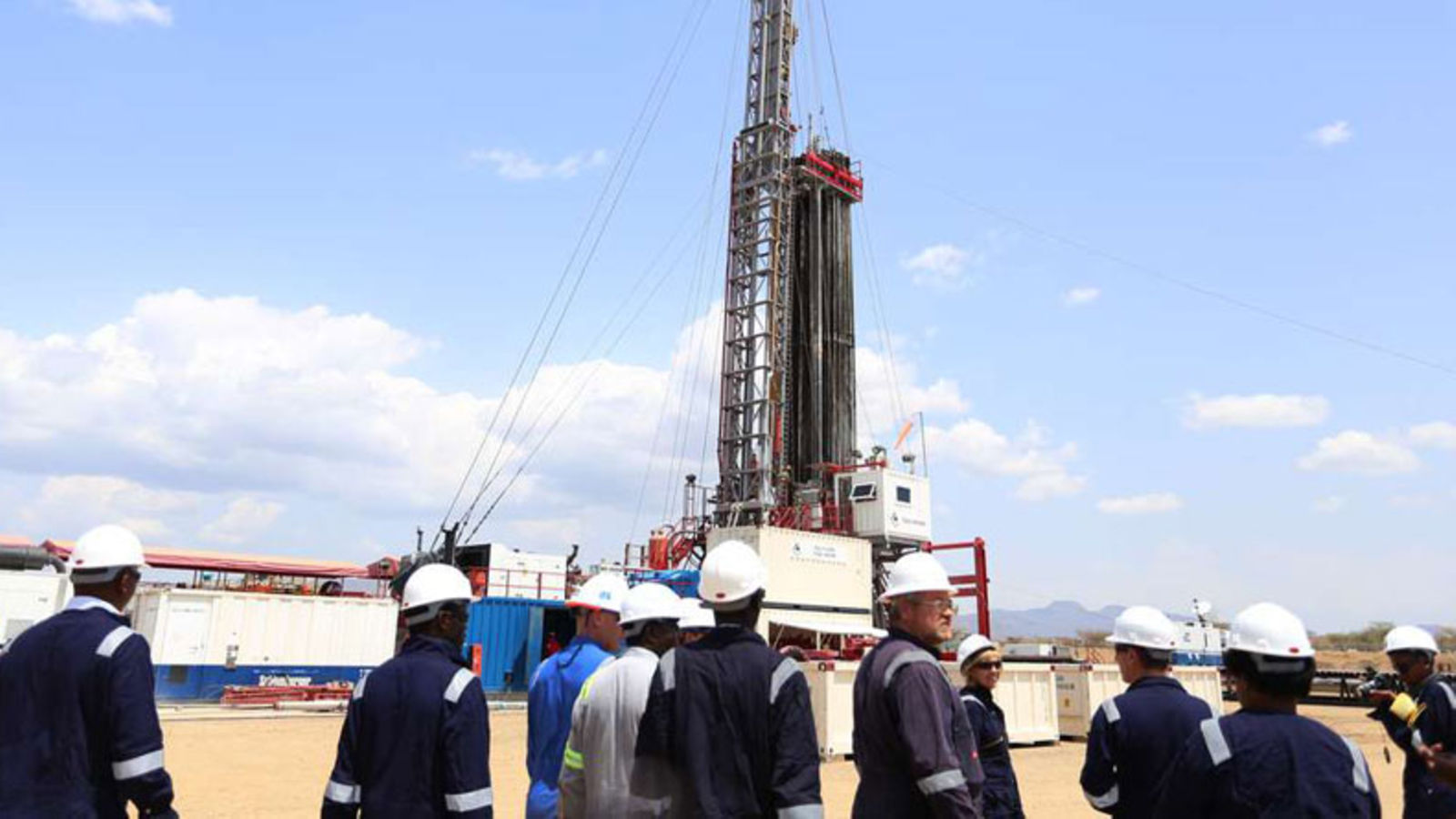
Kenya will start drilling crude oil in South Lokichar on Friday as the search for the name to be used in selling the commodity in the global markets narrows to four names.
Energy and Petroleum CS Opiyo Wandayi disclosed that the drilling rig will be switched on this Friday with the first production set for December 1, 2026 and subsequent export for refining abroad.
Kenya has also narrowed down the search for the trade name to Great Rift Light, Great Rift Intermediate, Great Rift Blend and Great Rift Sweet.
The Turkana crude is set to diversify the country’s foreign exchange earners as Kenya races to join Uganda and South Sudan as East Africa’s oil exporters.
Gulf Energy, the company undertaking the commercial oil production is targeting 20,000 barrels per day (bpd) in the first phase (2026-2032) in what will see Kenya join Uganda and South Sudan as East Africa’s oil producers.
“We are switching on the drilling rigs on Friday and the first production date of December 1 still remains as scheduled. Everything is set,” Mr Wandayi said.
Drilling oil in onshore wells takes a minimum of two weeks to lift the first volumes, placing Gulf Energy well within the target to have the first oil by December 1, 2026.
Production of the crude from Block T6 and Block T7 in South Lokichar is set to more than double to 50,000 bpd from the end of 2032 in what could potentially increase Kenya’s revenue from the oilfields.
President William Ruto is expected to flag off the first consignment of the Turkana crude on December 1, the same day that he will unveil its trading name.
The crude will be trucked to the port of Mombasa for export in the first phase, but trains will be deployed in the second stage (from end of 2032) when the volumes are set to more than double to 50,000 bpd.
Kenya kicked off the search for the trading name last month and has since narrowed down to four names.
The name is key to marketing Kenya’s crude oil which is described as light sweet (low sulphur levels), making it cheaper and cleaner for use in producing gasoline (petrol) diesel and jet fuel.
Density and Sulphur content are key metrics that determine the appeal of crude oil to refineries and traders in the global energy markets.
Currently there is no international law compelling countries to assign trading names for their crude oil. However, a name is critical for market recognition of the crude allowing traders to pick it out from the variety of crude oil traded globally.
“We are going to pick from four names and the one we settle on will be unveiled on December 1 during the flag-off of the first oil caravan by President William Ruto,” Mr Wandayi added.
Murban crude is the name of oil from the United Arab Emirates (UAE), West Texas Intermediate (WTI) is from the USA while Russia uses two trading names for its crude; Urals and Eastern Siberia–Pacific Ocean (ESPO).
Uganda recently named its crude Pearl Sweet, with Kampala saying the name represents its status as the Pearl of Africa while sweet stands for the low Sulphur (sweet) nature of the crude.
Nigeria refers to its crude oil as Bonny Light while Brent Crude refers to oil produced in oilfields located between the United Kingdom and Norway.
Kenya’s crude will fight for a market currently dominated by Brent, WTI and Murban, with the trio key in setting prices of the commodity and refined fuel. Kenya has remained coy on the refineries it will sell the crude.
“It will be a willing buyer, willing seller and whoever gives us a good price, we will take it there. Our crude is sweet and has very low Sulphur,” Edward Kinyua, the Director General of Energy and Petroleum Regulatory Authority said last month.
The Turkana crude was first exported to test its global appeal between 2019 and 2020. The samples, exported by Tullow Kenya BV, Total and Africa Oil are said to have earned discounts on the Brent crude.
The three exited the project, culminating in a deal where Tullow agreed to sell the entire project to Gulf Energy for $120 billion (Sh15.6 billion) last year.
Gulf, through its Auron Energy E&P Limited paid Tullow in three installments of $40 billion (Sh5.2 billion).
Tullow discovered commercially viable oil in South Lokichar in 2012 but struggled to get investors to derisk the project and pave the way for commercial production.
The British-owned firm also struggled in getting Kenya to approve the commercialisation plan of the Turkana oilfields, further hitting efforts to get a strategic investor for the project.
Tullow and its two partners had initially planned to reach a final investment decision in 2019 and production of the first oil by 2023.