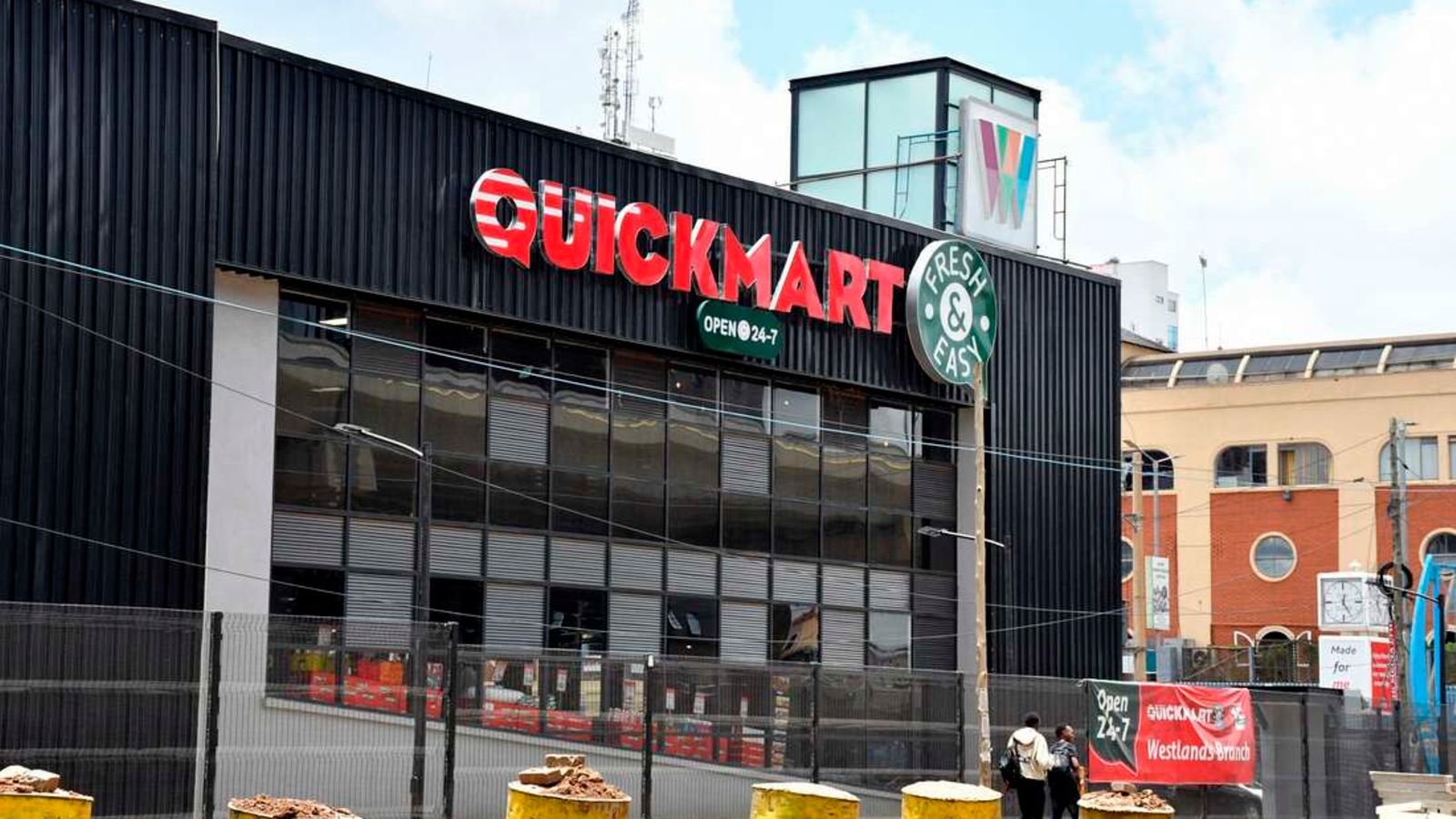
Quickmart Kenya owners will receive Sh15 billion from the sale of a 50 percent stake through a public offer at the Nairobi bourse, giving the retail chain’s founders handsome returns.
Shareholders, through Sokoni Retail Kenya Limited (SRKL), are selling two billion shares at Sh7.50 each in the weeks to October 31, providing a multi-billion-shilling partial exit route for private equity firm Adenia and its founders.
In SRKL, Adenia holds a 50.79 percent stake; the family of Quickmart founder the late John Kinuthia (31.83 percent), Tumaini Supermarket founders (12.02 percent), and the CEO of the retail chain, Peter Kang’iri, who has a 5.36 per cent.
They will all cede half their ownership in the initial share offer (IPO) in a transaction that reveals the outsized growth in value of the chain under Adenia, which first bought Tumaini Supermarket in 2018 and the following year acquired Quickmart– which were merged in 2020.
This will add billions of shillings to the worth of the founders of Tumaini Supermarket and Quickmart, which were smaller retailers in a market then dominated by Tuskys and Naivas.
Adenia will bank Sh7.62 billion from the sale of 1.06 billion shares that represent half of its 2.03 billion units in Quickmart.
The fund acquired a 55 percent majority equity stake in Tumaini in 2018 and a 51 percent stake in Quickmart in 2019, before merging the two units under the Quickmart brand in January 2020.
Quickmart CEO, who joined the company in 2019, is set to earn Sh803.3 million in the sale of half of his 214.2 million shares in the retailer.
The Kinuthia family is in line for a total windfall of Sh4.77 billion as they cede half of their 1.27 billion shares in Sokoni Retail.
Duncan Kinuthia, the late founder’s son and a director at Quickmart, is selling 414.6 million shares in the IPO, which will net him Sh3.1 billion. He currently owns a 20.73 percent stake in the retailer, equivalent to 829.2 million shares.
His sister Gladys Wambui Kinuthia holds 191.5 million shares, or a 4.79 percent stake in the vehicle, meaning she stands to earn Sh718.2 million after offloading half of the holdings.
The late founder’s wife, Zipporah Kinuthia, and William Gitau Kinuthia are in line to net Sh473.4 million each after offloading 63.1 million shares apiece. They currently hold stakes of 3.16 percent each in the retailer.
Tumaini founders Moses Nditika, Joram Ngeruro Njoga and Elijah Omullo Okello will collectively bank Sh1.8 billion from the sale, courtesy of their holding of 12.02 percent in Sokoni Retail.
Mr Okello is selling 87.98 million shares in the offer, or half of his 4.4 percent stake, which will see him earn Sh660 million.
Mr Nditika and Mr Njoga currently hold equal stakes of 3.81 percent or 152.45 million shares each in Quickmart, meaning they stand to earn Sh571.7 million each from selling half of their shares in the IPO.
The chain, which posted a profit of Sh1.7 billion in the year to December, is promising investors to share 80 percent of the profits as dividends.
The sale through the NSE is a boost to the bourse, which this year ended a listing drought that lasted years following the Kenya Pipeline Company IPO and the entry of Family Bank via introduction.
This has widened investors’ choice in a market where five counters—Safaricom, Equity Bank, KCB, EABL and Cooperative Bank—dominated trading, masking the overall performance of the bourse.
“The offer opens the next chapter in that journey by broadening ownership and enabling Kenyan and other eligible investors to participate in Quickmart’s future,” said Martha Osier, a partner at Adenia.
“The existing shareholder group will retain a substantial interest following the offer, reflecting our continued confidence in the company and its long-term prospects,” she added
The sale opened on Monday morning after obtaining regulatory approvals, and will run until October 30.
Quickmart will now become the second listed retailer at the bourse, joining the struggling Uchumi Supermarket which went public in 1992.
The sale of part of Adenia’s stake through the NSE also marks a rare move by a PE fund, which often exits their investments through share sales to high-net-worth investors or their peers.
The deal aligns with PE funds’ strategy of staying in a business for five to seven years, with an average holding period of about six-and-a-half years.
For their remaining shares, Adenia and other shareholders have agreed to a lock-in period of 24 months for at least 60 percent of their stock, opening the way for the investors to make further share sales via the NSE.
Kenyan institutional investors have been allocated 35 percent of the IPO shares, followed by local retail and offering investors at 20 percent each.
East African Community investors have an allocation of 12 percent. The limits can, however, be adjusted depending on subscription levels per investor category.
Quickmart is now the second largest retail chain in Kenya behind Naivas by store count and turnover, with an estimated 15 percent share of the market. The company has a current store count of 72, in 16 counties.
In the year ended December 2025, Quickmart reported a 33 percent growth in net profit to Sh1.51 billion. Sales rose by 9.3 percent to Sh50.43 billion in the year.
The retailer paid its shareholders a dividend of Sh1.65 billion, representing a payout ratio of 109 percent.
Adenia sought to bet on a sector that had witnessed turmoil after several Kenyan supermarkets, including Uchumi, Nakumatt and Tuskys, had either gone bust or were about to do so as foreign retailers such as Shoprite and Game exited.
Quickmart launched a breakneck expansion that at first saw it open a branch nearly every month to become the fastest-growing supermarket chain in Kenya.
Financial Times ranked it this year at number 97 among Africa’s fastest-growing companies in a top 100 list that had 17 companies from Kenya.
While taking over Tumaini and Quick Mart, Adenia judged Kenya a nascent retail market with potential to grow in both scale and sophistication.
Adenia’s initial growth strategy was two-fold. First, it replaced the Kinuthia founding family with professional management, bringing in Mr Kangi’iri, with a background in retail, logistics and finance, as chief executive, and Jacques Dôme, who had been in retail in Dubai for 15 years, as his deputy.
Second, it sought to strike better deals with Kenyan suppliers, many of which enjoy dominant market positions.