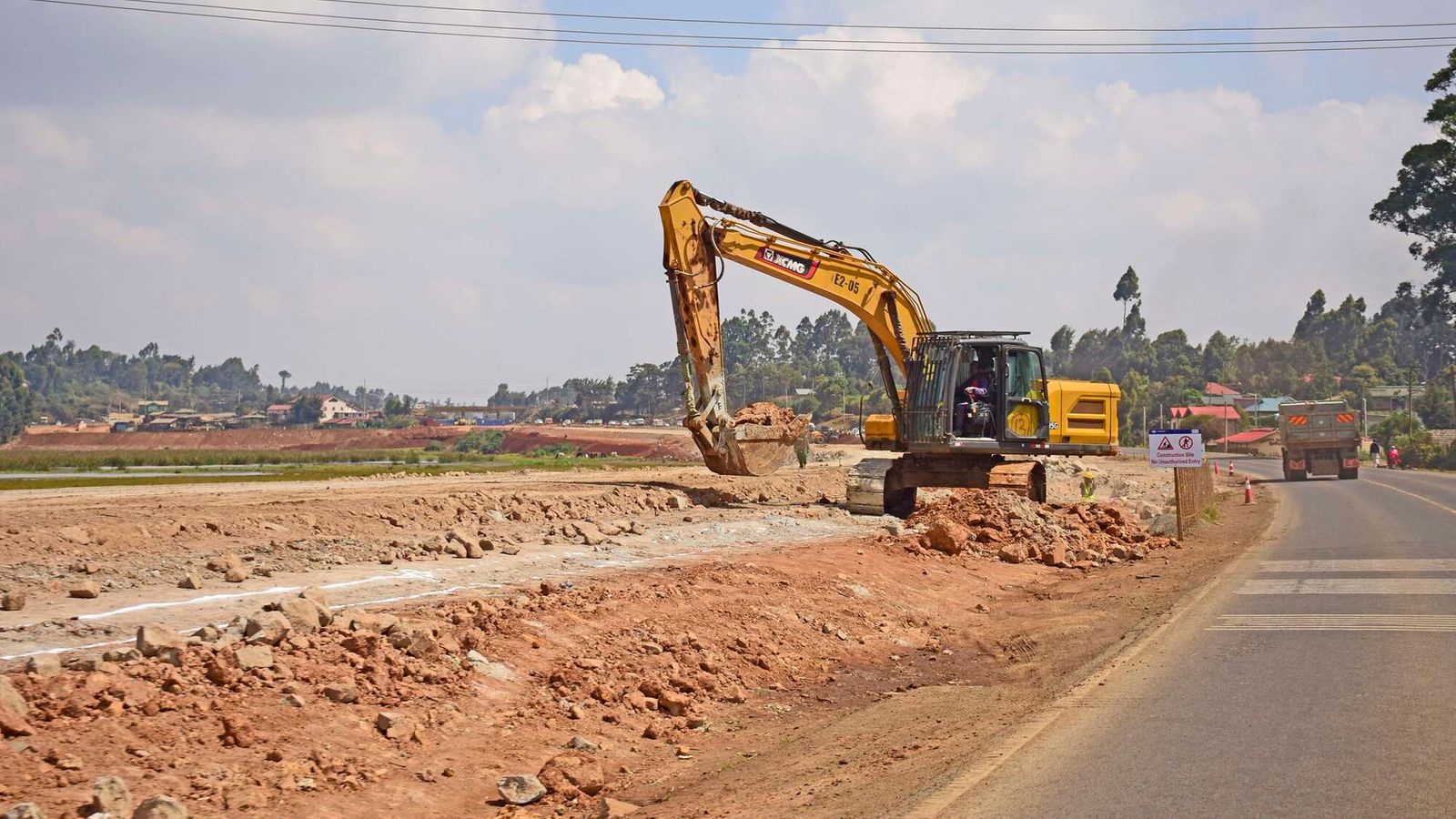
The planned 243-kilometre Mau Summit-Malaba dual carriageway has passed an initial viability test, with experts pointing out that the proposed toll road can be developed within the existing corridor.
The finding clears the way for a more detailed feasibility study that will establish the project’s final cost, traffic projections, tolling potential, and structure under the public-private partnership (PPP) model.
CPCS of Canada and Kenya’s Avatech Engineering undertook the pre-study that will anchor the cost of the project and toll fees to be charged by the investors who will fund the project.
Paul Kambalame, principal consultant at Canadian firm CPCS in charge of the Kenya market, said the pre-feasibility assessment examined the technical, environmental and social suitability of upgrading the existing road into a four-lane, access-controlled toll highway.
“Our findings were that it is a suitable project. It is an important national infrastructure project for the country, and it should move forward,” Paul Kambalame, principal consultant at CPCS in Kenya, told Business Daily .
“It is technically viable because it falls within Kenya’s existing road right of way. Environmentally and socially, the impact is also expected to be very minimal,” he said.
“There would not, for example, be a need for significant resettlement or for the road to pass through environmentally sensitive areas,” Mr Kambalame said.
The planned project comprises upgrading the 243-kilometre Mau Summit-Malaba highway, converting it into an access-controlled tolled road and expanding its capacity from two lanes to four lanes. The strategic transport route is part of the Northern Corridor connecting western Kenya and Uganda and will complement the upstream Nairobi-Mau Summit highway already under construction.
The project will join the Sh170 billion Rironi-Mau Summit dual highway, marking a departure from the earlier plan, which was to extend it on the Kisumu-Busia-Malaba side.
China Road and Bridge Corporation and the National Social Security Fund have already started work on the 236-kilometre section from Rironi through Nakuru to Mau Summit.
The Mau Summit-Eldoret-Malaba section, which is part of the Northern Corridor, currently experiences heavy traffic and is prone to accidents.
The government had earlier said that the dual carriageway would be extended to Malaba through Kisumu and Busia. It had remained mum on the Mau Summit-Eldoret-Malaba section.
The Kenya National Highways Authority (KeNHA) had earlier disclosed that 24 percent of the Northern Corridor roads were in deplorable condition by 2018, forcing transporters to endure over 100 hours moving from Mombasa to Malaba, against the targeted 78 hours.
Besides the existing 27-kilometre Nairobi Expressway, KeNHA plans to construct more expressways on key transport corridors to ease the rising traffic congestion and spur both local and foreign investment.
Expressways are typically high-capacity roads designed to allow vehicles to travel quickly and efficiently over long distances with minimal interruptions. They are built to handle large volumes of traffic at relatively high speeds compared to ordinary roads and often involve tolls.