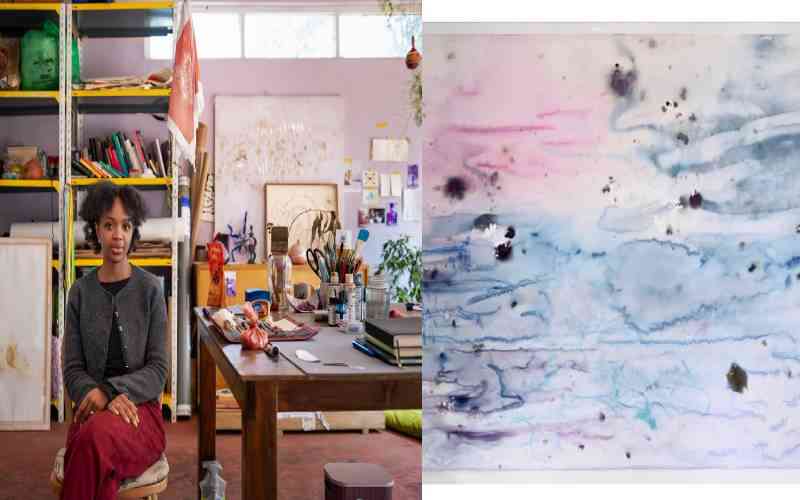
Hibiscus Lagoons, a piece by Agnes Waruguru is part of Water Memories and Blooms, a series exploring how water can hold memories and how landscapes shape the people who inhabit them. Waruguru traces these memories through layers of pigment and water.
The work is made using hibiscus, salt, water, paint and soft pastels. She creates it by building layers of water and allowing puddles to form and trace the passage of water and memory.
She uses hibiscus and salt for their personal and symbolic associations. Hibiscus is a plant her grandmother used to grow, while salt is connected to the sea and cleansing. The resulting landscape brings together water, nature and personal memory, particularly her memories of her grandmother.
The series also considers how people carry landscapes with them wherever they go. Travel, Waruguru says, leaves people with fragments of the places they have experienced.
In Hibiscus Lagoons, the moon marks the time of day while contributing to the work’s dreamlike quality. She describes the full moon as mysterious and romantic, with many of her works existing in spaces that feel “like a dream or a memory.”
She does not have a particular detail she expects viewers to notice first.
“I don’t worry about that because everybody sees different things. I hope the work brings a sense of calm and gives viewers time to reflect,” she says.
Waruguru made Hibiscus Lagoons while living in Amsterdam, where she found herself thinking about home and the connections between the Netherlands and Kenya. The work emerged from the feeling of remembering home while being far away.
The work has also received international attention. Artsy highlighted Waruguru and featured her among its Five Emerging Artists to Watch last year.
Waruguru’s exploration of memory and place is closely tied to her understanding of home and identity. She grew up surrounded by women, an experience that influenced her use of techniques that reference women’s work. Her practice explores spirituality, identity, landscape, women’s work and men’s work.
She also grew up on a farm, while her mother enjoyed planting trees and walking in the forest. Being surrounded by nature from an early age influenced the way she sees the world.
“I think ultimately we are here because of the environment we live in. People need to value and take care of the environment because it provides fresh air, food and life,” she says.
Her use of abstraction allows her to express emotions that can sometimes be difficult to communicate. She describes it as the best way for her to express those feelings and says the process can provide an immediate release of emotion. At the same time, abstraction gives viewers space to find themselves in the work.
Waruguru’s work has been described as visual poetry, a description she embraces. She says the more closely viewers look, the more details they discover.
“When you slow down, you see meaning in it,” she says.
Water Memories and Blooms developed over a year and comprises four works. The pieces share similar colours and feelings and grew partly from Waruguru’s experience of living in the Netherlands.
While there, she began thinking about the relationship between the Netherlands and Kenya, particularly the contrast between natural and man-made landscapes. The two countries are also connected through the flower trade, which contributed to her interest in natural pigments.
Waruguru’s artistic practice began with painting and drawing, interests she developed in primary school. Her parents encouraged her to pursue them, and she has continued working with art ever since.
Her practice later expanded to include printmaking, needlework and installation. She describes this development as natural. Her interest in landscapes led her to installation as a way of presenting landscapes in a tangible form and creating the kind of natural environment she wanted to inhabit.
Her choice of medium is similarly intuitive.
“Usually, the work tells me what it wants to be and the best way it comes out,” she says.
Over the years, her ideas about memory and place have also become increasingly informed by research. Everywhere she goes, she becomes interested in the economy, history, vegetation and colonial history of a place.
These experiences have made her deeply curious about the places she encounters.
The materials she uses, she says, can offer clues about what a work is about, where it might have been made and even when. Ultimately, she is also interested in how people experience the work.
Waruguru is currently preparing for a show in Lagos, Nigeria, where she is making work about the flooding that occurred earlier in the year. The new work, she says, carries a sense of hope.
Her practice has taken her to major international institutions and art events, experiences she describes as opportunities for more people to encounter her work.
“It has been great that many people get to see the work. I feel very lucky and happy that I can do that,” she says.
She describes participating in the Venice Biennale as an incredible milestone, particularly because it was something she had really wanted to do. She says she felt lucky to have the opportunity.
Despite the international recognition, Waruguru says her approach to her work has not changed significantly. Her work continues to come from a personal space, while the opportunities have allowed her to produce new work and reach audiences through international platforms.