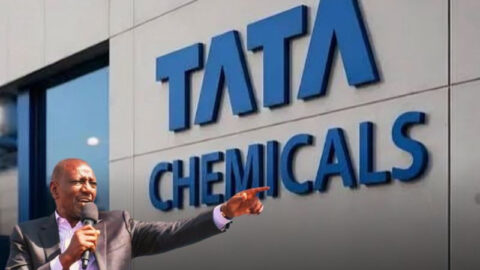
President William Ruto’s demand for Tata Chemicals Magadi to leave Kenya has opened a legal and investment test, exposing the economic cost of the country’s long-standing failure to turn mineral wealth into a deeper manufacturing industry.
Dr Ruto on Thursday announced a plan to replace the Indian-owned miner with an industrial operator which will be required to build glass and chemical plants in Kajiado County.
The plan, which faces unresolved legal disputes, will put to test the administration’s ability to attract an investor capable of preserving exports while delivering the local manufacturing the President says is missing at Magadi.
Dr Ruto, speaking at a public rally in Kajiado, said Tata and its predecessors such as Brunner Mond Group of the UK, had extracted the soda ash resource for a century without building factories or employing enough residents.
“I recently told them to leave. These people should leave,” the President said, promising to bring in another company.
He said the conditions for a new investor would include construction of a glass manufacturing plant and a chemicals plant in Kajiado, arguing that the county should be developed through its own resources.
“What do you say? Are we slaves?” he asked the crowd.
The remarks came after the government suspended Tata’s extraction operations on July 28, over compliance and licensing concerns, turning a long-running dispute into the future of Kenya’s more than Sh7 billion soda ash export business and a century-old industrial asset in Lake Magadi.
Tata’s shutdown is still before the High Court, while a separate Supreme Court case leaves the company exposed to a potentially significant county liability.
Kenya exported 254,779.6 tonnes of soda ash worth Sh7.36 billion in 2025, according to the 2026 Economic Survey report, making the mineral one of the country’s established export earners.
But the industry’s earnings have weakened in recent years, with exports falling from Sh11.88 billion in 2022, while the average value per tonne dropped to Sh28,908 last year from Sh47,550 in 2023.
The figures underline the industrialisation gap facing Kenya because the country possesses a commercially valuable mineral, but much of the higher-value manufacturing associated with soda ash takes place elsewhere.
Tata Chemicals is Africa’s largest soda ash processor, with the Magadi plant exporting more than 350,000 tonnes of natural sodium carbonate annually to India, the Middle East and Southeast Asia.
The mineral is processed into dense soda ash, used in glassmaking, and light soda ash, applied in detergents, soaps, chemicals, water treatment and paper manufacturing.
The government’s case is that Kenya should no longer allow raw trona (natural sodium carbonate) to be shipped abroad without local value addition, particularly when the mineral can support industries such as glassmaking.
Mining Cabinet Secretary Hassan Joho has also cited weak community integration, limited direct local procurement and the absence of formal skills-transfer plans to shift high-level engineering positions to Kenyan citizens.
The Mining ministry has further raised unresolved royalty reconciliations and alleged export under-reporting, while the National Environment Management Authority and local petitioners have challenged Tata over ecological management of the delicate salt-lake ecosystem.
The company, however, has rejected the shutdown and moved to the High Court, seeking an interim prohibition order to freeze the directive pending determination of its case, citing massive financial losses.
The court declined to suspend the decision, noting that implementation had already begun and that the parties had agreed during a July 29 meeting that the suspension would remain in force.
The primary compliance case is scheduled for mention on October 6, leaving Tata Chemicals Magadi’s operating future unresolved as the government advances its replacement proposal.
The dispute is also entangled in a separate land and revenue battle with Kajiado County, which has demanded Sh17.45 billion in alleged land-rate arrears and royalties accumulated between 2013 and 2018.
The claim relates to the 224,000 acres leased by Tata, with the county arguing that the company occupies vast tracts of ancestral Maa land while using less than 15 percent of it.
Tata has challenged the demands. Although the appellate court in October 2025 found the county’s claims under its Finance Act arbitrary and unconstitutional, the dispute escalated to the Supreme Court.
The Supreme Court in June allowed the critical county motion, leaving the company exposed to a potentially significant liability.
The government’s move has also been challenged by the opposition Democratic Congress Party, led by former Deputy President Rigathi Gachagua, which has demanded an immediate reversal of the shutdown.
The party has alleged that the directive is a political move intended to reassign the lucrative asset to business allies of Dr Ruto’s administration.
Tata has pointed to its community investments, including a subsidised rail service between Magadi and Kajiado, healthcare services, student scholarship funds and water supplies to households of the dry Kajiado County.
Magadi’s operations date back to 1911, making it one of Kenya’s oldest industrial enterprises, before passing through Brunner Mond and Imperial Chemical Industries of the UK.
Tata acquired the business in December 2005 and formally renamed it Tata Chemicals Magadi Limited the following year.
The financial pressure has been visible in India, where Tata Chemicals’ shares trade on the National Stock Exchange (NSE). Following the shutdown and eviction order, the stock touched ₹630 Indian rupees (about Sh856.80) on Thursday, before recovering to close at ₹643 (about Sh874).
The company’s market value stood at ₹163.81 billion (Sh222.78 billion) after the volatile session.
The figures underline the financial pressure facing the multinational as it battles to keep its major African subsidiary.