Under the Same Sky is an exhibition that places side by side the distinct voices of twin brothers Mbiyu Ng’ang’a and Antony Mega in a reflection on the world they inhabit. Working with abstraction, colour, mark-making and materials, the exhibition explores the space between hope and reality and aspiration and uncertainty.
Their works present two experiences and voices responding to the same world. They delve into dark aspects of their environments while retaining a sense of hope.
While Ng’ang’a’s body of work, Nimbus Paradigm, which is in this exhibition, speaks to awakening, abundance and the changing social consciousness of the time, Mega’s work is about Nairobi and the experiences that influence everyday life.
Curated by Santana Sino, the exhibition runs from August 22 to September 10 at Nobody Owns Me Gallery, near HOF Gallery in Kibera Arts District.
Ng’ang’a’s work explores politics and personal experiences. Nimbus Paradigm takes its name from two ideas: ‘Nimbus’ refers to rain-bearing clouds, while in art, it refers to an enlightened person, represented in his works through figures with halos.
He sees the nimbus as a duality. Rain can bring mud and floods, but it can bring growth and progression. He uses this duality to represent the current political climate.
“The wave of politics that is happening right now, for instance, with the Gen Z civic awareness, there are dark clouds symbolically, but there are greater things ahead,” he says.
‘Paradigm’ refers to a way of thinking or interpreting reality. Nimbus Paradigm, therefore, is about seeing the positive possibilities that can come from difficult circumstances while leaving behind their negative aspects.
He is presenting six mixed-media works made using rusted mabati sourced from scrapyards, acid and acrylic paint. He cuts, manipulates and collages the sheets, using acid to erode the metal before flattening it with a hammer. He uses silver and gold acrylics to represent stability and a golden age.
“The rusted mabati, which already has soot, is treated with acid and water. I retain the dark grey tones of the material to represent a transition,” he says.
He explains that the works are presented in pairs and explore awakening, perseverance and the effort towards greatness. One pair examines the recognition of failures and illusions, described as captive energies, being cut down and burnt to make way for fertile ground. The accompanying work represents the planting of new ideas, with gold and silver symbolising seeds and the possibility of a prosperous golden age.
In Perseverance, old charred wooden veneers are depicted as ships carrying gold, diamonds and silver. The vessels are battered by external forces but go towards their destination. Squodi depicts workers and masons being recruited for a construction project, representing the building of a new golden and prosperous age.


Another pair, Celestial Gathering 1 and Celestial Gathering 2, explores knowledge, humility and the relationship between human and animal nature.
Celestial Gathering 1 depicts wild and domesticated pigeons gathering golden grass or foliage for nesting. The work represents the harmonising of human and bestial nature through humility as a means of building a successful golden age.
In Celestial Gathering 2, an ibis represents knowledge, drawing from its significance in ancient Egyptian, or Kemetian, culture. A haloed figure represents a new initiate looking towards new experiences and knowledge.


Ng’ang’a says that his use of chromatic grey is how he expresses these ideas through abstraction, colour and mark-making.
“My personal experiences inform the work. I have been through a difficult time, and I’m trying to understand how to overcome challenges regardless of how circumstances are,” he says.
The title Under the Same Sky, he says, speaks to political and personal struggles and the possibilities that come out of them. The work is a form of reflection and activism.
Though the brothers have different techniques and approaches, Ng’ang’a says their work shares an interest in experiences, the human condition and the metaphysical.
Mega says that the exhibition represents the different ways people experience the same environment.
“The title speaks to two different perspectives, pointing to the contrasts in Nairobi, where affluent neighbourhoods and informal settlements exist under the same sky,” he says.
He is presenting five works on canvas paper, a material designed to resemble canvas. Two of the works, Creative Forces I and Creative Forces II, explore the creative force that is inside every person.
A piece titled ‘Slum’ responds to Nairobi’s informal settlements. Its upper section contains scribbles made with a technical pen, while the lower half uses ink, acrylic and bleach.

“Even though the approach is abstract, figures and colours represent aspects of life in a slum. The beauty of people doesn’t disappear because there are slums,” he says.
Another work, Negative Ethnicity, uses ink, acrylic and bleach to create an interaction of colours and forms. Some of the forms resemble creatures, evoking eerie, gory and dangerous feelings. It depicts Mega’s concern that negative ethnicity can lead to destructive consequences.
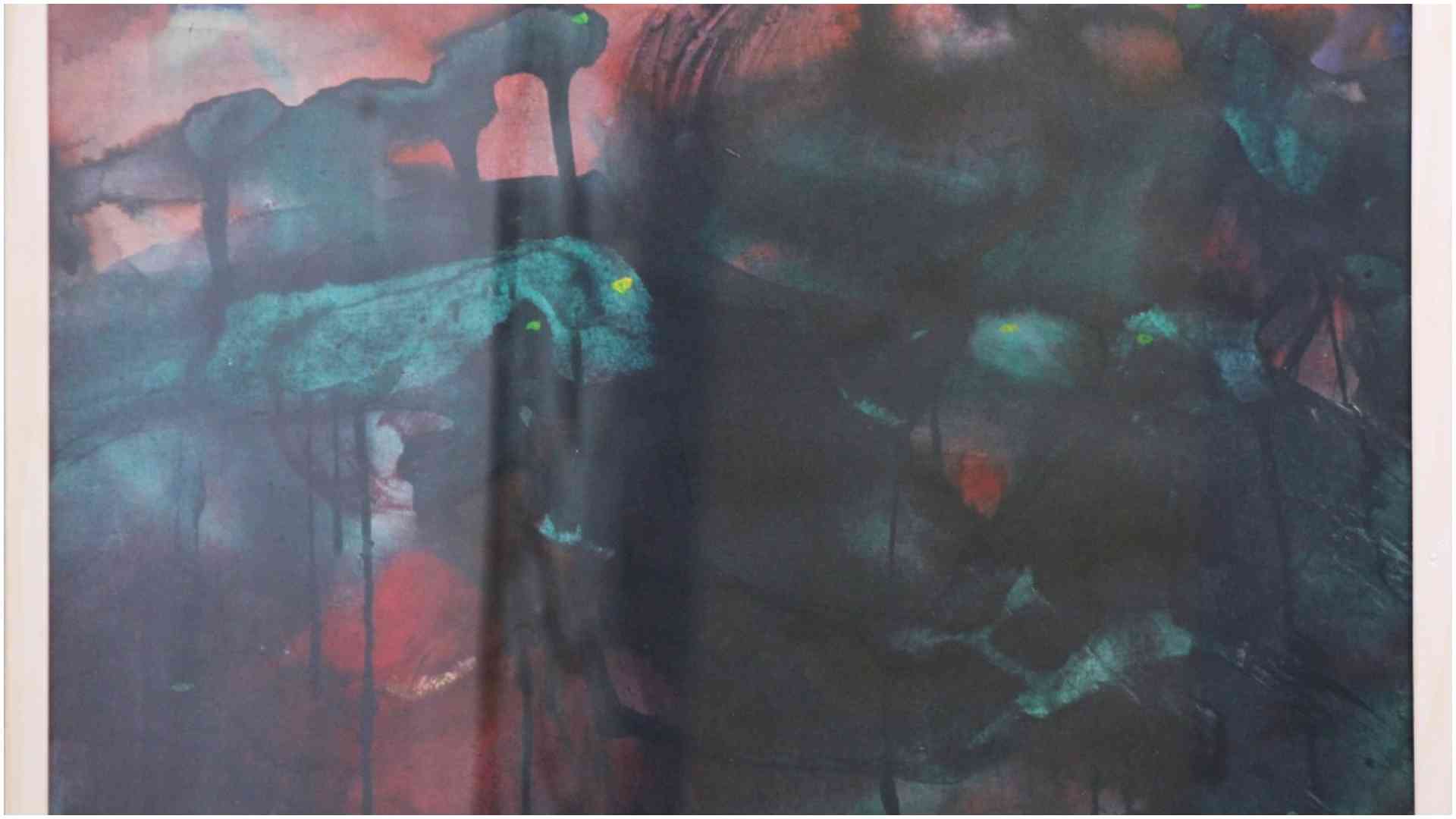
Written in the Stars shows scribbled patterns around a central area of blue ink. Tiny people and households are outlined using bleach, while stars are across the work. The blue represents Nairobi being known as a place of cool waters. Cattle, outlined in bleach, symbolise wealth. The stars represent time because they are seemingly unmoving.

Mega’s work is informed by his observations of Nairobi, such as its informal settlements; however, he also explores the city’s creativity and its potential.
“I don’t consider the works completely abstract. In Creative Forces II, for example, the central figure represents a man walking on a journey,” he says.
Hope is portrayed through the techniques and details of his works. He says that the scribbled patterns are intended to evoke beauty and wonder while drawing the viewer’s attention. He wants viewers to appreciate creativity and recognise that everyone possesses a creative aspect.
While the brothers are twins, Mega says that they are individual artists. They studied fine art at Buruburu Institute, where a teacher once told them that their work didn’t have to look the same.
“When I see his pieces, I feel fulfilled, though I also wanted to do the same. It inspires me to be more creative. We influence each other through our different approaches. Seeing his work inspires me, while he is similarly interested in my work,” says Mega.