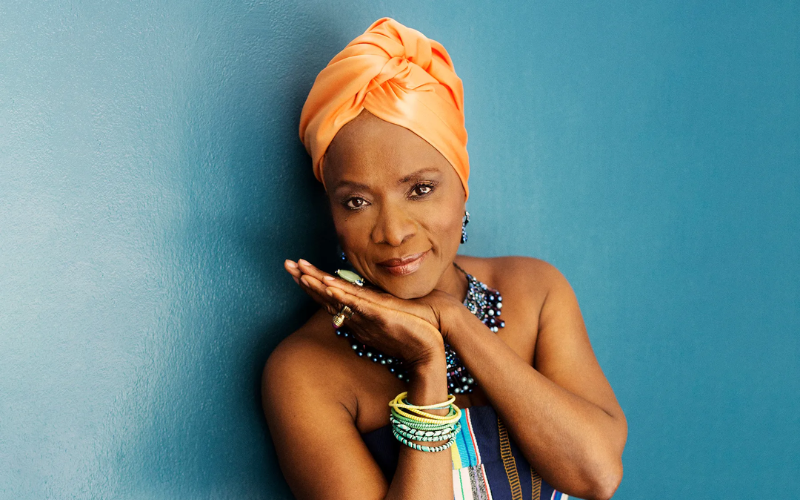
For more than four decades, Angélique Kidjo has turned music into a bridge between Africa and the rest of the world.
From Cotonou to some of the biggest stages in global entertainment, the Beninese singer-songwriter has built a career defined by musical reinvention, cultural pride and an unwavering commitment to using her voice beyond the stage.
On August 18, 2026, that remarkable journey reached another historic milestone when Kidjo received the 2,854th star on the Hollywood Walk of Fame in the Recording category.
The honour makes her the first African musician and first Black African artist to receive a star on the iconic Los Angeles boulevard, placing her among an elite group of global entertainment figures.
The ceremony brought together industry leaders, friends and fans to celebrate a career spanning more than 40 years, one that has taken Kidjo from West Africa to the centre of the global music industry.
Born in Cotonou, Benin, in 1960, Kidjo grew up surrounded by the performing arts. Her mother directed a theatre troupe, giving her an early introduction to music, dance and performance.
By the age of 11, Kidjo was already composing her own music. She drew inspiration from the rich musical traditions of West Africa while also embracing sounds from around the world.
In the early 1980s, she moved to Paris to study music, performing with different bands as she developed the distinctive sound that would eventually make her a global star. Her music blends Afrobeat, jazz, funk, reggae, soul and pop, while her multilingual performances have included Fon, French, Yoruba, Goun and English.
Her international breakthrough came with the 1991 album Logozo, setting the stage for a career that would see her collaborate with some of the biggest names in music.
Kidjo has consistently resisted being confined to a single musical identity. Instead, she has used her work to celebrate African culture while embracing influences from across the globe.
“Africa is not a country, it’s a continent, and every country has its own culture, its own music, its own reality. What I bring to the table is my culture, but I am open to the world,” she said in a past interview.
That philosophy has shaped a career marked by collaborations across generations and genres. Her collaborators have included Alicia Keys, Peter Gabriel, John Legend, Bono, Yo-Yo Ma and Burna Boy.
Her catalogue now spans 18 studio albums, earning her 16 Grammy nominations and five Grammy Awards. Among her winning albums are Djin Djin, Eve, Sings, Celia and Mother Nature.
Beyond recording studios and concert stages, Kidjo has also become a powerful advocate for social change. She performed at the Tokyo 2020 Olympic Games and has used her international platform to champion education, women’s empowerment and opportunities for young people across Africa.
Since 2002, she has served as a UNICEF Goodwill Ambassador. Four years later, she founded the Batonga Foundation, which focuses on secondary education and empowerment for girls and young women in Africa.
For Kidjo, it appears music has always been about more than entertainment.
“Music is a weapon of peace. It’s a way for me to speak for those who don’t have a voice, and to empower women and girls in Africa,” she spoke in a past appearance.
Now, with her name permanently etched onto Hollywood Boulevard, Kidjo’s legacy extends beyond the awards, albums and collaborations.
Her star represents a career that has carried African music onto the global stage while using art as a vehicle for connection, advocacy and change.