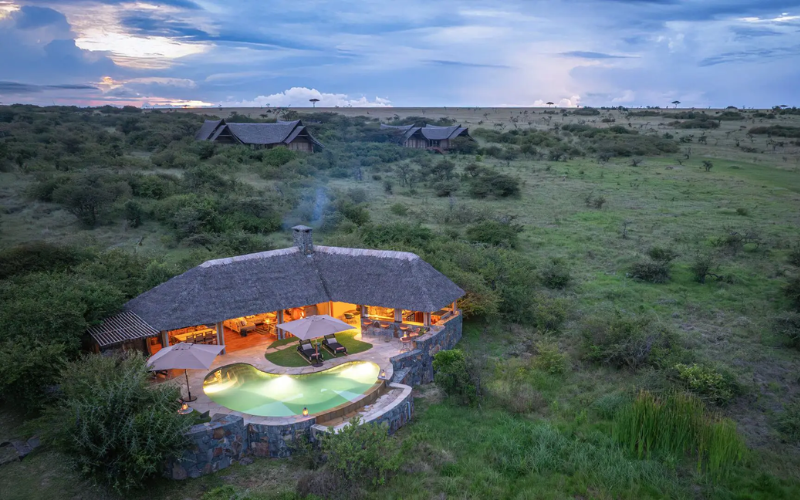
A morning in Naboisho Conservancy where the savanna tests your nerves and survival is written in the wisdom of guides.
I still remember the morning my knees trembled at the sight of a bull elephant, when silence felt heavier than fear, and when I learned that in the wild, respect is not optional. It is the only way to walk away whole.
That morning felt as though it had been stitched into my skin. Dew clung stubbornly to my boots, soaking through until my toes felt the chill. The horizon stretched wide and endless, and I felt small in a way that was both terrifying and liberating. We were a ragtag group of city folk, curious wanderers and Maasai companions wrapped in shukas, trailing behind our guide, Manfred. His stride was steady, his eyes scanning the land as though reading a language the rest of us could barely decipher.
The savanna whispered its secrets in broken twigs and faint scents. Manfred bent low, his fingers brushing the earth.
“Elephant tracks,” he said softly.
My stomach tightened. The prints were fresh and sharp. I swallowed hard, suddenly aware that the wild was not a postcard but a living, breathing force.
When we finally encountered the bull elephant, my knees betrayed me. They trembled as the giant flared its ears, a warning I felt in my chest. Manfred raised his hand, calm but firm. We froze. The air thickened and my breath caught. For a heartbeat, I thought the earth itself might split. Then, with a slow turn, the elephant dismissed us and lumbered away.
Relief came like a flood, but so did humility. Out there, survival was not about courage. It was about respect.
Buffaloes, Manfred warned, were another matter.
“Unpredictable,” he said, his voice carrying the weight of experience. “If one charges, climb fast. Or lie flat.”
He dropped to the ground, belly pressed to the soil, arms tucked in. I watched, imagining myself in that position, heart hammering against the earth, praying for stillness. The lesson was not theoretical. It was visceral.
Yet the walk was not all fear. There were moments of laughter: a warthog darting through the grass with its tail raised like a comic exclamation mark, antelopes poised in statuesque grace before bounding away, birds stitching the sky with their calls. Each encounter reminded me that the wild is not staged for us. It simply exists, indifferent to our awe.
Manfred’s stories stitched the morning together. He spoke of tourists who ignored warnings and stepped too close for photographs, forgetting that wild animals do not pose. He told tales of Maasai herders who read the land with instincts sharper than any textbook, and of lions whose roars rolled across the plains like thunder, shaking the marrow of those who listened.
As we walked, I realised the rhythm was not just in our footsteps but in our listening. Listening to the crunch of soil, to the guide’s low voice, to the unspoken language of the wild. It was a rhythm that demanded humility. Out there, we were not masters but guests.
By the time we returned to camp, the sun was high and the dew long gone. My boots were heavy, but my heart was light. I carried with me not just photographs but lessons etched deep: respect the elephant’s space, fear the buffalo’s unpredictability, marvel at the warthog’s comic dash.
Above all, remember that survival in the wild is not about dominance but coexistence.
As we walked back into camp, I realised the savanna had handed me more than stories of elephants and buffaloes. It had handed me a mirror. The wild teaches you that not everything can be controlled, that sometimes the wisest move is to step back, give space or simply lie low until danger passes.
Isn’t that the same rhythm we need in our daily lives, with children testing boundaries, colleagues pushing too hard, or the chaos of city traffic and deadlines?
Respect, patience and humility are not just survival tactics in Naboisho. They are survival tactics in everyday life. The elephant’s lesson of space becomes the lesson of listening. The buffalo’s unpredictability reminds us that not every battle is worth charging into. The warthog offers a comic dash of laughter we must hold on to even when life feels heavy.
The wild, in its raw honesty, whispers the same truth we need at home: coexistence, not dominance, is what keeps us whole.