Who cares about legacy? Legacy, Mendi Njonjo suspects, is one of humanity’s more flattering delusions – a hubristic little belief that we will be remembered, that history keeps careful, grateful records of our contributions. But history is a careless archivist. It forgets fast, and it forgets almost everyone. A century from now, nobody will know who built the bridge in Makueni, or who put 50 disadvantaged children through school in Rongo. The bridge will matter. The education will remain. The plaque never does.
“Once you accept the incontrovertible fact that we will all be forgotten,” says Njonjo, Managing Director of the KCB Foundation, “the question becomes: what are we straining for?” The answer, she has decided, cannot be remembrance. “If you’re doing it to be remembered, to be immortalised, then perhaps you should do something else.”
It’s afternoon. Her office has a glass wall scribbled with lines from Angela Davis and Toni Morrison, and it smells of a fresh pot of coffee she has just brewed. She’s casually dismantling orthodoxies, shaking dogma off its hinges.
Not even growth escapes scrutiny. She once assumed growth was linear – that you leave your first home for a second, then a third, moving steadily away from where you started. What she has found instead is that age draws you back to fundamentals: land, simplicity, the things you thought you had outgrown.
“Maybe growth is a circle,” she says.
Even now, after every achievement, a familiar voice arrives to qualify the victory: Still, you could have done better. It is, she laughs, a very Catholic, first-daughter-in-an-African-household affliction. A voice that has proved useful in keeping complacency at bay, but one she has had to learn not to obey unquestioningly.
Perhaps that is why her biggest ambition at KCB Foundation is not really about legacy at all. It is about possibility. She wants to help unlock opportunity for Kenya’s young people, women, and refugees – groups she believes the country continues to underserve despite their immense potential.
“We treat this treasure terribly,” she says.
Shall we start with your childhood?
I had a really happy childhood. You only realise how happy when you’re older and start swapping stories with people. Then you think, my God, I had it good. My mom was a teacher, my dad worked in education, and we grew up mostly in Thika in the 1980s. It was vibrant, but still small enough to feel like a community.

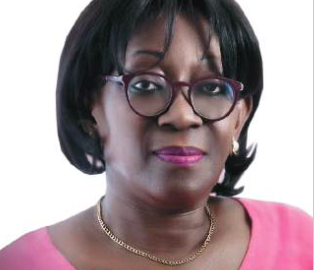
KCB Foundation Director Mendi Njonjo poses for a photo after an interview on June 16, 2026.
Photo credit: Francis Nderitu | Nation Media Group
For me, childhood is warm mangoes and streets where everybody knew your name. We were four children – three boys and me, the only girl. I once read a quote that asked, “Is acts of service your love language, or are you just the first-born daughter in an African household?” [Laughs]
But my dad was atypical for his generation. He was very clear that everybody did everything. If there was work in the garden, everybody worked. If cooking needed to be done, everybody cooked. It wasn’t really a gender thing. I think my position in the birth order mattered more than being the only girl. You learned to be scrappy. If there was something you wanted, you went out and got it.
What did you want, or dream of?
I remember my parents taking us somewhere around Naivasha, to a house with an orchard. It was probably my first time seeing apple trees. Up to then, apples were things from storybooks like Jack and Jill.
I’d never actually seen an apple tree. But this place had apples, apricots, all sorts of fruit trees. And I remember thinking, one day, when I grow up, I’m going to have an orchard full of trees. Apples remained aspirational because where we grew up, you could see mangoes, guavas, but apple trees? Those felt different. So yes, that orchard became a dream.
If your younger self were to see you now, what would surprise her most?
That’s a really good question. [Pause] Maybe it’s how things come full circle. I always thought that as you grow up, your thinking matures and you develop a more realistic sense of life. I assumed growth meant moving on – leaving one home for another, growing into new things. But what I’ve found is that the older you get, the more you return to what was fundamental. To the basics. Things like farming. Wanting to be on the land. Wanting to grow things. The younger me would be surprised by that. I always thought growth was something that took you somewhere else.
Growth is a circle. I like that. I will use it. Talking of children, do you have children?
No. [Raises hand] I’d rather not talk about that. Or about husbands and all that.
I respect that. I also want to assure you that my job here is to be your tugboat, your story being the ship, and it’s my job to see it to harbour safely. Having said that, I’m curious to know why it’s a topic you would prefer not to talk about.
As a woman of a certain age, there are certain boxes people expect you to tick. Why aren’t you married? Where are your children? And sometimes, you don’t get children or get married, for whatever reason – fate, circumstance – but after a while, you find yourself defending yourself every day, and you learn to just be [finishes sentence with hands]. Eventually, you’re like, whatever.

KCB Foundation Director Mendi Njonjo poses for a photo after an interview on June 16, 2026.
Photo credit: Francis Nderitu | Nation Media Group
But to answer your question, my family is my life. My nephews, my niece, my siblings, my in-laws – or in-loves, as they call them nowadays. [Chuckles] That’s my lodestone. It’s where I go to recharge. My mom is still alive. My dad passed away in 2008, my older brother in 2019. Sometimes it takes losing someone to realise just how integral, how foundational, they were to your life.
What’s your relationship with God?
We are cool; we have never had any feuds, not with Him. [Laughs] There’s no beef. Or to use a common phrase – He’s been faithful. [Grin] We grew up in a Catholic home – and I mean a proper Catholic home. Mass every Sunday, rosaries, and retreats during the school holidays. I also went to a Catholic high school, so it was Mass every day, rosary every day.
When you’re younger, and perhaps haven’t fully bought into it, you can feel quite distant from those rituals. But over time, you begin to see their value – whether from a religious perspective or simply because they give you a sense of direction. There’s a certain comfort in rituals. When I hear Gregorian chants, they speak to a childhood memory. When I smell incense, I’m taken back to Holy Communion, to Mass, to those moments. So, those rituals have come to carry a great deal of comfort.
What are the questions you’re asking yourself in this season of your life now?
There are some existential questions that occupy me these days. A lot of us obsess about legacy. The older I get – I’m 55 now – I find myself asking: what is this thing called legacy? Because the evidence is right in front of us.
As a species, we don’t remember that many people. Most of us can barely remember beyond one or two generations. Regardless of whether you sang the greatest song or played the greatest football, most people are forgotten. The ones who seem to endure are often artists – writers, musicians, sculptors. But if you look back across centuries, very few names survive.
So there’s a certain hubris in saying, this will be my legacy. Once you accept the incontrovertible fact that we will all be forgotten, the question becomes: what are we straining for? In truth, it will matter mostly to you, and perhaps to a few people who love you, and only for as long as they are here. [Pause] So, what do you still want your legacy to be, knowing that one day it may disappear like footsteps washed away by the tide?
Like footsteps washed away by the tide. Wow. So, how does this change how you live your life?
Initially, there was a risk of sliding into who cares? If we’re all going to be forgotten, then what does any of it matter? But then I came back to a simpler question: why are you doing it? Go back to your why. If you’re doing it to be remembered, then perhaps you should do something else. But if you’re doing it because it’s the thing you believe you’re meant to do, then do it. And I’m not just talking about work, I’m talking about life in general. For me, that’s become the test. Would I still be doing this if I were anonymous? Would I still do it knowing I’d eventually be forgotten? If the answer is yes, then that’s reason enough.
This quote by Angela Davis “I’m no longer accepting the things I cannot change. I am changing the things I cannot accept.” What does that mean for you?
It speaks to life as much as it does to work. I think there’s a certain foolishness you have to be willing to embrace when you look at a situation and say, this is intolerable, or I want to do this differently.

KCB Foundation Director Mendi Njonjo poses for a photo after an interview on June 16, 2026.
Photo credit: Francis Nderitu | Nation Media Group
There’s always a good reason why people who look like you can’t do X. And honestly, that’s one of the most dangerous things that can happen to a person, a society, a nation – when we stop questioning those axioms. Because if you accept them unquestioningly, you’ve bought into the system. Sometimes you have to be willful enough, foolish enough, to say, I’m not accepting that.
Then there is the Toni Morrison quote over there; “If you want to fly, you have to give up the things that weigh you down.” Is there something that weighed you down, that you have had to overcome?
Professionally, I’ve worked in spaces where sometimes you’re the first Black African woman to do certain things. Some of the things that weigh you down are other people’s perceptions, but also the narratives you tell yourself.
We like to think we’re above those things, but can you ever really outrun the beliefs that were drummed into you in childhood, through literature, songs, stories, the messages you absorbed growing up?
A lot of what weighs us down is self-limiting belief. There’s also something we don’t always give ourselves, or our children, permission to do, which is to dream fantastically. Some of the saddest conversations I have are about vision.
If we’re talking about young people in Kenya, why are our dreams always so small? One of my biggest dreams is to help undo one of the greatest injustices dealt to young people in Kenya. The greatest asset we have is our young people. Yet we treat this asset, this treasure, this opportunity, terribly.
And personal dreams?
I want to finish my books. I’m working on two of them. One is fiction. The other is also fiction, in a way, but it’s really a lexicon of Kenyan words -made-up words that describe some of the absurdities, frustrations and peculiarities of being Kenyan.
I’ve wanted to write it for a long time. It’s called We Need New Words. The idea is to create words for things we all recognise but don’t quite have language for. The second book is a work of magical realism. Those are the two projects I’m trying to finish.
What excites the child in you?
Quick story. I grew up in Thika, and we had a farm outside town where we’d spend every school holiday. People who grew up farming rarely join those Nairobi conversations about how they’d love to farm. [Laughs] They know there’s very little romance in it – especially if you weren’t sitting on a veranda pointing and telling other people what to do. But there were small pockets of joy in farming, and surprisingly, that’s what I find myself returning to now. There’s something about being on a farm, walking around, not thinking about work. The tasks are immediate and concrete. A mango has grown. You pick it. You eat it. The child in me still revels in that.
What’s the loudest voice in your head you’ve had to quiet down?
It is a phrase. “Okay. But still, you could.” You write the best article, people celebrate you, and for a moment, you’re pleased. Then a voice pipes up: Okay, yes, but you could have done better.
In some ways, it’s useful because it doesn’t allow you to get too comfortable. But after a while, you have to tell it to stop. You’re allowed to celebrate an achievement without immediately asking what the next mountain is, what the next breakthrough is, what the next thing is that you need to overcome.