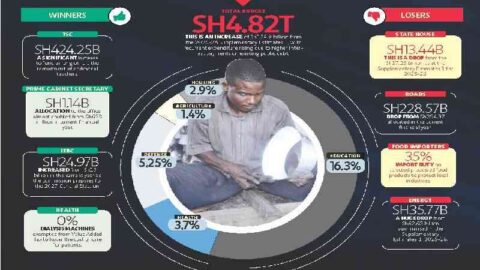
National Treasury Cabinet Secretary John Mbadi presented the Sh4.82 trillion budget for the financial year 2026/27 in Parliament on Thursday afternoon.
Here are highlights of the major pronouncements he made.
Economic forecasts
Treasury cut its 2026 growth forecast to 5.0 percent from 5.3 percent, pointing to the adverse effects of the ongoing Middle East conflict on the economy. The government, however, expects growth to recover to 5.2 percent in 2027.
Treasury expects inflation to remain within the CBK target range of 2.5 percent to 7.5 percent, assuming easing geopolitical tensions and stable food prices.
Current account deficit expected to widen to 3.0 percent of GDP in 2026 from 2.1 percent in 2025, reflecting higher international oil prices, lower receipts from services, slower growth in remittance inflows and reduced exports.
The wider deficit points to increased pressure on the country’s external accounts amid a challenging global environment.
Treasury projects the fiscal deficit, including grants, to narrow from 5.5 percent of GDP in the 2026/27 financial year to 3.3 percent by 2028/29.
Policy reforms
Mbadi says no public procurement will be conducted outside the Electronic Government Procurement System from July 1; Treasury to end all exemptions.
Treasury plans to settle Sh155.3bn in verified pending bills through direct budget allocations and securitisation over the next two years.
Mbadi proposes extending by three years to December 31, 2032 the deadline for banks to meet the Sh10 billion minimum core capital requirement. Mbadi says the move will allow a better-structured approach to recapitalising the sector.
Treasury proposes amendments to the Insurance Act to establish agricultural insurance as a standalone class of insurance business, aimed at strengthening the regulatory framework for agricultural risk management.
- County requisitions and payment
Government to expand implementation of the Treasury Single Account to counties from July 1, overhauling county requisitions and payment processes.
Government to amend the Public Finance Management Act and related regulations to strengthen oversight across the public sector after recurring audit queries exposed public resources to fiscal risks and weakened service delivery, Mbadi says.
Treasury to amend the Public Finance Management Act and the Kenya Information and Communication Act, together with supporting regulations, to enable the use of electronic signatures, electronic seals and electronic time-stamping services across government.
Allocations
Treasury allocates Sh3.9 billion for village elders’ stipends for the first time.
Treasury has allocated Sh2 billion for the rollout of NextGen.Ke, a programme developed with the UNDP to place recent graduates in paid private-sector internships and equip them with market-relevant skills.
Tax measures
Treasury revises Finance Bill 2026 proposal on income tax filing schedules; PAYE taxpayers to file by April 30, other taxpayers by June 30, while nil filers will be required to file within one month of the end of their year of income.
On auto-populated tax returns, Treasury allows taxpayers to review, confirm and amend pre-populated returns before assessments are issued.
Treasury revises proposed VAT changes on digital payments to exempt core financial service providers, easing concerns over the proposed 16pc VAT on M-Pesa and other digital transactions.
Hellen Githaiga, Kepha Muiruri, George Ngigi, Julians Amboko, Kabui Mwangi, Edna Mwenda, Vincent Owino.