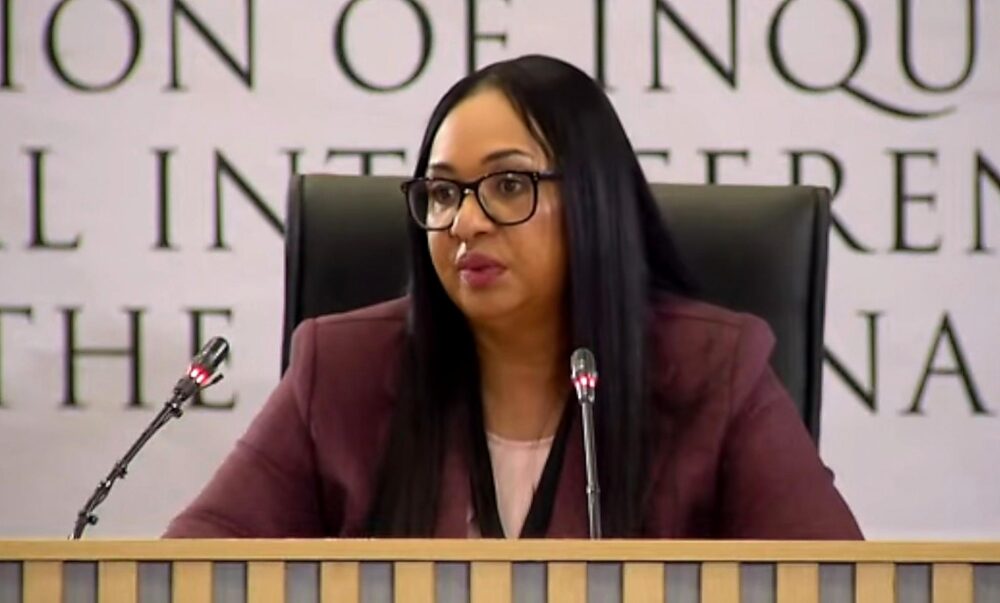
Testimony: TMPD Chief Yolanda Faro has told the commission she stopped an R800 million tender in March 2025. Photo: Supplied
The Madlanga commission investigating criminality in the justice system turned its attention this week to tender looting through security outsourcing at the Tshwane Metropolitan Police Department (TMPD).
Senior officials told the commission that more than R2 billion was siphoned through security contracts meant to protect metro police properties and personnel.
TMPD chief Yolanda Faro testified on Tuesday that she had stopped an R800 million tender in March 2025.
On Thursday, TMPD director of asset protection services Tshukudu Malatji denied any involvement in tender rigging and defended his part in the controversial R300m security contract, which was stopped in 2017 and reinstated in 2022.
“In as far as TMPD 02/2016/2017, where I participated as a BEC (bid evaluation committee) member, I can assure the commissioner and this commission, from the beginning to the end, we never had a situation where there was a complaint that documents were tampered with,”
he said.
Malatji wrote the bid specifications for the security tender, which was advertised in 2016, attracting 272 bids. The BEC narrowed it down to 22 companies.
The R300m contract was halted within a year after a report found irregularities in the evaluation process and that metro police had removed documents from the storage facility.
However, the three successful companies that were awarded the contract took the metro to court, after which the contract was reinstated in 2022.
Tshwane deputy mayor Eugene Modise, who also holds the finance MMC position, was implicated in a February 2025 internal investigative report for improperly benefiting from the contract through links to one of the companies, Triotic Protection Services.
During his two-week testimony at the commission, sergeant Fannie Nkosi said the security company had been regularly awarded security contracts.
Malatji told the commission that the TMPD and City of Tshwane had not had capacity to protect its properties, assets and personnel when he was appointed in 2013, “hence the asset protection services section was established under TMPD”.
However, Faro told the commission many tenders were cancelled after officials had requested outsourced security for 22 more property sites when there were no reports of break-ins or security concerns at city assets and properties.
Malatji was suspended in 2025, shortly after TMPD deputy chief Revo Spies was appointed.
Spies had previously told the commission about a similar security tender looting scandal in the Ekurhuleni Metropolitan Municipality involving the blue-lights saga and Cat VIP Protection owned by the alleged leader of the Big Five cartel, Vusimuzi “Cat” Matlala.
“When I was appointed as a director in June 2013, the City of Tshwane was already outsourcing functions of Asset Protection Services to external service providers,” he said.
Malatji said former TMPD chief Steven Ngobeni had instructed former deputy chief Rex Mahlaule to prepare the contested TMPD 02-2016/2017 tender.
Malatji had assisted in the procurement process and submitted bid specifications, which were then forwarded to the supply chain management.
“There were reasons why the BEC requested the documents be moved from the supply chain management to Primrose College.
“These reasons were purely security concerns the BEC had observed before we could start with the actual evaluation process,” he said.
The storage facility was accessed without control by city officials, which necessitated the removal of the bid documents, he said. “I have no knowledge …of anything that might have gone wrong with the tender when I was a BEC member.”
Malatji said that after submitting the bid specifications and facilitating the evaluation process he had not been involved in the bid adjudication process.
“When it comes to the court issues, the reason why this tender was litigated was never brought to my attention.
“I heard from the corridors but from the top management who assigned me a duty right from the beginning, to come to me and say: ‘Director come here, here is a problem,’ such a thing never happened.”
Malatji said he was not aware of the nature of the litigation of the tender he prepared, which was halted and later reinstated in 2022.
“Between May 2017 to 2019 I was not in that space … There might have been communication to the effect the tender was not moving … but now since I was taken out of the position for almost two years, that part I might have missed.”
Shifting bid evaluation processes to digital tender applications instead of paper-based submissions would solve such challenges, he said. “Alternatively, if files could be submitted electronically, this would assist a lot in terms of addressing the issue of papers being replaced out of the tenders.”
In the weeks to come, the commission will hear further testimony from implicated officials such as Lebohang Phiri, the inspector in the Asset Protection and Security Services and Gareth Mnisi, the chief financial officer of the City of Tshwane