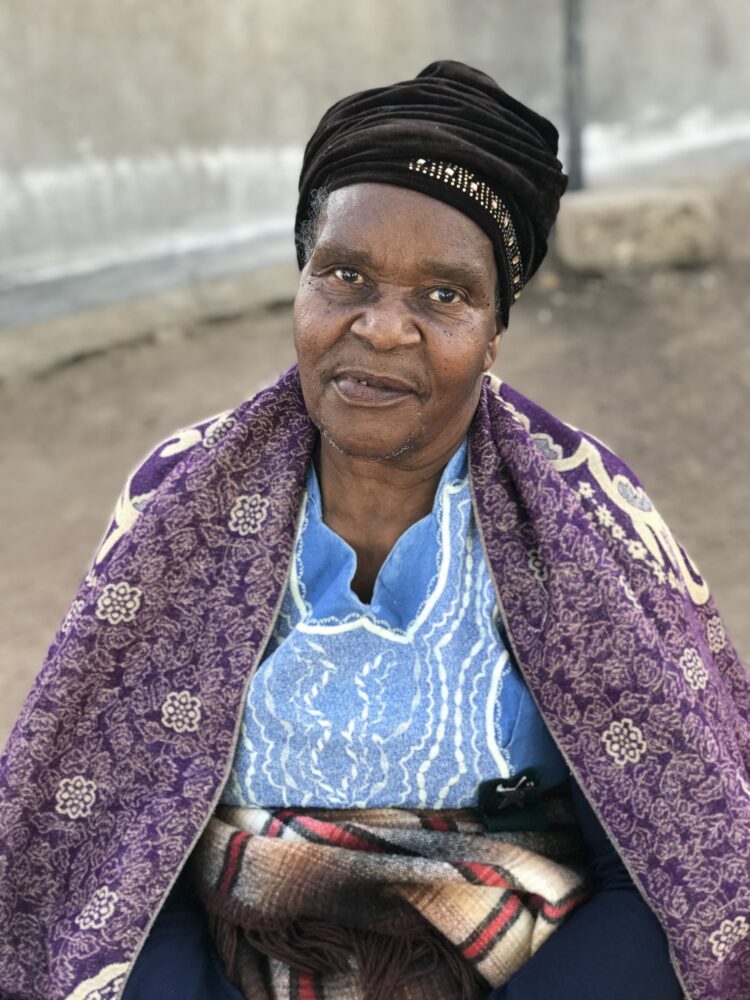
Lifelong toll: The author’s grandmother, Tryphina Chepape’s body has become the most immediate site of the quiet war, the place where everything seems to converge, where time, labour, memory and pain all meet without buffer. Photo: Supplied
There is a quiet war unfolding in my house. The kind that does not announce itself with sirens or headlines.
The kind that does not make it onto timelines or into breaking news alerts but instead settles into the corners of the home, into the rhythm of breathing, into the slow, deliberate movements of a body that has carried too much for too long.
My grandmother is here, having travelled from Limpopo with very little in her hands but everything in her being.
There is an understanding among us that no one has dared to name out loud, a fragile, hovering awareness that her visit is not just a visit in the ordinary sense but something heavier, something final, something that sits between presence and departure, between being here and preparing to leave.
Before goodbye, though, there is something else entirely, something urgent and insistent, something that feels almost like a release.
There is testimony.
She talks now in a way that feels both deliberate and uncontrollable, as though the stories have been waiting for this exact moment to surface, as though her body has decided that silence is no longer necessary.
Her voice moves through the room, stretching across time, collapsing decades into single sentences, bringing the past so close it feels like it is happening again in front of us.
She talks about my grandfather but not in the way we have come to know him, not as the softened figure who existed within the safe borders of our childhood memories, not as the quiet presence who occupied space without demanding too much from it but as a man who was once sharper, more difficult, more flawed in ways that we were never made aware of.
And there is something deeply unsettling about listening to her speak of him like this, not because it feels like betrayal but because it shifts something fundamental inside us, rearranging the neat and uncomplicated stories we had told ourselves about who he was, forcing us to sit with the uncomfortable reality that people are never just one thing, that even those we think we understand are layered with histories we may never fully grasp.
She speaks of his flaws not with anger, not with resentment but with a kind of calm clarity that feels almost heavier than either, as though she has done the work of processing, of carrying, of surviving and what remains now is simply the truth, laid out plainly, without decoration, without apology.
It is strange, the way proximity to death seems to loosen the grip of silence, the way it creates space for things that once felt unsayable to be spoken without hesitation, as though the urgency of the moment demands honesty above all else.
She talks about her life as a domestic worker in apartheid South Africa in a way that sounds almost ordinary but the more she speaks, the more it becomes clear that there was nothing ordinary about it, because domestic work was never just about cleaning houses or raising other people’s children.
It was about a system that quietly reorganised black life, pulling women out of their own homes and placing them into white households where their labour was needed but their lives were not fully seen.
Where they woke up before dawn to travel distances shaped as much by apartheid laws as by geography, leaving their own children behind in order to care for others, learning the rhythms and intimacies of families that were not theirs while their own grew up in fragments of absence.
Even though she does not name it as violence or injustice, the weight of it sits in the way she tells it, in the pauses between her sentences, in the understanding that what she calls “work” was in fact a lifelong negotiation with a system that demanded her presence everywhere except where she was most needed.
There is a violence in that kind of life, even if it does not announce itself as such, even if it does not
leave visible scars in the way we have been taught to recognise harm, because it stretches across years, across relationships, across the very structure of family itself, altering it in ways that are still unfolding long after the fact.
She does not name it as sacrifice and she does not frame it as loss but it sits there anyway, in the spaces between her sentences, in the pauses that linger just a little longer than expected, in the weight of what is not explicitly said but deeply understood.
And then there is her body, which has now become the most immediate site of this quiet war, the place where everything seems to converge, where time, labour, memory and pain all meet without buffer.
She tells us that the cartilage between her knees is completely gone, that there is nothing left to cushion the bones from one another. Now, with every movement she makes, there is direct and unforgiving contact, a grinding that she cannot escape, a friction that has become her constant companion.
Bone on bone, she explains and even in the clinical clarity of that description, there is something almost unbearable about imagining what that must feel like, about understanding that there is no position of relief, no simple adjustment that can ease the discomfort, no small intervention that can restore what has been worn away.
She describes the pain not with exaggeration, not with the kind of language that seeks to make others understand through intensity but with a careful, measured precision, as though she is documenting something that must be acknowledged in its full reality, without distortion.
“It is painful,” she says and again, the simplicity of the statement carries far more than the words themselves, because what she means is that the pain is constant, that it does not negotiate, that it does not allow for rest in the way we might hope.
What she means is that her body has become a place of resistance, a place where ease is no longer possible.
And this is where the idea of the “God of War” begins to take on a different kind of meaning for me, shifting away from something distant and mythological and becoming something deeply personal, something that lives within the body, within memory, within the quiet conflicts we carry every day.
Because war, at its core, is about conflict and conflict does not always require armies or borders or declarations; sometimes it exists in the tension between what was and what is, between what the body remembers and what it can no longer do, between the stories that were once hidden and the need to finally speak them aloud.
My grandmother is fighting but not in a way that can be easily understood or neatly resolved, not in a way that promises victory or even relief but in a way that is ongoing, relentless, deeply embedded in the experience of being alive in a body that is slowly, inevitably changing.
She is fighting pain that does not pause, memories that continue to surface, a body that no longer cooperates in the ways it once did.
She is doing all this in a way that refuses silence, that insists on articulation, that demands to
be heard.
It makes me think about how many wars exist quietly within our families, how many stories remain just beneath the surface, never fully expressed, never fully understood, how many lives are lived in ways that we only begin to comprehend when it is almost too late to ask the questions we should have asked much earlier.
And so the act of listening becomes something more than passive reception; it becomes a responsibility, a form of care, a way of honouring what is being given in these moments of openness.
To listen is to hold space for complexity, for discomfort, for the recognition that the people we love are not simple, that their lives contain contradictions, pain, resilience and choices that we may never fully be able to reconcile.
We cannot fix what has happened, we cannot rewrite the conditions that shaped her life, we cannot restore what her body has lost and perhaps the most difficult part of all of this is accepting that limitation, sitting with the knowledge that presence is the only offering we have left. But presence, in its fullest form, is not small.
It requires attention, patience, a willingness to remain even when the stories become heavy, even when the truths disrupt our sense of comfort, even when we would rather retreat into simpler versions of the people we thought we knew.
The God of War, then, is not always something that exists out-side us, not always something that can be pointed to or named in a singular way.
Sometimes, it lives in the body of a woman who has endured more than she ever spoke about.