Bombardment: Residential neighbourhoods targeted in airstrikes reportedly carried out by US and Israeli fighter jets in Tehran, Iran, on 7 March. Photo: Behnam Tofighi
The war between the US, Israel and Iran is entering a more dangerous phase, with strikes on Iran’s South Pars gas field followed by retaliatory attacks across the Gulf that are drawing the region’s energy infrastructure into the conflict and raising the risk of wider economic disruption.
Saudi Arabia said it intercepted ballistic missiles targeting Riyadh and nearby energy sites, with debris injuring civilians and falling near a refinery south of the capital.
The incident signals a shift in the war’s trajectory, extending the battlefield into systems that underpin global oil supply.
What began with coordinated US and Israeli strikes on Iran in late February has widened into a new phase.
The targeting of South Pars — the world’s largest natural gas field shared between Iran and Qatar — signals that the conflict is no longer confined to military assets. It is
intersecting with global energy networks, exposing supply routes and transport corridors such as the Strait of Hormuz.
Roughly a fifth of the world’s seaborne oil passes through the strait. Even limited instability has historically triggered sharp market volatility and markets are pricing in sustained disruption.
The escalation has extended beyond Iran’s borders.
Iran targeted Qatar’s Ras Laffan Industrial City, one of the world’s largest liquefied natural gas hubs, with Qatari authorities confirming damage to the facility after missile strikes.
The development marks a widening of the conflict into shared energy infrastructure central to global gas supply.
In an interview, Iran’s ambassador to South Africa, Mansour Shakib Mehr, said Tehran’s military response was directed at US bases rather than neighbouring states.
“Our neighbours have never been our target,” he said, adding that Iran was acting within its right to self- defence.
Mehr said Iran had substantial evidence that the territory and airspace of neighbouring countries were used in attacks against Iran.
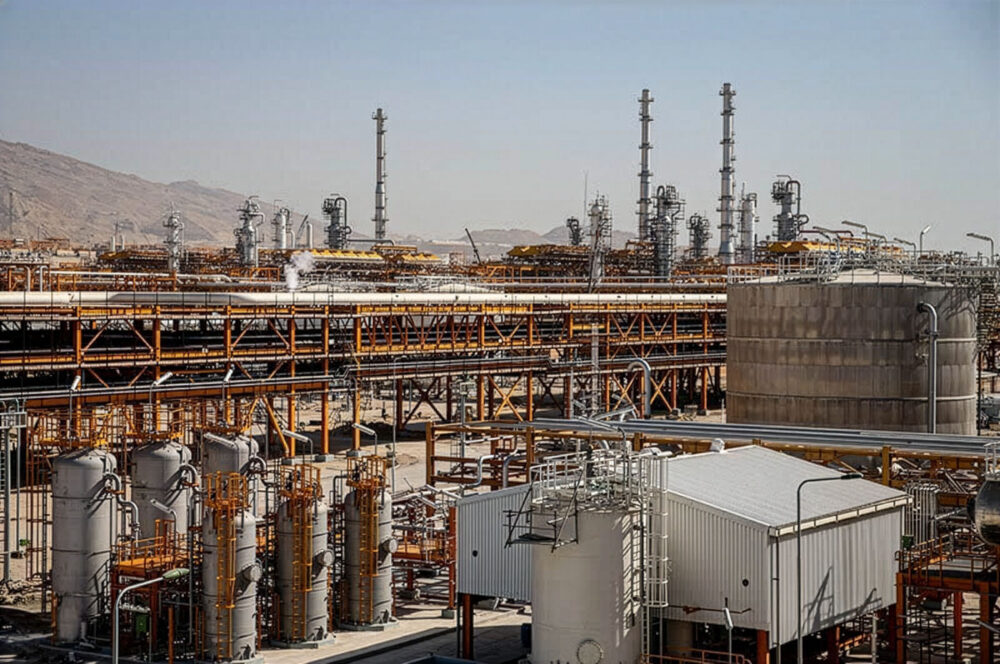
between Iran and Qatarm. Photo: Hamed Malekpour
The position exposes a central tension in the conflict.
While Iran maintains that it is not targeting the Gulf, its response is increasingly shaped by the role those same territories might have played in enabling strikes against it.
The strike on South Pars carries particular weight because of its link to global gas markets. The field is critical not only to Iran’s domestic supply but also to Qatar’s liquefied natural gas exports. Disruption across either site introduces immediate volatility into strained energy markets.
Oil prices have surged toward $110 (about R1 900) a barrel, with brief spikes above that level as markets react to escalating risks to Gulf energy infrastructure.
War risk premiums for shipping and aviation have also risen sharply, increasing the cost of
moving goods through the region and placing additional strain on global supply chains.
For South Africa, the consequences are immediate. Higher oil prices feed directly into fuel costs, with knock-on effects across transport and consumer inflation. The impact will extend into the agricultural sector.
Disruptions to Gulf petrochemical industries, which are central to fertiliser production, could translate into higher input costs and sustained food price pressure.
The department of international relations and cooperation warned this week that the escalation was contributing to energy insecurity and could disrupt food supply chains through fertiliser shocks.
The scale of civilian harm inside Iran is significant.
Iranian officials told the United Nations that more than 1 400 civilians have been killed and thousands more injured since the start of the strikes.
One of the deadliest incidents was a strike on a girls’ primary school in Minab, which killed more than 180 children.
Amnesty International said the attack might have violated international humanitarian law and called for accountability.
The conflict is also exposing fractures within the US.
Joseph Kent, the director of the US National Counterterrorism Centre, resigned this week in protest over the war, becoming the highest-ranking official to step down amid the escalation.
Kent challenged the administration’s rationale for the strikes, saying Iran posed “no imminent threat” to the US.
“I cannot in good conscience support this war,” he said.
The resignation signals unease within parts of the US security establishment at a moment when the conflict is expanding rather than stabilising, underscoring a widening gap between the administration’s public position and internal threat assessments.
The war is unfolding against a backdrop of contested legal claims. South Africa has taken a position that reflects this complexity, condemning the initial strikes by the US and Israel as violations of international law while raising concerns about aspects of Iran’s response.
The stance aligns with South Africa’s broader foreign policy posture of non-alignment and its emphasis on the primacy of international law.
It also illustrates the difficulty of navigating a conflict in which all parties are advancing competing legal justifications.
In neighbouring Lebanon, renewed cross-border exchanges linked to the widening conflict have displaced thousands, adding to a fragile humanitarian situation along the country’s southern regions and underscoring how quickly the war is extending beyond its initial frontlines.
The targeting of energy assets, shipping routes and supply chains suggests the war is entering a phase where economic disruption is becoming a strategic objective.
Whether it can be contained will depend on whether diplomatic efforts regain traction before escalation hardens.
For now, the trajectory points towards further expansion, with consequences that extend well beyond the region.