For Batoul Hamdan and her two children, seven-month-old Fatima and Jihad, three, Monday’s iftar, the evening meal that breaks the daily fast during Ramadan, was special.
For a week, they had eaten to the sounds of bombs in their home in Arab Salim. Hamdan eventually decided to leave for Al-Nimiriya, the sleepy town where she had grown up. Surrounded by her parents and siblings in the family home, she hoped they could finally enjoy the festive mood of Ramadan.
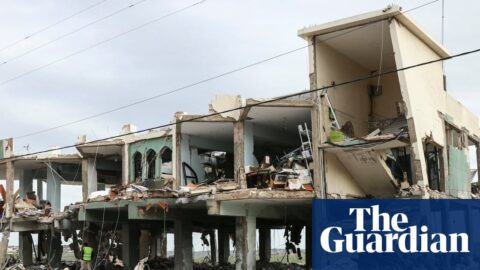
They had just finished their meal when the bomb fell. The Israeli airstrike collapsed the two-storey building instantly, killing all eight members of the Hamdan family: grandparents Ahmad and Najib, their children, including Batoul, and grandchildren Fatima and Jihad – three generations wiped out in a moment.
On Thursday, only snarled rebar and broken concrete remained of the Hamdan family home. The fragments of their lives – a certificate of achievement from the children’s schooldays, cutlery from their cabinet, frayed purses – had been ejected by the force of the blast and now littered the ground.
“There was no warning before the strike. My own two kids started to cry, I picked them up and started to run away from the explosion when it happened,” said Qassem Ayoub, a neighbour and town police officer, as he stared at the wreckage. “Why were they targeted? I don’t know, ask the Israelis.”
Batoul and her loved ones were among the 773 Lebanese people – including more than 100 children – killed by Israel’s campaign in Lebanon since 2 March. They join a growing list of families completely wiped out by Israeli bombings, in a conflict whose death toll is rising faster than in any previous war in Lebanon.
Forty-one people were killed by Israeli airstrikes in Nabi Chit in the Bekaa valley in only five hours last Saturday, and 18 people died in a single night in the town of Sir el-Gharbiyeh on 8 March. The pace of death has stunned Lebanese people and left them struggling to keep up.
Relative to population, the death toll in Lebanon is equivalent to more than 9,236 people being killed in the UK in 11 days, or about 45,600 if compared with the US.
The war began when Hezbollah fired rockets at Israel on 2 March, prompting Israel to launch a campaign across Lebanon. The conflict is escalating sharply and has already pushed beyond the parameters of the 13-month Israel-Hezbollah war of 2023-24. Israel has displaced about 1 million people from wide swathes of the country and has bombed deep inside the capital city, Beirut.
The strike on Al-Nimiriya pushed out almost all of the town’s residents. Those remaining include Ayoub, the mayor and his deputies, and ambulance workers who sit on plastic chairs until the sound of airstrikes sends them running to their cars.
In Nabatieh, a short drive away, Israeli bombing has turned the community of about 90,000 people into a ghost town. The buzz of a low-flying drone echoed eerily through the empty streets and the crunch of broken glass underfoot sounded unnaturally loud.
“There’s probably only about 150 families left here, the rest have left,” said Ali Hariri, a lawyer who also works as a first responder and is deputy head of the Beit al-Talaba aid organisation. He drove through the town with fellow first responder Abbas Fahad in a battered red ambulance, checking on people who stayed behind.
Hariri rattled off casualty counts as he passed strike sites. A collapsed four-storey apartment building left four people dead, he said as he looked over the crater where the structure once stood. At another strike site, Fahad picked up a photo album lying on the ground. “I took these wedding photos! These are Ahmad’s,” he said.
Hariri said: “We’re worried about tanks coming in of course. They’re talking about invasion. Maybe the Israelis will come all the way to Nabatieh, who knows? I mean, they came to Beirut in 1982.”
Hariri escaped injury the other day after the building directly behind the aid centre was levelled by an Israeli bomb, damaging medical facilities. “We won’t leave though – our organisation is meant to help people, so we have to stay,” he said.
He looked up as the rumble of a war plane filled the air. “You should leave now, the drone is gone and the jets are coming. That means they found a target to hit,” he said, jumping in the ambulance.
An hour later, Israel issued a displacement order for a wide swathe of south Lebanon, including Nabatieh. People living up to 25 miles from the border with Israel had to move northwards, the Israeli military said, before strikes it would conduct on Hezbollah targets. Hezbollah had fired its largest volley of rockets yet into Israel on Wednesday night, injuring two people.
The order, analysts said, was issued to help Israel fight Hezbollah, which it has been clashing with on the ground in south Lebanon over the past week. It has steadily carved off the south from the rest of the country, bombing and collapsing a bridge over the Litani River on Friday.
Human rights groups said the order was illegal and amounted to forced displacement. Nevertheless, the thousands of cars that soon clogged the highways leading northwards showed people had taken it seriously.
Riyadh al-Lattah, 57, a woodworker and father of five, complied with Israel’s displacement order and left his home in Beirut’s southern suburbs last week, leaving his windows and doors open so they would not shatter from the force of nearby bombings.
Al-Lattah was surprised, then, when the sidewalk 15 metres (49ft) in front of him exploded in the early hours of Thursday morning. He screamed at his children to stay in the tent, watching as a man writhed and reached for his legs, which were lying some distance away on the sidewalk. A second Israeli drone strike moments later killed the man and 11 others.
“This war is harder, because at least last time they’d tell you before they hit. Now it’s just random,” said Al-Lattah, sitting smoking argileh next to his tent facing the corniche in the central Beirut neighbourhood of Ramlet al-Baida, where the sand by the seaside walkway was still stained red with blood. “But I guess I’ll stay here, my house is still under evacuation order.”
Batoul Hamdan had not wanted to sleep on the street, Ali Farhat, the mayor of Al-Nimiriya, said. He showed the Guardian a screenshot of texts she had sent to her friend before her death.
“I called many numbers but there is no place to go, I don’t want to be on the streets,” one text read. “I’d rather stay and die in my house.”