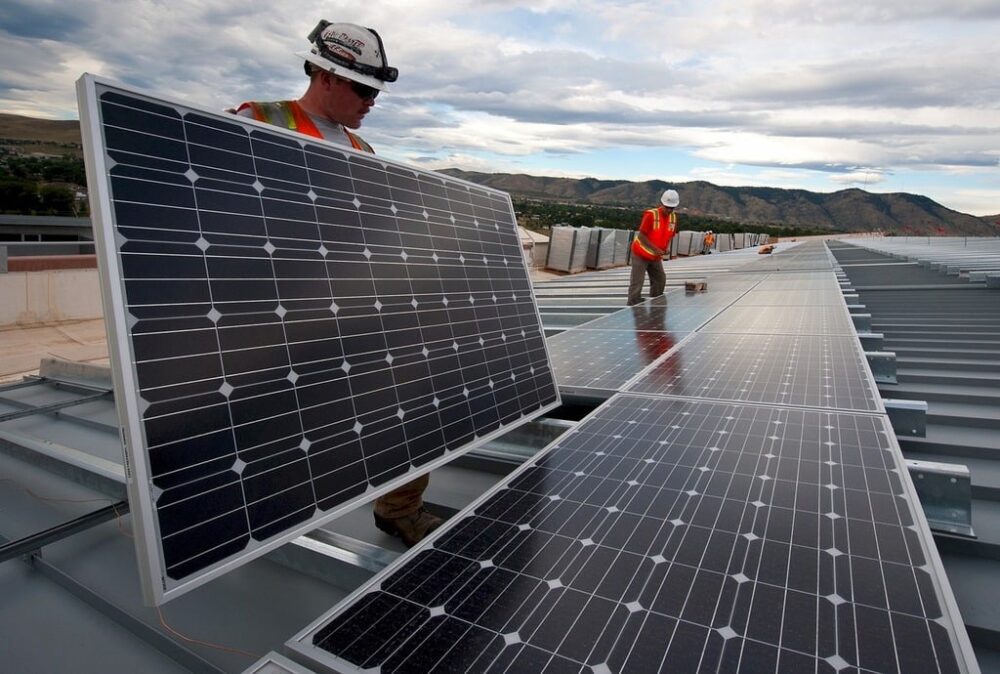
Alternatives: As businesses and wealthier households increasingly turn to rooftop solar and private
generation, municipalities are being left with shrinking revenue bases . Photo: File
South Africa’s municipal electricity system is entering a dangerous phase of decline as falling revenue collection, rising tariffs and deteriorating infrastructure undermine the financial model that has sustained power distribution for decades.
As businesses and wealthier households increasingly turn to rooftop solar and private generation, municipalities are being left with shrinking revenue bases while carrying the fixed costs of maintaining ageing electricity networks.
As the pressure intensifies, new renewable energy models are beginning to emerge that aim to stabilise municipal electricity finances while lowering energy costs.
The proposals are designed to address a central weakness in the country’s electricity system: municipalities rely on electricity sales to fund their operations, yet they are increasingly unable to sustain the networks that deliver that power.
The implications extend far beyond electricity supply. For most municipalities, electricity sales are one of the largest sources of income and a key mechanism for funding other public services.
As the revenue declines, the financial strain is beginning to ripple across water systems, road maintenance and other basic services.
Rakesh Maharaj, an electrical engineer who has worked across Eskom, municipal electricity systems and renewable energy projects, said the electricity distributors are entering what economists describe as a utility death spiral.
“Very simply put, we have a decreasing income base with rapidly increasing tariffs,” Maharaj said. “As tariffs increase, more people leave the grid. Those who can afford to put up their own generation do so. What’s left is a smaller base with higher costs.”
The dynamic has become increasingly visible across the energy landscape.
Businesses and middle-income households have installed solar panels and backup generation in large numbers to escape both load-shedding and rising electricity prices.
While the shift provides relief for the customers, it also undermines the revenue model that municipal electricity distribution depends on. The result is a cycle in which declining electricity sales force utilities to raise tariffs, prompting even more consumers to reduce their reliance on the grid.
“The biggest challenge is that the poorest of the poor get hit the most,” Maharaj said. “If you look at tariffs across the country, prepaid indigent customers are often paying more for electricity than large-scale users.”
The financial strain facing municipal electricity utilities is compounded by widespread non-payment and ageing infrastructure.
Maharaj said the roots of the non-payment problem stretched back decades.
“Some of the protest action in the 1980s involved non-payment as a form of resistance,” he said. “What started as protest has, over time, become a culture of non-payment.”
Economic pressures have deepened the problem. With unemployment high and many households living below the poverty line, large numbers of consumers are unable to pay electricity bills, while others simply do not.
The consequences are visible in municipal finances across the country. Maharaj points to cases where municipalities collect electricity revenue from customers but fail to pass the money on to Eskom, which supplies much of the electricity they distribute.
If current trends continue, the financial gap could widen dramatically. Maharaj estimates that municipal debt to Eskom could exceed R1 trillion by 2050. “That level of debt is simply not sustainable.”
Electricity sales have historically provided municipalities with one of their most stable sources of income. In metropolitan municipalities electricity typically accounts for more than 30% of revenue.
The income is used to cross-subsidise services that are not designed to generate profit, including water provision, roads, parks and other public amenities.
As electricity income declines, the municipal financial structure weakens.
“When electricity revenue drops, everything suffers,” Maharaj said. “Electricity infrastructure is not maintained, water infrastructure is affected, roads are affected. It becomes a systemic problem.”
The deterioration of electricity networks is visible in parts of the country where outages have become frequent and prolonged. Power failures can quickly cascade into other service disruptions. Water supply systems, for example, depend on electrically powered pump stations.
The treasury recommends that municipalities reinvest at least 8% of their electricity revenue in maintaining and upgrading infrastructure.
Maharaj estimates that the national average stands at less than 1%. “At those levels the network simply cannot be sustained.”
He was part of a 2017 assessment of municipal electricity distributors conducted under the Presidential Infrastructure Coordinating Commission, which examined roughly 172 municipal electricity utilities. The findings suggested that about half were beyond viable recovery, with another quarter struggling to maintain basic functionality.
Only a small group of municipalities were considered financially and technically stable.
“If we do not arrest the decline of municipalities, we are going to see further degradation,” Maharaj said.
The fragility of municipal electricity systems also complicates the country’s energy transition. National policy increasingly emphasises solar and wind generation to reduce reliance on coal and stabilise electricity supply but most municipalities lack the financial capacity to invest in renewable projects.
Financial institutions, Maharaj said, regarded most municipalities as unbankable.
To illustrate the scale of the challenge, he points to the cost of a relatively small solar project.
A 10 megawatt solar installation can cost between R140 million and R160m. A more meaningful project of about 100MW could require more than R1 billion in investment.
“Very few municipalities can take on that kind of financial commitment,” he said.
As a result, municipalities risk being excluded from the emerging renewable energy market even though they supply electricity to most customers.
Businesses operating within municipal networks could also face growing pressure if they are unable to access low-carbon electricity as international markets tighten environmental requirements.
It is within this gap that companies such as BluEnergy Solutions are attempting to intervene. The renewable energy platform, linked to the Blu Label group, proposes a model in which private investors finance and build renewable generation that supplies electricity directly into municipal distribution networks.
Under this approach, BluEnergy funds the construction of renewable energy facilities and sells electricity to municipalities through long-term supply agreements.
“If we build a project, we put up the capital,” said Maharaj, the technical director and shareholder in the BluEnergy group of entities. “The municipality receives electricity at a lower cost.”
The model also aims to strengthen municipal revenue collection.
The Blu Label group operates one of the country’s largest prepaid electricity distribution platforms, processing billions of rand in electricity purchases each year. The infrastructure can be used to identify losses in municipal electricity systems and improve billing and payment collection.
“The strategy is to combine lower energy costs with improved revenue assurance,” Maharaj said. The approach attempts to address the core financial constraint preventing municipalities from investing in renewable infrastructure.
By financing the generation assets privately, the model avoids the need for municipal capital investment or government guarantees.
“We are not asking for government guarantees or grants,” Maharaj said. “We bring the investment.”
BluEnergy aims to develop a portfolio of renewable projects embedded within municipal distribution networks and eventually build as much as one gigawatt of renewable capacity over the next three to five years.
The initiative draws partly on experience gained from large-scale renewable developments elsewhere in the sector. Maharaj is also involved in building a hybrid renewable energy plant that combines solar, wind and battery storage technologies.
The project includes about 155MW of solar generation, roughly 90MW of wind capacity and a battery storage system capable of delivering more than 240MW hours of energy.
Hybrid plants of this type are becoming increasingly important as renewable energy expands, allowing different generation technologies and storage systems to stabilise electricity supply.
Whether models such as BluEnergy’s can be implemented at scale will depend on cooperation between private developers, municipalities and national government.
Maharaj said discussions with the minister of electricity and several municipalities have been positive but acknowledged that implementation required navigating municipal governance processes.
“You have to follow the proper governance procedures. Proposals have to go through council and receive the necessary approvals.”
Despite the challenges, the pressure on municipal electricity finances continues to intensify. For a country where municipalities supply electricity to most customers, stabilising power systems may prove central not only to the energy transition but to the future functioning of local government itself.
“If electricity fails,” Maharaj said, “everything that depends on it begins to fail as well.”