When Sudanese refugee Abu Amin left for work one day more than two weeks ago, his family expected him back hours later. They have heard nothing since.
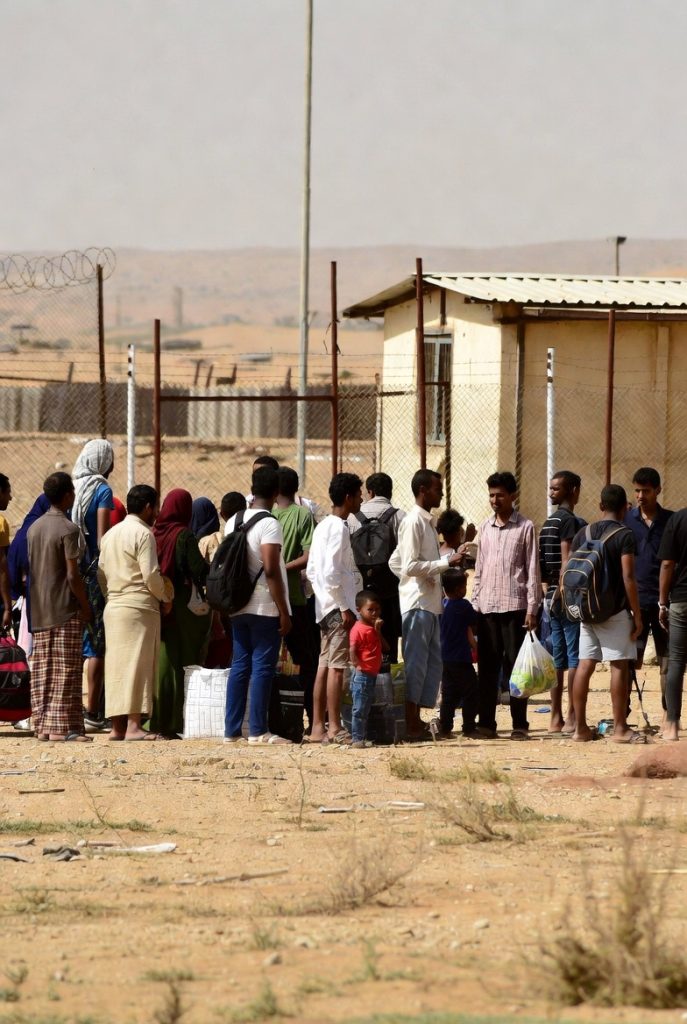
The restaurant worker is one of thousands of refugees swept up in what activists say is a broad security crackdown intended to discourage those who might seek asylum in Egypt.
“We don’t know if he’s dead or alive,” his wife told AFP.
She said the 40-year-old was detained during a morning sweep of a neighbourhood that is home to many Sudanese.
Authorities boast that millions from war-torn countries live safely in Egypt, with UN envoy Ihab Awad telling the Security Council last week that hundreds of thousands of Sudanese live “in their second home Egypt as guests”.
But, since late December, the government has been “arbitrarily detaining and unlawfully deporting” nationals of Sudan, South Sudan, other sub-Saharan countries and Syria from the streets or their workplaces, according to Amnesty International.
Egypt’s interior ministry has not responded to AFP’s request for comment.
Within a two-week period, around 5,000 refugees were brought to overcrowded police stations, leading to two deaths, including a child, said Karim Ennarah, head of research at the Egyptian Initiative for Personal Rights (EIPR).
Another NGO, Human Rights Concern Eritrea, says more than 3,000 Eritrean nationals may currently be detained, with testimonies recorded of mistreatment.
Accounts gathered by AFP from four sources, including activists, describe police stations so overcrowded that detainees are forced to stand and sleep in shifts.
Others have been held outdoors in unsheltered courtyards, including on cold winter nights.
– ‘Constant fear’ –
According to the Refugees Platform in Egypt, Sudanese high schooler Al-Nazeer Al-Sadiq — an asylum seeker registered with the UN — died while held in a courtyard after complaining of chest pain.
Another asylum seeker, 67-year-old Mubarak Abdullah, died in custody after being denied medical care, the NGO said.
Earlier this month, Egypt’s interior ministry denied reports of the death of another Sudanese detainee, and said one more had been arrested for “entering the country illegally”.
For more than two years, Egypt has tightened restrictions on refugees, but Ennarah says “new patterns” include raids on community-run schools and “direct targeting of dark-skinned Africans on streets and public transport”.
Amal Rahal, founder of a local Sudanese charity, told AFP that people only leave their homes when “absolutely necessary”, while volunteers deliver free meals to families too scared to go outside.
Rahal told AFP that one student at her community school had been detained and deported back to Sudan, while a teacher’s child was in custody “despite having a valid residency permit”.
In the city of Alexandria, history teacher Abdelrahman Fadel said authorities ordered the Sudanese community school where he works to close for a week last month.
“We live in constant fear of being arrested at any moment,” he said.
“Many have stopped going to work or sending their children to school.”
– Forced ‘irregularity’ –
Abu Amin had lived in Cairo with his wife and three children since 2022 before his disappearance.
“He is the sole breadwinner. I don’t know what to do now,” his wife said, adding that he “never went anywhere without his UNHCR card”.
She said she had met many other families at the UN refugee agency’s office whose relatives were detained “despite being registered or having pending appointments”.
While trying to secure her husband’s release, she was informed by the Sudanese embassy that he could be returned to Sudan for 13,000 Egyptian pounds (around $270), a sum she cannot afford.
According to Amnesty International, Syrian refugees have also been detained and deported in what the Syrian embassy described as “routine verification campaigns” . The embassy urged Syrians to regularise their status.
One Syrian refugee was detained six days before an appointment to renew his residency, with his lawyer told by police that “unless his family purchased him a flight ticket to Syria, he would remain indefinitely detained”, Amnesty reported.
More than one million refugees are registered with the UN in Egypt, though many more are awaiting official registration.
According to Amnesty and EIPR, appointments for asylum seekers at the UNHCR and Egypt’s immigration authority are being scheduled as far away as 2027 and 2029, creating what Ennarah described as “forced irregularity”.
A new asylum law, approved by Egypt in 2024 and criticised internationally for infringing on refugees’ rights, has not yet come into force.
Ennarah argued the current crackdown is aimed at “creating a hostile environment for refugees” to deter new arrivals, at a time of economic crisis in Egypt.
He says growing anti-migrant policy is “strongly linked to the European Union’s support for Egypt on migration”, criticising the lack of clear human rights conditions in the EU’s most recent 7.4-billion-euro aid package to Cairo.
Amnesty has called on the EU, as “a close partner to Egypt on migration”, to press for the protection of refugees and migrants.
The post Mass detentions push refugees into hiding in Egypt appeared first on Vanguard News.