Water trucks parked at an empty water reservoir in Midrand.. Photos: Delwyn Verasamy
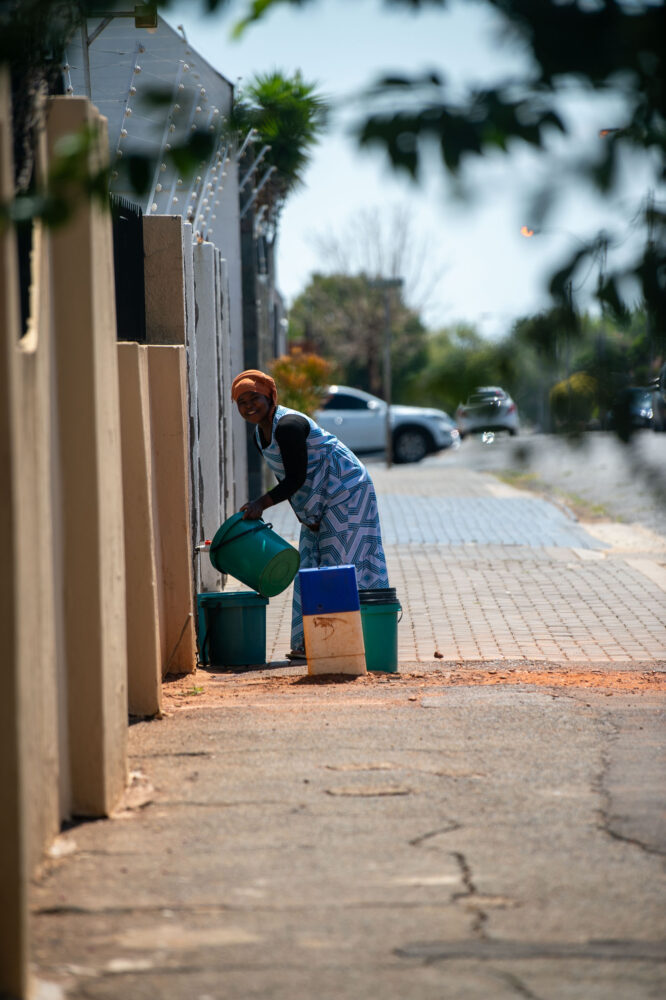
It’s a scorching Tuesday in Melville, west of Johannesburg. Plastic buckets line the driveway of Michael Almeida’s home, a makeshift lifeline in the city’s worsening water crisis.
Almeida has endured more than 23 days without water, leaving him desperate and exhausted. “This area continuously has water outages,” he said, wiping sweat from his brow. Almeida, who hopes to move his family out of Melville to “an area in Johannesburg that still has water”, installed a water tank in December. That supply is long gone.
“We made a mistake spending money on the tank because I thought it would be a buffer for us,” he said.
“Now, we are washing with buckets or we have to swim to get clean. I have to go to Northcliff to get water from friends, who still have water.”
From Melville to Kensington, the picture is the same: dry taps; schools, clinics and businesses unable to operate without a basic supply; households forced to make impossible choices; pregnant women pushing wheelbarrows for kilometres to reach tankers and pensioners using their Sassa grants to pay others to carry water.
The water crisis is more than an inconvenience; it’s systemic, says Ferrial Adam, the executive manager of water advocacy group WaterCAN.
On Wednesday, Melville, Parktown and Emmarentia residents mounted peaceful protests, highlighting frustration in communities where taps have run dry for weeks.
City residents are “living under Day Zero conditions”, Adam warned. Communities continue to experience prolonged water outages lasting days and in some cases, three weeks.
While drought-related national disaster declarations have been made for parts of the Western Cape and Eastern Cape, Johannesburg’s crisis — driven by infrastructure failure, poor planning and weak accountability —is no less severe.
Tatjana Grabow, who runs a music studio in Melville, has not had water for more than 16 days. “I’ve been a Melville resident since 2002 and I have never seen anything like this before; it’s never been this bad.”
Even with two water tanks, she is forced to pay private water companies R2 000 each time they refill them, an unbudgeted expense.
“The most ridiculous thing is that they [Rand Water and Johannesburg Water] say we are consuming too much water as Johannesburg residents. Where is the water? I have to constantly ask my pupils and parents to bring their own water … It’s the mental impact that it has. There’s no certainty and it’s this uncertainty that drives people bonkers.”
Lesedi Khumalo, a student in Westdene, described the impact on her residence since 26 January.
“It’s horrible, especially when it comes to the toilets, because now we can’t flush; we can’t cook and there’s 30 of us students in this house. We also need water to drink, so now we have to drink less water than normal … We normally have to go to the other reses [student residences] just to look for water.”
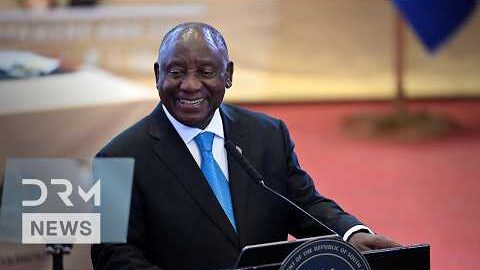
In his 2025 State of the Nation address, President Cyril Ramaphosa flagged ensuring a secure and reliable water supply as a priority.
“Many people in the cities, towns and villages are experiencing more and more frequent water shortages as a result of failing water infrastructure,” he said. “It is impossible to live without water and it is impossible for the economy to grow without water.”
The government was taking “decisive actions” to resolve the crisis, he said, including securing R23 billion for seven large water infrastructure projects through the Infrastructure Fund, advancing Phase 2 of the Lesotho Highlands Water Project, preparing the uMkhomazi Dam and establishing the National Water Resource Infrastructure Agency within a year to unlock investment.
Through the Water Services Amendment Bill, a licensing system would be introduced for water service providers, allowing licences to be removed where providers fail to meet drinking water standards.
A year later, department of water and sanitation spokesperson Wisane Mavasa said Ramaphosa had not promised that “water will reach you where you live” within a year.

“Water is not like electricity. There is no single water grid in South Africa, like there is an electricity grid. Water is a very localised function and water is supplied through a large number of separate water supply systems, which are not linked to each other,” Mavasa said.
She said Johannesburg and Gauteng’s population growth has driven water demand beyond Rand Water’s supply at times. Decades of underinvestment have left municipal systems vulnerable. Storage reservoirs can absorb short demand spikes, but heatwaves, load-shedding and breakdowns overwhelm them. Gravity-fed systems mean high-lying areas lose water first, and recovery is slow under sustained high demand.
Mavasa said four things must happen to reduce future disruptions: Phase 2 of the Lesotho Highlands Water Project must come online, society must reduce average water consumption, municipalities must reduce leaks in distribution systems and storage and pumping capacity must be improved.
Although national and provincial governments provided more than R60 billion a year in support to municipalities, declining performance persisted often due to leadership failures, she said.
Mavasa said the department’s ability to hold municipalities accountable was constitutionally limited. Water and sanitation were “original powers” of local government, meaning the national government could not directly run municipal water systems or permanently intervene.
Even criminal charges under the National Water Act, such as cases against dozens of water service authorities for sewage pollution, had “not resulted in a significant improvement” in performance.

The national government cannot remove municipal leadership. “Neither the president of the republic nor any minister can fire a mayor,” Mavasa said. The powers rest solely with municipalities and ultimately, with voters through local elections.
Before Ramaphosa’s 2026 Sona on Thursday, Nelson Odume, a director at Rhodes University’s Institute for Water Research, said the presidency’s commitments last year were “commendable but not adequate” from a systems perspective.
The government had focused largely on the supply side — large infrastructure projects such as dams — while neglecting demand management and governance failures that underpinned the crisis. South Africa was water-stressed, he said, but dams alone were “not enough”.
Untapped groundwater resources, maintenance of infrastructure and stronger protection against theft and vandalism were also essential. Reducing consumption through stepped tariffs, meter audits, pressure control and public education was equally critical.
“While South Africa is undeniably water-stressed, physical scarcity is not the main driver of the current crisis,” Odume said. “The country has the engineering and scientific expertise to resolve the physical scarcity dimension. Instead, the failures — collapsing infrastructure, poor maintenance — are largely the result of governance breakdowns. ”
Odume said large infrastructure projects remained necessary but they had to go hand in hand with fixing governance failures. “The evidence is a mere comparison of service delivery in a well-run municipality versus one that is poorly run, even where physical water conditions are similar.”
He suggested that Johannesburg declare a state of disaster in the water sector to allow sharper focus, better coordination and faster mobilisation of resources, while urgently confronting governance problems by separating political and technical roles and empowering accountable decision-making.
The City of Johannesburg stated this week that Johannesburg was not at Day Zero. “Day Zero refers to a complete system failure where water can no longer be supplied. Johannesburg continues to receive and distribute water across the city. However, the system remains under significant pressure due to high demand, infrastructure constraints and ongoing supply challenges.”
To intensify coordination and fast-track interventions, an intergovernmental water war room had been established, bringing together the city, Rand Water, Gauteng provincial government and national stakeholders. “This structure is actively monitoring the system in real time, coordinating technical responses, accelerating repairs and implementing demand-management measures to stabilise supply and protect critical infrastructure.”
Adam said the city’s statement reeked of arrogance and ignored residents’ lived experiences.
“When people have been without water for 22 days, the system is not under pressure; it is empty where people live. And this is a failing system. You can call it whatever you like … but for residents with dry taps for weeks, Day Zero has arrived — not as a technical definition, not as a climate definition but an infrastructural Day Zero and it is a lived reality for millions of Joburgers.
“When there is no water to drink, flush, wash, cook, clean, semantics do not matter. A system that only works on paper or in some parts of the city, is not a functioning city. It is a deeply unequal and deeply dysfunctional system.”