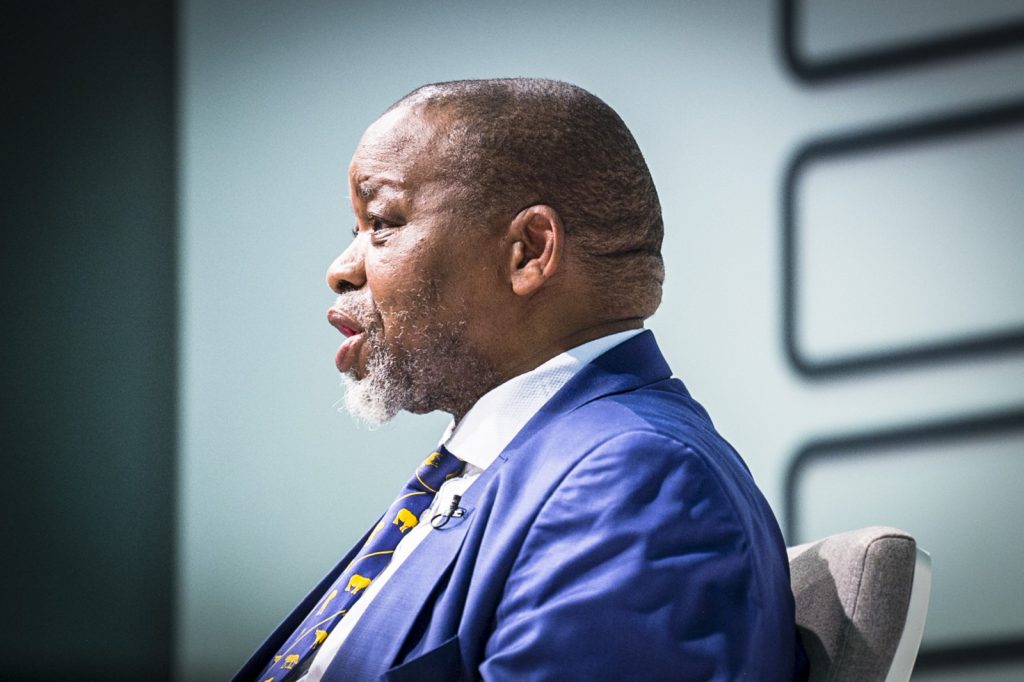
Mineral and Petroleum Resources Minister Gwede Mantashe (Delwyn Verasamy, M&G)
Intensifying geopolitical competition for minerals was putting renewed pressure on the sovereignty of resource-rich African states as major economies race to secure control over supply chains critical to energy transitions, defence and industrial policy, Mineral and Petroleum Resources Minister Gwede Mantashe warned on Monday.
The global scramble for minerals had entered a more aggressive phase, driven by strategic priorities in developed economies seeking to reduce dependence on external suppliers, Mantashe told delegates at the Investing in African Mining Indaba in Cape Town.
The annual conference is a gathering of African leaders, industry stakeholders and investors to discuss the development of the continent’s mineral resources.
“This year’s Indaba convenes at a moment of profound global uncertainty. We are witnessing heightened geopolitical tensions, driven largely by the competition of some developed economies seeking greater control over the natural resources of developing nations,” Mantashe said.
He said the dynamics were increasingly exposing mineral-rich developing countries to external pressure as Africa became a central arena in widening global rivalries.
“This dynamic represents a serious threat to the sovereignty of resource-endowed countries, the majority of which are on the African continent,” the minister said.
He warned that uncoordinated national responses risked triggering a race to the bottom, in which countries weakened regulatory standards and offered increasingly generous concessions to attract foreign investment, undermining long-term developmental and fiscal interests.
Mantashe called on African governments to act collectively, particularly in relation to minerals that had become central to global economic and security agendas.
“There is growing recognition that reliance on raw mineral exports leaves countries vulnerable to price volatility, external policy shifts and geopolitical leverage exercised by major consuming nations,” he said.
As a result, African governments were increasingly evaluating partnerships on commitments to industrialisation, value addition and technology transfer, rather than capital inflows alone.
The scramble for Africa’s minerals is driven by major developed economies seeking strategic control over resources critical to energy, defence and industrial technologies.
According to reports and analyses from the US Geological Survey, the European Commission and the African Development Bank, China leads in rare earths, lithium and cobalt for electronics and renewable energy.
The US is focused on securing strategic minerals for defence and industrial policy, while European countries such as Germany, France and the Netherlands target lithium, cobalt and copper for green energy and electric vehicles. Japan, India and South Korea are also competing for cobalt, lithium, nickel and rare earths to support battery production and high-tech industries.
Mantashe said the considerations were also shaping South Africa’s domestic policy response, confirming that the country had completed its Critical Minerals Strategy after a comprehensive review of the mining sector initiated in 2024. Implementation was under way.
“As per the G20 declaration, this achievement has not only shaped South Africa’s critical minerals agenda – it has also positioned Africa more broadly to assert greater control over its strategic resources,” the minister said.
He said early indicators suggested renewed interest in the sector, citing new geological data pointing to significant untapped mineral potential and progress in projects supported by the Junior Mining Exploration Fund.
Despite global uncertainty, Mantashe said investment activity had continued, with his department granting 358 prospecting rights and 32 mining rights between February 2025 and January 2026.
The developments showed that a more assertive approach to resource governance was not incompatible with maintaining South Africa’s attractiveness as an investment destination, he said.
Africa’s challenge was to navigate a narrow path between dependence and isolation asserting sovereignty without undermining growth or investment. Coordinated action, rather than confrontation, offered African countries the most viable means of strengthening their bargaining power in global mineral markets as geopolitical competition intensified.
“Our objective is to deepen collaboration, accelerate responsible exploration and mining and ensure that Africa captures greater value from its own mineral endowment,” Mantashe said.
“As per the consensus reached last year, our partnership must move beyond extraction to industrialisation and value addition closer to the point of production.”