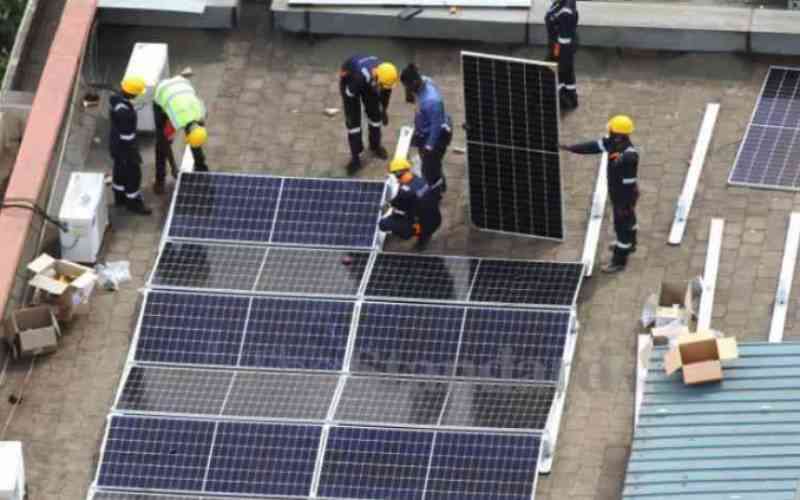
Solar power plants are expanding across Africa as countries grapple with frequent blackouts and power shortages. [File, Standard]
Africa’s solar industry will add up to 1,000 megawatts of new electricity after three projects backed by Chinese banks get underway.
The $5 billion (Sh645 billion) investment targets a power crisis that leaves more than 600 million people without reliable electricity and forces countries like Kenya into daily load shedding.
Power shortages disrupt daily life across the continent, with Nigeria’s national grid collapsing repeatedly and Kenya implementing planned blackouts between 7 pm and 10 pm to manage insufficient supply.
Chinese engineering firm Dalian CDS Solar Energy Technology Co. has formed a strategic alliance with Hong Kong investment bank Treadway to deploy the solar power stations across Africa, with funding already secured from two major Chinese banks.
The partnership combines CDS Solar’s manufacturing and engineering capabilities with Treadway’s government connections and financing expertise to accelerate renewable energy infrastructure development.
CDS Solar, which operates a 100,000-square-metre manufacturing facility in Dalian City, Liaoning Province, produces solar trackers, systems and battery management solutions.
The company has delivered hundreds of Engineering, Procurement and Construction (EPC) solar projects worldwide.
Three major solar projects are already underway across Africa, collectively valued at more than $5 billion (Sh645 billion), with funding secured from two major Chinese banks.
The smallest project generates $40 million (Sh5.16 billion) annually for Agilitee, the technical partner, over 30 years.
Under the agreement, CDS Solar oversees EPC responsibilities while construction prioritises local employment.
Engineers from CDS Solar comprise 20 per cent of the workforce, with Agilitee providing the remaining 80 per cent and managing operations and maintenance once stations become operational.
One project has received full regulatory approval, with the other two expected to clear soon.
Solar infrastructure costs remain substantial in Africa, where capital costs run three to seven times higher than in developed countries.
Stay informed. Subscribe to our newsletter
A 1,000-megawatt facility ranges between $900 million (Sh116.1 billion) and $1.6 billion (Sh206.4 billion), making external financing critical for countries unable to fund projects independently.
More than 30 African countries experience power shortages and regular service interruptions, forcing many to rely on costly leased generating plants.
Nigeria tops the list as the African country with the worst power outages in 2025, with the national grid collapsing again on February 12.
The World Bank Group and the African Development Bank committed to delivering electricity to 300 million Africans by 2030 through Mission 300.
Africa’s solar sector grows rapidly, with 18 African countries expected to install at least 100 megawatts of new solar capacity in 2025, up from just two in 2024.
Renewables and clean technology attracted $700 million (Sh90.3 billion) in funding in 2025, more than three times the prior year.
The partnership creates thousands of local jobs while strengthening Africa’s renewable energy infrastructure.
Africa’s young population will nearly double to 2.5 billion by 2050, requiring massive energy infrastructure to support industrialisation and job creation.
Despite progress, Africa receives only 3 per cent of global energy investment, far from the $200 billion (Sh25.8 trillion) per year needed to achieve energy access and climate goals.