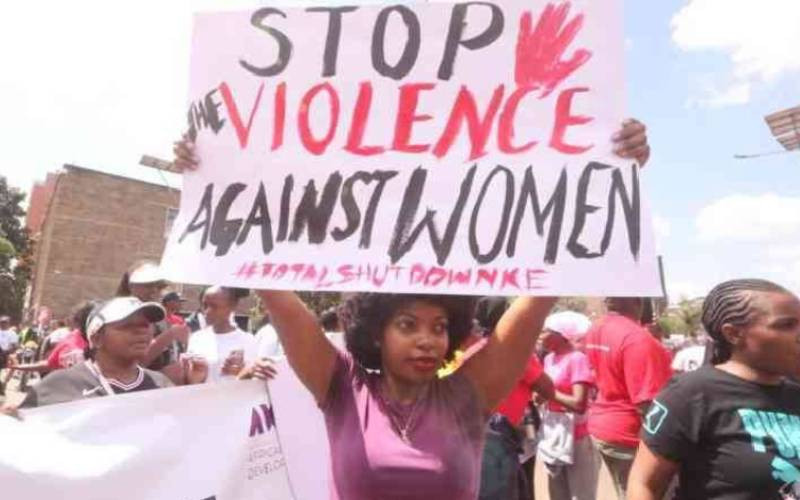
Kenya lacks a standalone legal offence for femicide despite a 10 per cent rise in reported cases between 2022 and 2024, with 1,639 women killed in circumstances linked to their gender, a presidential technical working group has revealed.
The Technical Working Group on Gender-Based Violence Including Femicide, chaired by former Deputy Chief Justice Nancy Baraza, found that women aged 30 to 44 face the highest risk of violence, with intimate partners or known individuals responsible for 77 per cent of cases.
“The family unit, traditionally viewed as a source of protection and support, is increasingly becoming a site of hidden violence, particularly for women, girls and children,” the report states.
The group’s findings expose deep cracks in Kenya’s response systems. Support services remain fragmented, underfunded and trauma-insensitive, whilst community mechanisms like Nyumba Kumi prioritise reconciliation over justice.
President William Ruto established the working group in January 2025 following public outcry over escalating femicide cases.
The team conducted consultations across all 47 counties, receiving submissions from survivors, civil society groups, government agencies and the public.
Data systems emerged as a critical weakness. No centralised database exists to track gender-based violence or femicide cases, leaving gaps in evidence-based policymaking and resource allocation.
“There is no centralized, disaggregated or publicly accessible national data system on GBV and femicide,” the report notes.
Economic factors compound the crisis. Kenya loses approximately 46 billion shillings annually to medical expenses, productivity losses and legal costs related to gender-based violence, equivalent to 1.1 per cent of gross domestic product.
The Kenya Demographic and Health Survey 2022 shows 34 per cent of women and 27 per cent of men have experienced physical violence since age 15. Sexual violence affects 13 per cent of women and 7 per cent of men.
Nairobi, Meru and Nakuru counties recorded the highest number of femicide cases.
Harmful cultural practices including female genital mutilation, child marriage and widow cleansing persist in counties such as Kisii, Narok and Samburu.
“Many femicide cases stem from seemingly minor interpersonal conflicts that escalate into lethal violence,” a Directorate of Criminal Investigations officer told the working group.
Social media plays a contradictory role. Campaigns like #StopFemicideKE raised awareness and sparked national debates, but platforms also enable victim-blaming, misinformation and online harassment.
Stay informed. Subscribe to our newsletter
The report documents overlooked forms of violence including economic abuse, technology-facilitated violence and attacks on elderly women accused of witchcraft.
Persons with disabilities, men and boys face compounded invisibility in response mechanisms.
Informal justice systems often obstruct formal legal processes.
In Kisii, Bomet and parts of Nyanza, families settle defilement and incest cases through monetary compensation or dowry exchanges, denying survivors justice.
“When I went to my Pastor and told her I was being beaten and denied money, she told me to pray and forgive him. That I was to endure for the sake of the marriage,” a survivor from Kasarani recounted.
Law enforcement faces capacity constraints. Only one pathologist serves both Mombasa and Taita counties, delaying forensic evidence collection in time-sensitive cases.
The working group proposes declaring gender-based violence,, including femicide, a national crisis.
Other recommendations include amending the Penal Code to define femicide as a distinct offence, establishing a national toll-free helpline and creating one-stop centres in all counties.
“Addressing this crisis demands more than reforms on paper. It requires transformative action across sectors, anchored in law, financed with intent, data-driven, family-conscious, digitally responsible and rooted in dignity for survivors,” the report says.
The group calls for mandatory installation of closed-circuit television in short-stay rentals and commercial accommodation facilities, enacting legislation requiring citizens to report gender-based violence incidents and operationalising a funding mechanism drawing contributions from government, development partners, the private sector and philanthropists.
County governments show uneven commitment. Kiambu allocated Sh10 million for gender-based violence programmes in 2021-22, whilst Kilifi historically allocated only Sh2 to 3 million.
Training gaps persist across sectors, with police officers, magistrates and healthcare providers lacking standardised curricula on trauma-informed approaches to gender-based violence cases.
The Constitution guarantees rights to life, equality, dignity and security, but implementation remains weak.
Kenya ratified the Maputo Protocol in 2010 but reserved Article 14(2)(c) on reproductive rights, limiting full implementation of women’s protections.
Ruto directed the working group to submit recommendations within 90 days, later extending the deadline.
The report provides an implementation matrix assigning responsibilities to government agencies with proposed timelines.
“For a full set of proposed interventions, please refer to each chapter, which provides additional detailed findings and recommendations,” the working group stated.