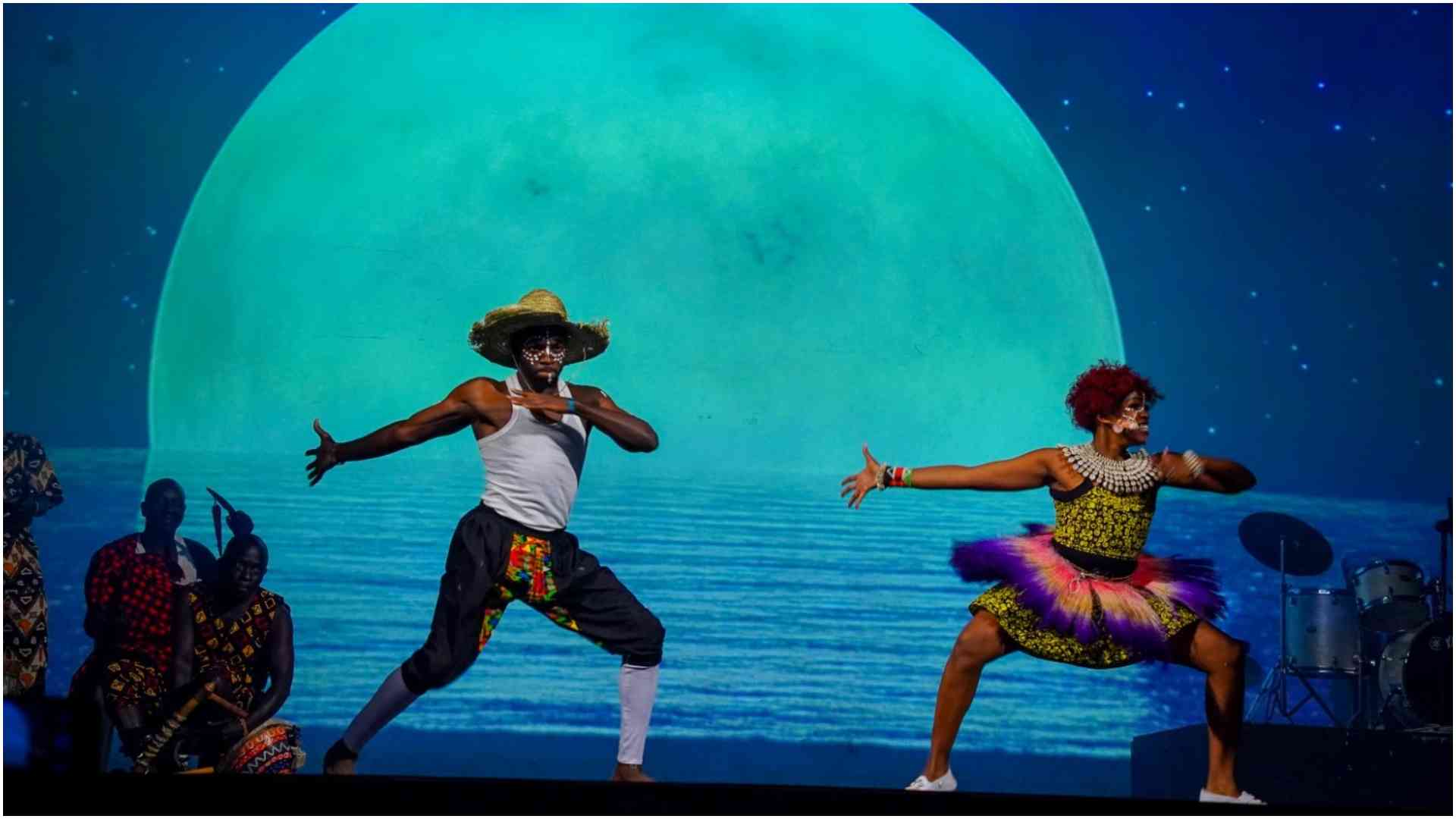
A Luo legend reborn through dance [Photo/Courtesy]
There are stories that outlive generations because their lessons never grow old. The Luo legend of Nyangodho Wuod Obare is one such tale. Passed down through generations, it tells of a poor fisherman whose fortunes change overnight after he pulls a mysterious woman from the waters of Lake Victoria. But what begins as a story of unexpected riches soon becomes a cautionary tale about greed, arrogance and the dangers of forgetting one’s roots.
In Echoes from the Lake, this familiar folk epic is reimagined through physical theatre, bringing together dance, music, acrobatics and aerial performance to create a visually compelling stage production.
The story follows Nyamgodho, a struggling fisherman whose encounter with a supernatural woman transforms his fortunes. She emerges from Lake Victoria accompanied by abundant wealth, including herds of cattle that follow her from the waters to the shore. What follows is a dramatic journey from poverty to prosperity, and ultimately, from pride to ruin.
Performing artiste Odhiambo Eugine Omondi takes on the role of Nyamgodho, a character whose transformation presented a demanding acting challenge.
“My biggest challenge was showing Nyamgondho’s transformation from a poor, humble fisherman into a wealthy but arrogant man, especially through my facial expressions and body language,” he admits.
Omondi says he chose the role because he connected with the story and believed he could bring its central character to life.
“I used a bent posture, slow movements and exhaustion to portray his suffering, hunger and desperation,” he explains.
The actor’s physical expression is particularly important in a production that relies less on conventional dialogue and more on movement to communicate emotion. As Nyamgodho’s fortunes improve, his posture, gestures and demeanour change, reflecting the growing pride that eventually becomes his undoing.
“In the end, I wanted the audience to feel sadness, regret and sympathy, while learning to remain humble and appreciate those who help us,” Omondi says.
The production captures Nyamgodho’s sudden rise through energetic ensemble movement and the infectious rhythms of Ohangla music. Dancers and musicians build the excitement surrounding his newfound prosperity, creating the atmosphere of a community witnessing a man whose fortunes have changed beyond imagination.
For producer and artiste Josiah Otieno, authenticity was central to bringing the folk epic to the stage.
“I wanted to tell our story the way our grandparents told it, using songs, dances, and narration. Then, who does a Luo dance without a nyatiti, ohangla drums, orutu and horns?” he asks.
He insists that the traditional instruments are indispensable to the production.
“They are the spine of our Luo music. All in all, I wanted the story to be as authentic as possible,” he explains.
But beneath the music, spectacle and celebration lies a warning. As Nyamgodho accumulates wealth, prosperity gradually breeds arrogance. He becomes so consumed by his newfound status that he forgets the source of his good fortune and the woman who brought it to him.
His downfall comes during one of his drunken outbursts when he insults the supernatural woman, shattering the sacred trust between them and the lake spirits, known as Juogi.
The woman decides to leave, taking her cattle and everything she brought with her back into the depths of Lake Victoria. Nyamgodho is left with nothing.
The departure becomes one of the production’s most gripping sequences, brought to life through intense partner acrobatics and aerial work. The performers use their bodies to recreate the woman’s disappearance, the movement of the cattle and the restless power of the lake.
Michael Pundo, CEO of the Kenya Cultural Centre and producer of the production, says the work grew out of the Ngoma Na Sarakasi programme, whose participants were trained in percussion, dance and acrobatics.
“The production was first performed by participants in the Ngoma Na Sarakasi programme, who are trained and practiced in percussion, dance, and acrobatics,” he explains.
He says physical theatre was a natural choice because it allowed the performers to draw on their existing artistic skills while exploring a different approach to storytelling.
“It also allowed us to move away from conventional stage plays,” he says.