Audio By Vocalize
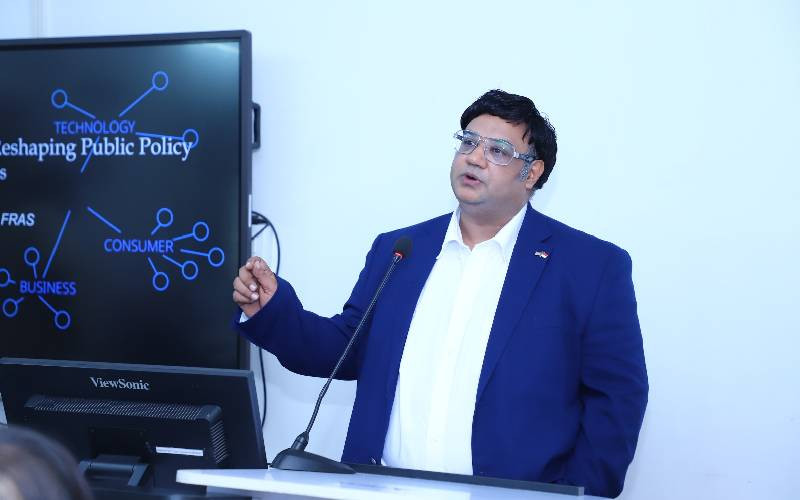
Dr Siddhartha Paul Tiwari, speaking on how technology is reshaping public policy and national development. [Courtesy]
Kenya is widely regarded as one of Africa’s leading digital economies. Mobile money has changed how people pay, save and do business, while more public services are moving online. Yet those advances have not reached everyone.
For many Kenyans, particularly outside major towns, the barriers are still familiar. A device is too expensive, the connection is unreliable or the service is too difficult to use.
For Dr Siddhartha Paul Tiwari, a Singapore-based technology-policy specialist, this is the central question. How does a country turn technological innovation into national development? Tiwari works in mobile technology policy and has spent more than two decades in the sector. He is also a Fellow of the Royal Anthropological Institute and the Royal Asiatic Society. His research and teaching examine the choices and institutions that determine who benefits from technological change.
“A nation’s happy future lies in combining talent and technology. Talent brings the purpose, technology brings the reach,” Tiwari says.
His work has already appeared in a Kenyan policy document. In June 2024, the Kenya National Innovation Agency cited his 2022 book, The Impact of New Technologies on Society: A Blueprint for the Future, in its Kenya Innovation Outlook on emerging technologies. The report explored how new technologies could support the country’s development priorities.
Tiwari sees Kenya’s experience with mobile money as an example of technology succeeding because it answered an everyday need. People use it to trade, pay bills, save and support relatives.
By June 2026, the Communications Authority of Kenya recorded about 54 million mobile-money subscriptions. The figure counts subscriptions rather than individual people, but it shows how deeply digital finance has entered economic life.
There is another sign of Kenya’s ability to innovate. In the World Intellectual Property Organisation’s 2026 Global Innovation Index, Kenya ranked 86th for innovation outputs and 111th for inputs. Tiwari sees that difference as a sign of the country’s capacity to innovate despite limited resources. But he cautions that the rankings do not show how evenly the gains are shared.
“What Kenya has done well is make technology useful. The next challenge is making those benefits more widely available.”
The country’s internet use figures make that distinction clear. An analysis of the 2023-24 Kenya Housing Survey by the Communications Authority and the Kenya National Bureau of Statistics found that 56.6 per cent of urban residents aged three and above had used the internet in the three months preceding the survey, compared with 25 per cent of rural residents. That divide has implications for who can study online, find customers and access digital public services.
Tiwari says extending network coverage is only part of the answer. A family also needs to be able to afford a handset and data. Electricity must be dependable. People need practical digital skills and confidence that the services they use will work. A connection on a coverage map is not necessarily one somebody can use.
“Technology gives a country its speed, society decides the direction. Kenya has the speed,” he says.
The next decisions, in his view, concern affordability, public accountability and whether digital services are designed with the needs of ordinary users in mind.
Stay informed. Subscribe to our newsletter
He asks policymakers to consider the person at the other end of a new system. “Can someone use a public service with an inexpensive phone and an unreliable connection? Is there help when something goes wrong?”
Tiwari also wants citizens to question decisions and correct errors. Otherwise, moving a service online may make administration faster without making it more accessible.
These concerns also run through his books and teaching. “Working in technology has made me interested in what happens after a new system is launched.”
Tiwari says the important questions are whether teachers can use new tools, public offices can maintain them and citizens can challenge decisions made through digital systems.
In 2025, Tiwari co-authored Understanding Technology in the Context of National Development: Critical Reflections with Oleksii Kostenko and Yuriy Yekhanurov, a former prime minister of Ukraine.
The book examines why similar technologies produce different results in different countries, depending on public institutions, skills and policy choices.
His hope for Kenya over the next five years is practical: A child in a remote village should have access to good digital learning tools; a small business should be able to reach customers well beyond its own county; public services should work for people with ordinary phones and modest incomes, not only for those with the newest devices.
Achieving that across all 47 counties will require more than new platforms. It will depend on affordable access, skills and institutions able to maintain services and answer to the people who use them.
Kenya has shown what can happen when technology meets a real need. Tiwari returns to a principle that guides his work. “Technology policy is about systems, but it is also about the people expected to live with them.”