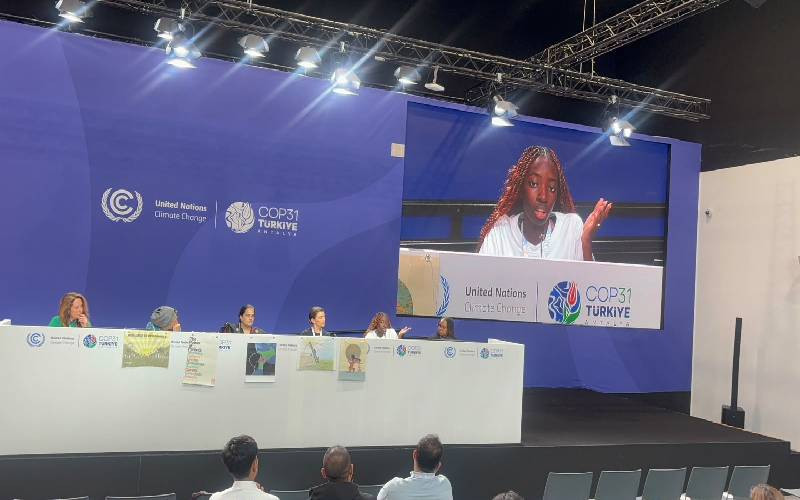
At 16, Shirley Akinyi Ochieng is making a case for children to have a greater say in global climate decisions, drawing on her experiences growing up in Kisumu, where floods, drought and environmental degradation continue to threaten communities.
The young Kenyan climate activist is attending the 31st United Nations Climate Change Conference (COP31) in Antalya, Türkiye, where she is advocating for policies that recognise the impact of climate change on children’s health, education and safety.
Her participation comes as she seeks to amplify the concerns of children who often bear the consequences of environmental challenges but have limited influence over decisions on how to address them.
“Honestly, I should be at home. I should be in school, spending time with my friends and enjoying my childhood. But I am here today because children like me are already experiencing the effects of climate change, and I believe our voices need to be heard,” Shirley said.
Growing up in Kisumu, Akinyi recounted witnessing how heavy rains and flooding have disrupted daily life, damaged homes and prevented children from accessing education.
She explained that the consequences extend beyond missed school days, with flooding also putting children’s health and safety at risk.
“When children miss school because of floods, it is not just their education that is affected. Their health and safety are also at risk,” she said.
She further warned that flooding can leave families without clean water and increase their exposure to diseases, including malaria, a major health concern in the region.
“Children should not have to worry about getting sick because of the environment they grow up in,” she said.
Akinyi also highlighted the effects of prolonged dry spells, saying inadequate rainfall leaves families struggling to access food and clean water, with consequences for children’s nutrition, growth and health.
“When there is not enough rain, families can struggle to access clean water and enough food. This affects children’s nutrition, growth and overall health,” she said.
“These are not just statistics to us. These are people’s lives. These are our communities. And these are children who deserve a safe and healthy childhood.”
The teenager wants governments to increase investment in healthcare, clean water and sanitation, particularly in communities vulnerable to climate-related disasters. She has also called for safer schools and communities that can better withstand floods and other climate impacts, alongside stronger action against pollution.
However, her biggest concern is the limited influence children have in climate decision-making, despite increasingly being invited to participate in international discussions.
“Above all, I want leaders to listen to children. Include us in climate decisions because we understand what is happening in our communities. We should not only be invited to speak; our ideas should also lead to action,” she said.
Akinyi’s environmental activism began at the age of nine, inspired by her mother, who is also a conservationist. She has since participated in tree-planting activities, community clean-ups and environmental awareness campaigns.
According to a 2025 interview published by the Child Rights International Network (CRIN), she had planted more than 1,000 trees and developed an environmental talk show, Tuongee Na Shirley, through which she encourages young people to participate in conservation.
She currently serves as the Miss Greening Kisumu County Ambassador and a climate adviser at CRIN. She is also involved in the #LetLakeVictoriaBreatheAgain campaign and is a member of the Kisumu Environmental Champions.
COP31, running from November 9 to 20, 2026, in Antalya, Türkiye, brings together governments, scientists, civil society organisations, young people and other stakeholders to discuss climate action, adaptation, resilience and financing.
Akinyi is attending alongside her mother, who is also participating as a climate advocate representing mothers from Kenya and beyond.
Her mother said the opportunity was significant for both of them as they sought to represent children and families while gaining knowledge that could help advance environmental action.
Akinyi wants children’s concerns to move beyond conference discussions and translate into policies and tangible action.