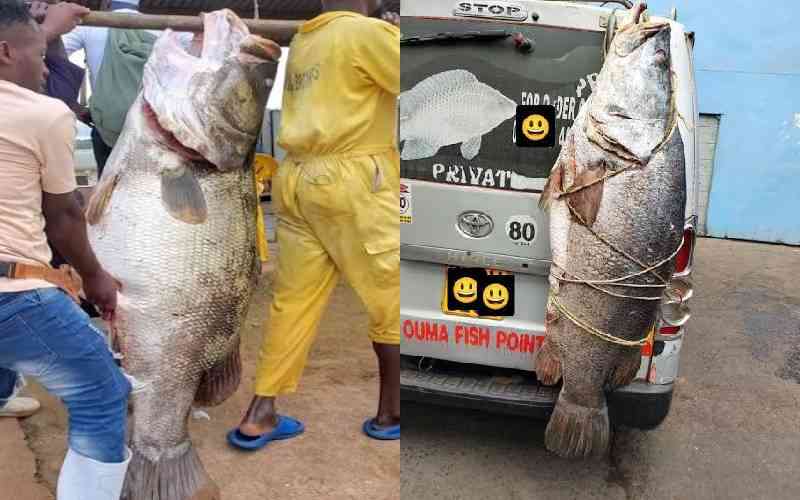
A giant Nile perch from Lake Victoria recently went viral in Kenya after people spotted it tied upright to the back door of a matatu. The fish was so large that it appeared to stretch almost the full height of the vehicle.
In the viral clip, the matatu was white, carried the registration number KDH 623K, and had “OUMA FISH POINT” and “BIG FISH” written on it.
The fish was identified as a Nile perch, locally called Mbuta or Sangara. Videos shared online showed it hanging vertically behind the van, leaving many Kenyans amazed.
Nile perch are among the biggest freshwater fish found in Lake Victoria. They can grow up to about 2 metres long and may weigh as much as 200 kilograms.
However, the exact size, weight, and value of this particular fish have not been independently confirmed.
Some estimates suggest that a very large Nile perch could be worth around Sh100,000, but that figure depends on its real weight and the market price at the time.
Nile perch usually grow large because they are aggressive predators. They feed on smaller fish, including tilapia and other species in the lake.
With plenty of food and few natural enemies, they can keep growing for many years. In Lake Victoria, they were introduced decades ago and later became a major source of income for fishermen, traders, and fish-processing companies.
Tilapia, on the other hand, are usually much smaller than Nile perch. They mostly eat plants, algae, and tiny water organisms.
Tilapia grow faster in warm water and are popular because they breed easily and are affordable for many households.
Some tilapia can grow larger when raised in well-managed fish ponds with good feeding, clean water, and enough space.
The size of a fish often depends on its species, age, food supply, water conditions, and whether it is wild or farmed.
Nile perch can become especially huge because they are top predators, while tilapia usually remain smaller because they have a different diet and growth pattern.
The viral video, shows how large Nile perch can become when they live long enough in a lake rich with food.