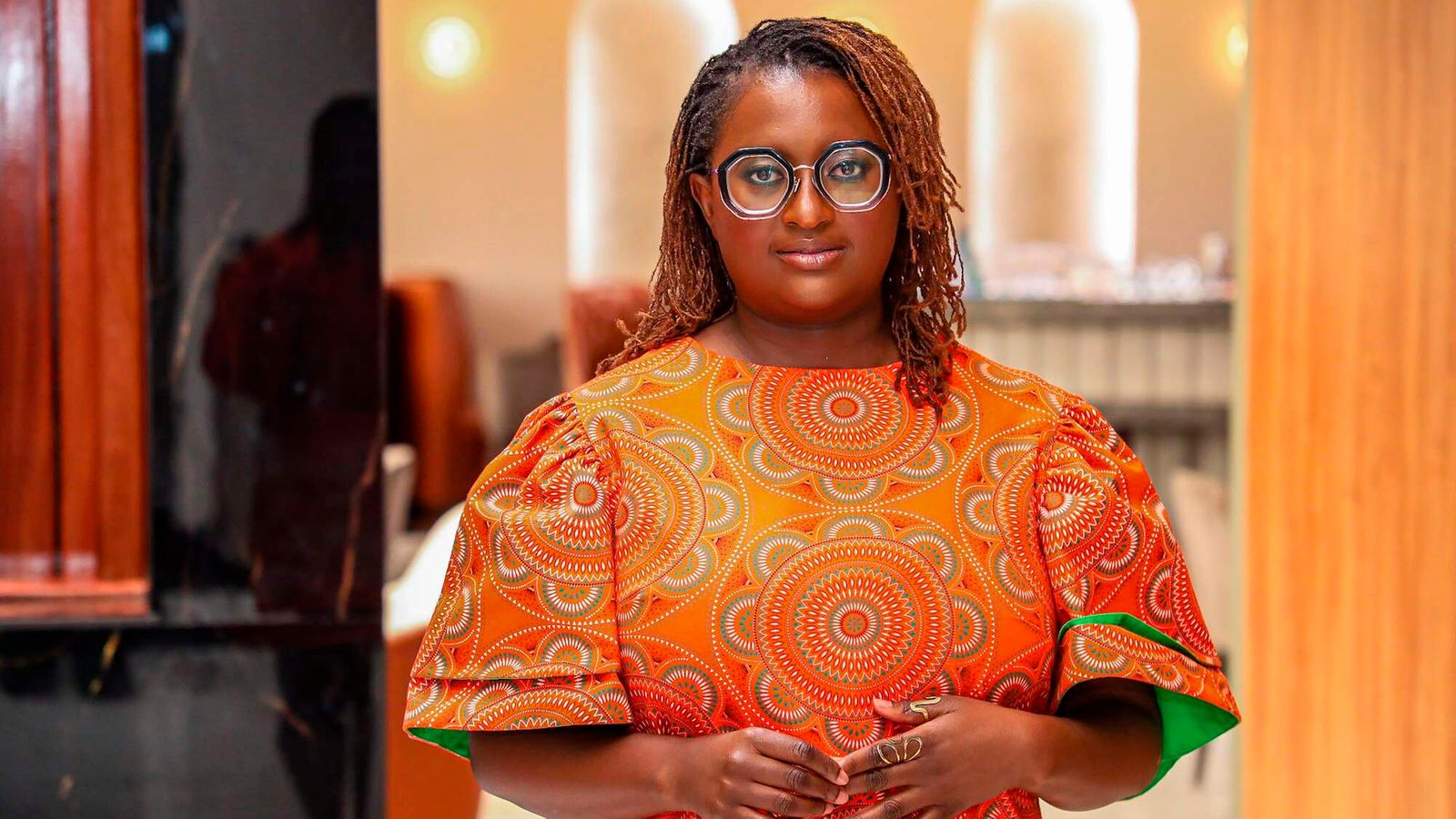
M ercy Mutemi, the executive director of The Oversight Lab Africa, has taken on big tech, notably representing 185 content moderators who allege they were trafficked to Kenya and subjected to forced labour to moderate content across Facebook, Instagram, and WhatsApp.
“We knew who we were fighting for and why,” she says. “It was always about the people harmed by tech.”
She even had the government on the ropes, challenging the amendment to the law that provided for Huduma Namba, which, she argues, violated fundamental privacy rights.
The High Court ruled in her favour. A gladiator in a suit, it is easy to see why TIME named her to the 2023 TIME100 Next list of emerging global leaders. This is who she has always been: refusing to accept the status quo and, from a young age. Like that time, in her Catholic high school, where all students had to attend Mass daily.
“I went to the principal and asked if non-Catholic students could have dedicated time to worship in their own way,” she says.
With a Master’s degree in internet governance from the University of Malta, and an undergraduate degree in law from the University of Nairobi, Mercy was recently named a 2025 Ford Global Fellow.
“There is the path you are told you are supposed to take, and there is the path your gut inclines toward,” she says. “Follow your gut.”
What is that gut decision you made that was difficult or unpopular, but taught you the most?
Starting my own law firm at 25 years old was extremely unpopular. Senior advisers and lawyers warned me against it, telling me it would fail, and that as a young woman I should wait. Taking that bet on myself is the biggest risk I’ve taken.
That and the decision to pursue tech and human rights were seen as foolish by peers because there was no money in it. I wasn’t representing wealthy clients; I was representing people rendered destitute by technology.
For the first five years, it was a constant struggle just to keep the lights on. Courts were reluctant to hear things on technology. I once had a judge tell me to speak very slowly because he didn’t understand any of the tech things I was saying and just wanted to write down my words and go make a judgment later based on that [chuckles].
I often wondered why I chose this path, but despite the struggle, I was so passionate about it and my heart felt at peace doing this work. Over time, society and the legal system began recognising that tech deeply impacts fundamental human rights. Fulfilment is my measure of success, and I am happy I followed my gut.
What has it been like to lead the career you have?
Incredible. I think of careers as a series of responses to roadblocks, and when you hit one, you find a way out of a closed path.
Early on, I thought I was going to be a parliamentary legal counsel, I was set on that. But it didn’t work out, and I had to very quickly ask myself: if not this, then what? I then found a deep passion in technology: how it interacts with people and the law.
Thinking about the experience of women working in law firms and the abuse they go through, especially where abuse is sometimes normalised, and how vulnerable they are, I decided to start my own firm and create safe spaces for other women to work with me.
Are gender and age still major issues in law?
Yes, absolutely. Not too long ago, I was in court and had the displeasure of being referred to as: “This little girl does not know what she’s doing in the court.” Moments like that, especially during a heated argument with a colleague about a legal subject matter where you both come to the table as experts and lawyers, take you back. You realise, “Oh, we’ve made so much progress, yet we haven’t moved at all.”
There are people who hear you speak and the first question they ask is, “Who beds that woman?” Sexism is a big issue in the legal profession.
Age is an issue as well. For many years, this profession was much more closed. You had to be of a certain status or elite to chart your own legal journey and thrive.
Some people are still stuck in the old mentality that legal practice needed to look one way, and that’s where the ageism comes out.
With time, people started realising that nowadays, technology is central. Respect came by allowing time to pass. That required enduring many years of being sidelined, minimised, and trivialised in court, where judges didn’t think these issues were real, even when people were impacted. It took patience, fighting, and really believing in what I was doing.
Most lawyers are told to start small and rise steadily, but you seemed to go straight for the jugular and take on the big players. Was this by design?
Haha! I did start small. You could frame it as going after the big tech companies and going for the jugular, but my perspective is different.
My career was not just about the law; it’s about people. People come first. You think about the person and ask: What tools do I have to help them? Law is just one of those tools.
When you think about it that way, it doesn’t take as much guts because what you’re doing is standing with people and focusing on what they need. It just so happens that some of the disputes I’ve been involved in include some of the biggest tech companies in the world. But it was never about ‘going after them’; it was about aligning with people.
One of the earliest cases I took on was for a pregnant woman who had been doxed on Kilimani Moms [social media page]. Her private details were shared alongside allegations, and people were attacking her. We lost that case, but I was trying to argue that she still deserved protection regardless of the forum. It wasn’t a Facebook [now Meta] issue; it was about the human being.
For many years, I was my own clerk and my own secretary. I typed my own court proceedings, carried them to court personally, queued, paid fees, and did all the running around. You start small and build out slowly.
What has taking on these tech giants taught you about running a specialised, smaller law firm?
Initially, that you can do anything as long as your focus and your heart are in the right place. We knew who we were fighting for and why. It was always about the people harmed by tech.
However, the bigger lesson is that litigating a complex problem as a small firm has clear limitations.
For example, in our work against Meta, we have been representing 185 content moderators who allege they were trafficked to Kenya and subjected to forced labour to moderate content across Facebook, Instagram, and WhatsApp. That case has been ongoing since 2023.
But think about the bigger problem: why can a multinational company come to Kenya, bring in people from various countries, and end up facing allegations of human trafficking and forced labour? What are the economic and societal conditions that allow this? Last year, a content moderator from Nigeria died because they couldn’t return home due to invalid papers.
When you see governments supporting tech companies in court over their own people, you realise these are not just straightforward legal problems. They are broader societal and economic issues.
Why are tech companies welcomed full-scale to exploit people, and how can it be solved? That kind of systemic issue cannot be solved inside a courtroom alone. It requires broader thinking, research, community advocacy, and policy reform.
That realisation prompted my transition from private litigation in a law firm to a non-profit organisation focused on working with communities to build better tech futures. The problem is far bigger than litigation alone can address.
In popular culture, people often talk about two outcomes when confronting massive interests: being threatened or being bought out.
Where have your chips fallen?
Threatened, for sure. We’ve had moments where we had to face the reality that my life was in danger because of this work.
In Kenya, tech was framed as a primary pillar of Vision 2030 and the promise that Kenya would become the ‘Silicon Savannah’ and generate millions of jobs to solve our economic problems.
When you litigate against these big tech companies, it puts you in direct conflict not only with the tech companies, but also with government narratives about employment. Our position is clear: we want young people to have jobs, but those jobs must come with dignity.
When you represent victims, it forces you to confront fundamental questions about economic development and employment and unemployment:
Are we willing to let our people and resources be exploited just to claim we are part of the tech evolution?
Should we celebrate being a tech hub when women in our country are being recorded without consent and having their content sold on platforms? Those are the hard truths we have to confront.
Was this your dream growing up?
[chuckles] I actually wanted to be a doctor. We believed that to be successful in life, you had to become a doctor. I adopted that dream, even though I don’t think I would have made a good doctor. I faint at the sight of blood haha!
Luckily, I missed the grade cutoff for public university admission to medical school by a single point. The only alternative was paying for a private parallel programme, which wasn’t a given for me.
When filling out the JAB (Joint Admissions Board) university selection forms at the last minute, I wasn’t sure what to choose. Someone suggested, “Write law and try it out. If you don’t like it, you can change.”
What do you know about tech and the internet that most people miss?
The people cost. We talk a lot about humanity’s environmental footprint, but for tech to become what it is, it leaves a large trail of human harm.
Nothing happens automatically. Behind impressive AI models, chatbots, and autonomous vehicles, there is a huge human price that has been paid on the backend.
There is a human being involved in training any technology to be what it is. Human beings spend endless hours labeling data, categorising content, and training algorithms. Many of them work under exploitative conditions and suffer severe mental health consequences from reviewing graphic content.
Beyond data training, look at hardware: technology requires minerals extracted from mines in places where people live. The push for AI dominance requires massive data centres, which drive up demand for rare earth minerals and energy, leaving behind exploitation, environmental degradation, and disenfranchisement.
There is nothing fancy about AI; it is the way it is because some people have suffered on the backend while a few people make billions out of it. That human price is what we miss.
What has this work cost you personally that, looking from the outside, we don’t see?
Beyond fearing for my life, there is immense mental strain, burnout, and fatigue.
After years in high-stakes negotiations, what have you learnt about getting people to agree?
It always comes down to an emotional problem. The biggest disputes or corporate battles aren’t just about money or commercial terms; behind them lies an unaddressed emotional issue.
If you want to resolve a massive conflict, you have to identify the underlying emotional problem, whether someone felt cheated, disrespected, or deceived. In professional environments, people rarely create space to address emotions because when you address the emotional core of a dispute, the commercial or legal dispute resolves itself.
What advice would you give someone on this path?
There is the path you are told you are supposed to take, and there is the path your gut inclines toward. The path that allows you to sleep soundly at night and feel fulfilled is the one guided by your gut, no matter how unconventional, unpopular, or traditional norms dictate otherwise.
If you firmly believe in something, start it. Whether a blueprint exists or you have to build it yourself, just begin. Your gut will guide you through the roadblocks and help you find creative ways around them. True self-fulfilment comes from trusting yourself and charting your own path.
Have you always been this brave?
Haha! Maybe not brave, but I’ve always been someone who thinks outside the box and questions the status quo.
In high school at a Catholic boarding school, we had to attend Mass daily. Non-Catholic students felt unable to practice their faith freely. I went to the principal and asked if non-Catholic students could have dedicated time to worship in their own way.
That is what is consistent with me. I’ve always looked at rigid situations and asked: What alternative possibilities exist, and how can we make them work? I refuse to accept being stuck.
What don’t you have a handle on?
[chuckles] That’s interesting. I struggle with the full range of human emotions, including doubt, fear, and uncertainty about the future. I meet many of my colleagues who have their long-term plans completely mapped out, whereas I am constantly reflecting and questioning. It’s not a done deal.
This may come off as a gendered question, but has being a woman in this field opened doors, or forced you to push them open?
There are definitely many doors that have been closed because I am a woman. The job won’t be taken directly from you, but you’ll have to trade your human dignity for the job.
Patriarchy and sexism don’t always manifest as outright denial of opportunity; often, they demand that you compromise your human dignity to access the opportunity. I’ve had to walk away from environments where my dignity was at risk. But you make it despite patriarchy.
Look, you don’t get special privileges for being a woman in this system. In every meeting or negotiation, you constantly have to evaluate how the environment might dehumanise you and how to protect yourself from that. It constantly threatens to take away from you, not give you things.
Does success change something in you?
I’d say when you make any progress in life, it definitely changes how you see things. But I have my own definition of success. Growing up in boarding school from Class 5, success was hardwired in us: get top grades, go to a specific high school that leads you to a specific university to study a specific course, and then you make a lot of money. That was not a path that has ever been comfortable for me, so I had to break free.
To me, success is connecting with yourself enough to understand what is important to you, and then actualising those personal goals, whether that means running an organisation or owning a small shamba in Kaloleni with 10 chickens.
The path to that desired goal is what changes you, not you getting there. It shifts your worldview and chases away naivety because you experience life in all its breadth.
Life stops being a future event and becomes a present thing, where my feet are currently planted, as opposed to never being happy until I achieve something.
What feelings do you have when you look back at your life now?
It feels like a child coming home to a proud parent. I look back at the obstacles, mistakes, and learning experiences with deep compassion and pride. We really did try our best.
Does taking on power make you feel powerful or remind you that you are not?
It helped me understand what power actually is. When I started litigating tech cases, I felt smaller than an ant facing a giant. There was so much anxiety around it, but I did it afraid anyway.
But over time, I realised that corporations only hold power because millions of ordinary people use them and sustain them. People are the true source of power. By aligning my work with everyday people, content moderators, workers, and impacted communities, I realised we are actually on the side that holds real power.
What matters less to you now than it used to?
Acceptability and palatability. Earlier in life, being viewed favourably by others felt important. Today, self-alignment and internal fulfilment matter far more. The primary person I need to be accountable to and live at peace with is myself. What are my values, what do I hold dear to me, and what do I want to protect? You could do everything right, and people still think you are the demon, so can you live with yourself?
What core question do you hope your life answers?
Generational joy. We hear so much about generational trauma, poverty, and struggle. I hope my life demonstrates what generational joy looks like.
Once, I thought if you work hard enough at a thing, then you can actually win the thing or solve the problem. I wasted many years stuck in that emotional turmoil of whether I succeeded or failed because I had that perspective. With age, you learn that once you put effort toward something, it is you succeeding, not waiting for the result.
Are you somebody someone can get stuck with in an elevator?
Haha! I am claustrophobic. So, for the first 10 minutes, I’ll give you stories, but at some point, the claustrophobia will check in, and then I will become a burden to you. And that will be a problem [chuckles].