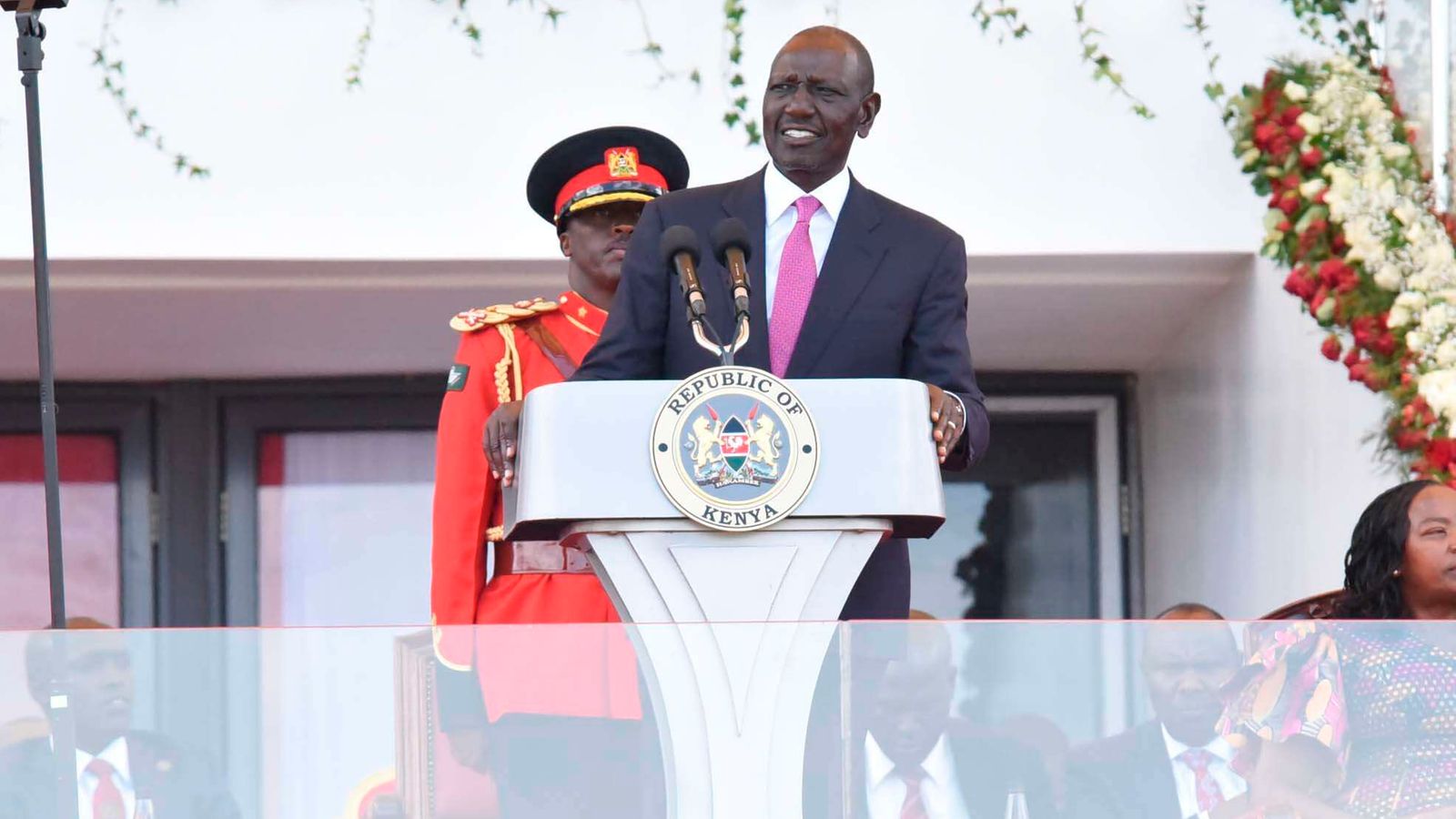
President William Ruto on Tuesday signalled reduced income tax for workers earning less than Sh32, 333, exemption of land transactions below Sh1 million from stamp duty and scrapping 25 percent import duty on phones in efforts to boost disposable incomes.
Workers earning Sh32,333 will enjoy an income tax of Sh2,083 monthly while property buyers in urban and rural areas will save Sh40,000 and Sh20,000 respectively for deals valued at Sh1 million.
The relief package will also see an expansion of the paid internship to 50,000 graduates from January from about 10, 000 to tackle youth unemployment. Kenya plans to weed out tax evaders and boost revenue by billions of shillings as part of a raft of measures to repair its coffers and cover for the tax cuts.
“These measures address four barriers that Kenyans confront every day: the burden of taxation on modest incomes, the cost of acquiring property, the expense of accessing digital opportunities and the difficulty of entering the labour market,” said Dr Ruto in his Mashujaa Day address.
The easing of taxes comes as the State seeks to placate the electorate with just months to the General Election in August next year. President Ruto’s administration has introduced a raft of new taxes and raised old ones since he was elected in August 2022.
The decisions proved unpopular with many Kenyans who believe he has betrayed his campaign pledge to champion the interests of “hustlers” — those who struggle financially.
This emerged in a period when the Kenya Bankers Association (KBA) estimates that workers’ purchasing power has declined by up to 12 percent over the past five years on the back of rising taxes, multiple statutory deductions, and the high cost of living.
KBA, which had earlier proposed a uniform five percent reduction in pay-as-you-earn (PAYE) across all income tax bands, said in May that the purchasing power of incomes for households has dropped by between 10.7 percent and 12 percent.
Besides the tax cuts, Mr Ruto is betting on increased economic growth to boost earnings and rev up jobs as he counted on increased earnings from farming, including sugar, coffee and dairy, to ease poverty.
Kenya’s economy shrugged off effects of the Iran war to grow 5.1 percent in the second quarter of 2026, compared with 4.9 percent in the same period last year, the statistics office said on Friday. The growth was mainly supported by strong activity in sectors including transportation and storage, accommodation and food services.
Other sectors that recorded notable growth included electricity, information and communication technologies, financial services and construction. Earlier Treasury proposals had sought to raise the threshold of untaxed income from Sh24,000 to Sh30,000 and income falling between Sh30, 000 and Sh50, 000 taxed at lower rate of 25 percent. Currently, income above Sh32, 333 attract a tax rate of between 25 percent and 30 percent.
Under the current tax bands, the first Sh24,000 of monthly taxable income is taxed at 10 percent, while the next Sh8,333 attracts a 25 percent rate, with residents receiving personal relief of Sh2,400 monthly. At taxable income of Sh32,333, a worker currently incurs about Sh2,083 in PAYE each month after personal relief.
For land buyers, the government has proposed scrapping stamp duty on transactions valued at below Sh1 million, in addition to introducing progressive rates for more expensive transfers.
“These measures will help reduce the cost of acquiring and transferring land, strengthen security of land ownership and make property ownership more accessible to ordinary Kenyans,” said the head of State.
Currently, stamp duty on property transfers is generally charged at four percent of the property’s value in urban areas and two percent in rural areas, making the tax a significant additional expense for buyers already raising money for land purchases.
Savings on these taxes would lower the upfront cost of registering property ownership, with buyers left to meet other expenses associated with a transaction, including legal, valuation and registration charges where applicable.
The President also proposed removing the 25 percent import duty on mobile phones in a move intended to lower the cost of devices used for banking, education, communication and digital work.
The duty currently adds a quarter of the phone’s customs value before other applicable taxes and commercial margins are factored into the final price. Mobile phones are also subject to other applicable charges, including value-added tax and excise duty.
The government’s national internship programme, which is now set to accommodate 50,000 young Kenyans from next January, is intended to help young people overcome the experience barrier that often prevents fresh graduates from securing their first formal employment.
“Too many young people cannot secure employment without experience, yet cannot gain experience without employment,” said Ruto.
“This programme is intended to break that cycle by providing a pathway from education to practical and productive workplace experience and, ultimately, meaningful employment. “Interns under the programme receive a monthly stipend of Sh25,000, meaning government will have to make an annual budgetary allocation of at least Sh15 billion to remunerate the expanded group.