Audio By Vocalize
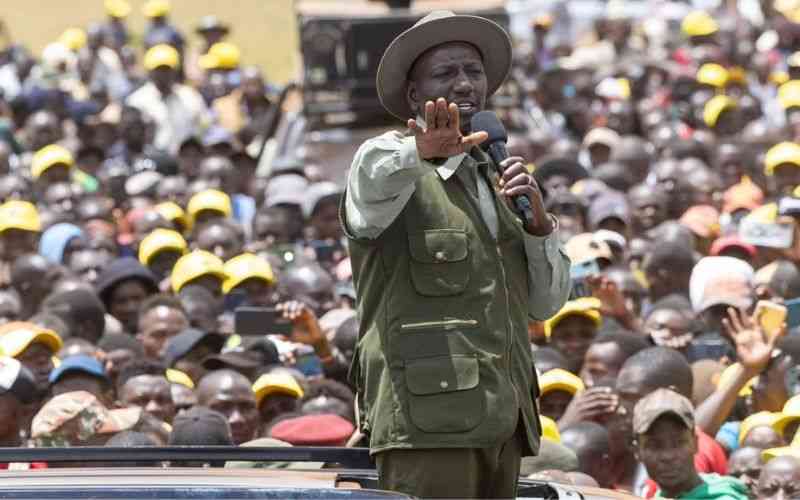
President William Ruto delved into the growing tension among Orange Democratic Movement (ODM) and United Democratic Alliance (UDA) contenders in the Coast and asked them to tone it down during his recent tour of the region.
Speaking hours before he wound up his eight-day tour, Ruto appeared to notice the widening cracks and told politicians within the two parties to embrace a ceasefire and unite against the opposition.
The head of state, who is facing a formidable challenge from the united opposition, warned that divisions in the ODM and UDA could weaken their team, whose union gives it a chance to win the 2027 general election.
“ODM and UDA are one team, and you should accommodate each other under a broad-based government. We should not allow divisions in ODM and UDA to undermine our unity of purpose,” he stated.
His statement appeared to be directed at the growing tensions among contenders, particularly in Kwale, Mombasa and Kilifi counties where prominent politicians face challengers within the ODM and UDA political union.
President Ruto’s earlier attempt to zone the region in favour of sitting governors is also blamed for the cracks in the broad-based team at the Coast.
In Mombasa County, UDA secretary general Mr Hassan Omar has already rejected a plan by the so-called broad-based team to support governor Abdulswamd Nassir’s re-election.
Omar, who is also a member of the East African Legislative Assembly (EALA) insisted that he will challenge Mr Nassir.
Already, businessman and EALA member Mr Suleiman Shahbal has quit ODM after he left he could not get the party ticket as the president’s allies favour Nassir, a deputy party leader.
Shhabal has since aligned himself to former Laikipia governor Mr Murithi Nderitu’s Kenya Reform Party even as he insisted that he will be on the ballot.
In Mombasa, Mining, Blue Economy and Maritime Affairs Cabinet Secretary Mr Hassan Joho and governor Nassir appeared to be handing over Coast which was the ODM leader late Raila Odinga’s political turf, to President Ruto.
“This region stands with Ruto because he has dignified us with title deeds and many other development projects. We however expect him to support us when we seek the presidential seat in 2032,” Joho said.
Joho’s elder brother Abubakar Joho, who is a prominent businessman, has also joined the campaign for President Ruto.
While touring Kwale, Ruto addressed the growing noise among the main contenders, Governor Fatuma Achani (UDA), Prof Hamadi Boga and Engineer Lung’anzi Chai (ODM) after the broad-based leaders appeared to settle for Ms Achani who has the backing of Sports CS and former Kwale governor Salim Mvurya.
Stay informed. Subscribe to our newsletter
After witnessing the rising political tension, Ruto changed tone and told the three contenders to directly seek support from the voters rather than relying on external political backing.
In a complete change of heart and political tact, Ruto emphasised that the power to choose leaders ultimately belongs to the electorate, who will evaluate candidates based on their track record and development agenda for the region.
“You should all seek votes from the people and not rely on external backing. What I need from all of you is your support,” he stated.
For long, Governor Achani has enjoyed unwavering backing of President Ruto, Mvurya and recently Joho, who had preferred Kwale to be zoned in favour of the governor and UDA.
But Prof Boga, who has been Mr Joho’s ally, described the broad-based government’s zoning arrangement as undemocratic and a coercion to the Kwale electorate who he said should be allowed to choose their leaders without external interference.
Boga has been critical about the attempt to stop some aspirants from contesting seats in the broad-based government, noting that it was possible to zone candidates and difficult to do so for the voters.
In a statement, Boga noted that former Gender CS and Kilifi governor aspirant Ms Aisha Jumwa’s recent departure from UDA to Wiper Patriotic Front (WPF) reflected a growing sense among a segment of coastal leaders that decisions about their political future are increasingly being made elsewhere, then handed down as settled outcomes rather than negotiated realities.
“Zoning at the Coast is a fantasy: You can zone candidates but you cannot zone the voters,” Boga had warned.
“And if UDA and ODM are not paying attention to that signal, they may be underestimating the political consequences of their emerging arrangements at the Coast. “There is a dangerous assumption taking root in the broad-based arrangement: that coastal politics can be settled around a table in Nairobi and then delivered to voters as a finished political package. You take this seat, we take that one, and the voters will follow,” he added.
Boga, who came second in the 2022 governor poll, warned that if the Coast is mishandled, the problem will not necessarily be that voters have suddenly embraced another political formation, but the greater danger is that voters may decide that none of the established arrangements speak for them, creating either a rebellion or apathy.
In Kilifi County, the broad-based team publicly worked with Governor Gideon Mung’aro, forcing Ms Jumwa, his main challenger, to quit the government team in protest.
Kilifi Senate aspirant Mr Stephen Kahocho and Ganze parliamentary aspirant Ms Zawadi Kingi have publicly warned that they might be forced to quit UDA and vie as independent candidates or join other political formations.
This is after it emerged that the broad-based arrangement was behind Mung’aro (ODM), Kilifi senator Stewart Madzayo (ODM) and Ganze MP Kenneth Kazungu Tungule of Pamoja African Alliance (PAA), an affiliate of UDA.