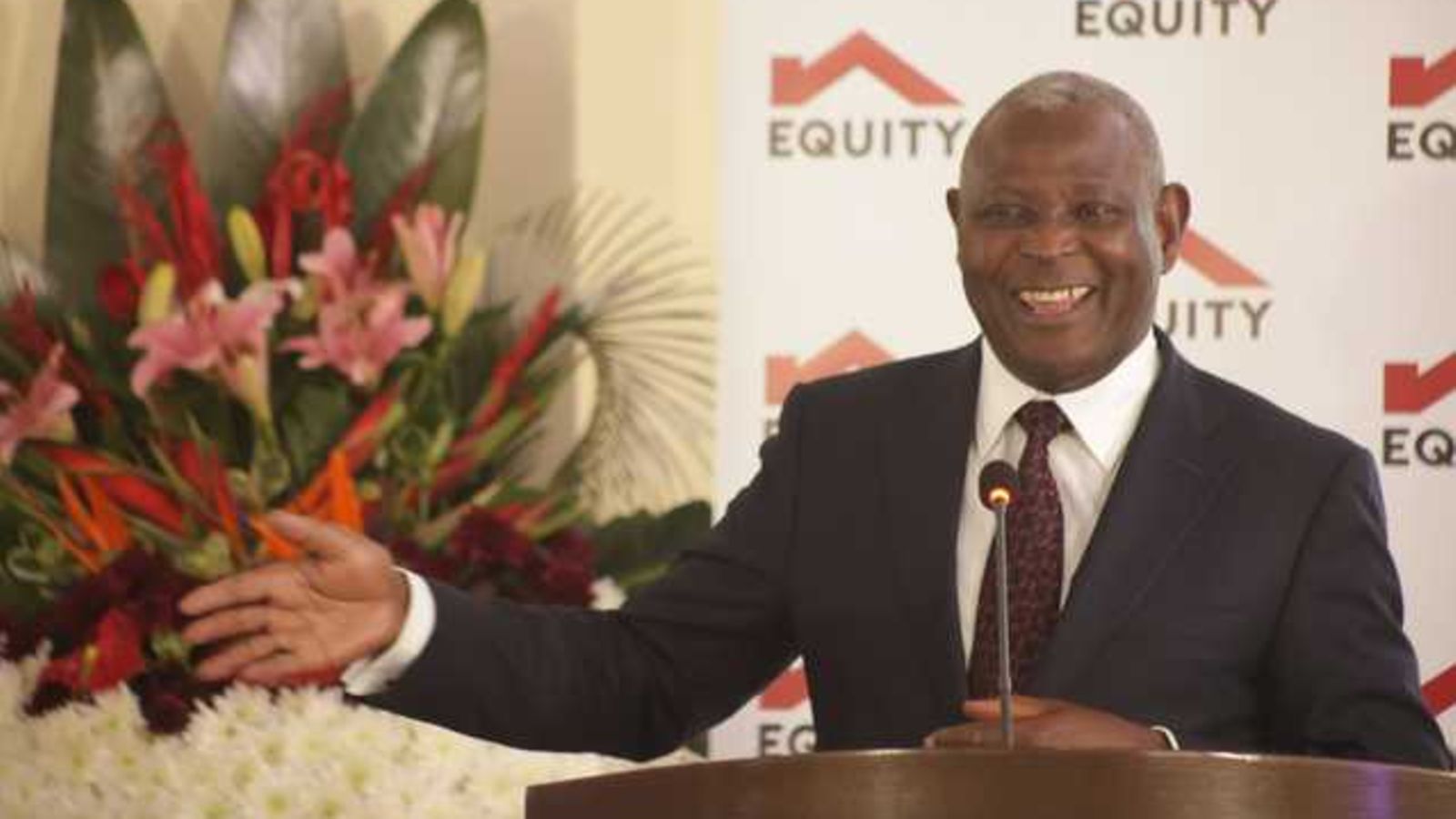
Equity Group chief executive James Mwangi has joined a 20-member global commission that will help craft a new global development roadmap to succeed the United Nations’ Sustainable Development Goals (SDGs) that expire in 2030.
Mr Mwangi is the only African private-sector representative on the South-North Commission on Development, giving Kenya a seat on a panel whose recommendations are intended to influence the global development agenda after 2030.
The new outfit brings together World Bank president Ajay Banga, World Trade Organisation director-general Ngozi Okonjo-Iweala, Nobel Peace laureate Denis Mukwege and former political leaders from Africa, Europe, Asia and Latin America.
The commission, unveiled on June 30, 2026, will lay out a sweeping vision for improving the lives of people all over the world for decades.
Its input will craft a new development plan meant to replace and expand on the United Nations’ current road map, the Sustainable Development Goals that were adopted in 2015.
The 17 Sustainable Development Goals are focused on ending poverty around the world, while protecting the planet and ensuring a new prosperity for everyone.
The commission is co-chaired by former German Chancellor Olaf Scholz and former Costa Rican president Laura Chinchilla, giving the panel political leadership from Europe and Latin America.
Its first meeting is scheduled for Bangkok on October 16 and 17 alongside the International Monetary Fund (IMF) and World Bank annual meetings, with interim findings due in 2027 and a final report at the end of 2028.
In his new role, Mr Mwangi is expected to bring his experience from Equity, which has built a large regional banking business around lending to households, small enterprises and agriculture across East and Central Africa.
“Africa should no longer be seen through the lens of aid. It is a source of growth, talent, innovation and investment. I am honoured to join the Co-Chairs and my fellow Commissioners,” said the Equity Bank boss following the appointment.
“I will bring what Equity has learned about mobilising domestic and global capital, backing entrepreneurs and small businesses, and making financial and economic inclusion a platform for jobs and shared prosperity.”
The new global commission is modelled partly on the North-South Commission, which was chaired by former German Chancellor Willy Brandt from 1977 to 1983 and whose term lapsed.
It examined economic inequality between developed and developing countries. The fresh elite global team will propose new forms of international cooperation.
Germany says the new commission will build on that legacy while responding to a fundamentally changed global environment, with regular meetings and regional consultations over the next two years before its final report in 2028.
Its recommendations are expected to feed into the global development agenda after the United Nations Sustainable Development Goals expire in 2030.
The SDGs, adopted by all UN member states in 2015, set 17 global goals covering poverty, hunger, health, education, jobs, inequality, climate change, peace and other development priorities, giving countries a common blueprint for improving living standards by 2030.
But the goals are falling short of targets, with the latest UN assessment showing only 36 percent of measurable goals are on track or making moderate progress, while 49 percent are advancing too slowly as 15 percent fall below their 2015 baseline.