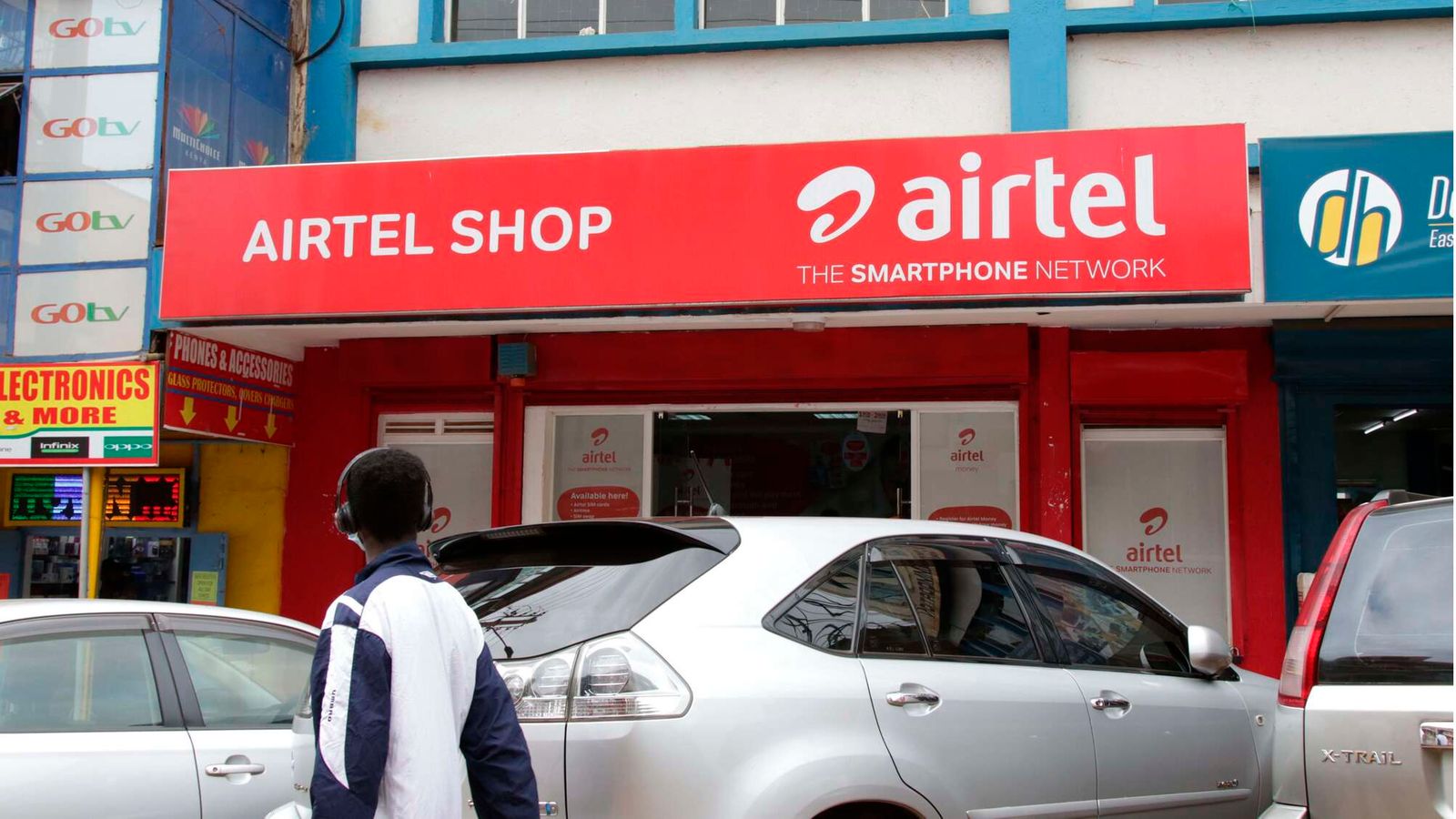
Airtel Money Kenya’s parent firm has signalled a mobile money market price war with Safaricom’s M-Pesa in its effort to expand its local market share, saying that high market penetration limits room for organic growth in the country.
Kenya’s mobile money segment has for years been dominated by Safaricom’s M-Pesa, which enjoys an 88.8 percent share of total subscriptions that stood at 54 million in June 2026, compared to an 11.1 percent share for Airtel Money.
However, Airtel Money has been chipping away at Safaricom’s lead over the last three years, having grown its share from 2.8 percent in June 2023, when Safaricom commanded 97 percent of the market.
Airtel Money’s current mobile money subscriptions market share is equivalent to 5.99 million users, compared to 47.95 million for Safaricom’s M-Pesa.
The parent firm of Airtel Money—Airtel Mobile Commerce NV—made the strategy disclosure in a prospectus ahead of the listing of its mobile money business in London this month.
Airtel Money provides mobile wallet, payments and other broad financial services to 53 million active users across 13 sub-Saharan African markets including Kenya, Chad, Uganda and Tanzania.
“The group has been successfully gaining customer market share in Kenya as it leverages a clear value proposition built on lower transaction fees, superior customer incentives, improved interoperability and rapid expansion of its agent network and distribution partnerships,” Airtel Mobile Commerce said in the prospectus.
“There is still significant runway for mobile money growth, as evidenced by a meaningful difference in the maturity of its proliferation across the group’s footprint versus Kenya, which pioneered the use of mobile money and is today at a more developed stage in its maturity.”
The company noted that at 231 percent, mobile money total processed value (TPV) as a percentage of GDP in Kenya is three times higher than Sub- Saharan Africa’s 66 percent, indicative of significant potential growth across the other markets in which the group operates relative to Kenya.
TPV is measured as the total value of transactions on a mobile money platform generated for various products and services during a set period.
“In Kenya, the group is focused on further scaling its distribution network to accelerate customer and revenue growth, which is also driven by top-down regulatory reforms,” said the multinational, which is part of the businesses owned by India’s conglomerate Bharti Enterprises.
“For example, the group recently unlocked a significant new TPV stream after the country’s regulator enforced person-to-person interoperability, opening direct payment inflows from the incumbent’s user base.”
Airtel Money has already set off the price fight by cutting fees charged on merchant payment platforms in the past three months, triggering a response from Safaricom.
On August 3, Airtel Money launched Bizna Wallet to rival Safaricom’s M-Pesa Pochi la Biashara, a low-cost product that provides small-scale traders with a simplified digital payment solution. Airtel Money’s wallet was offered free of fees to attract merchants.
Airtel Money also halved the costs on its other mobile money transactions, such as paybill payments, sending money to rival mobile money networks, bank transfers to wallets and transfers of money to bank accounts.
In response, Safaricom raised the threshold of transactions on Pochi la Biashara that are not levied fees from Sh100 to Sh200, and also halved the charges on payments to business tills and paybills.
Safaricom’s new tariffs, effective August 7, cut the maximum charges for M-Pesa tills and Paybill payments from Sh108 to Sh54 for transfers of between Sh45,001 and Sh250,000.
Pochi charges were revised for a three-month period to October 31, 2026, setting the top rate at Sh50 for transfers of between Sh2,501 to Sh250,000.
Safaricom launched Pochi in 2020 as part of its strategy to drive the adoption of digital financial services among micro-entrepreneurs, allowing them to keep business earnings separate from personal funds in a unique wallet linked to their M-Pesa account.
The number of merchants on the Pochi platform doubled to 2.1 million by March 2026, from 1.1 million a year earlier.
The Nairobi Securities Exchange (NSE) listed telco’s move to revise its prices indicated that it was aware of Airtel Money’s moves, lowering its own prices to protect and grow the market share of M-Pesa, its biggest money maker.
In its financial year to March 2026, Safaricom reported a 13.4 percent growth in M-Pesa revenue in Kenya to Sh182.7 billion, accounting for 45.6 percent of the company’s total revenue of Sh414.1 billion from its Kenyan operation.
Revenue from mobile data sales rose 14.4 percent to Sh83.3 billion, while earnings from fixed internet sales to homes and offices rose 12.2 percent to Sh20.2 billion. Voice revenue was up 1.3 percent to Sh81.8 billion in the period.
Airtel Mobile Commerce does not publish standalone financial performance data for markets like Kenya, instead bundling the country into a wider East Africa market.