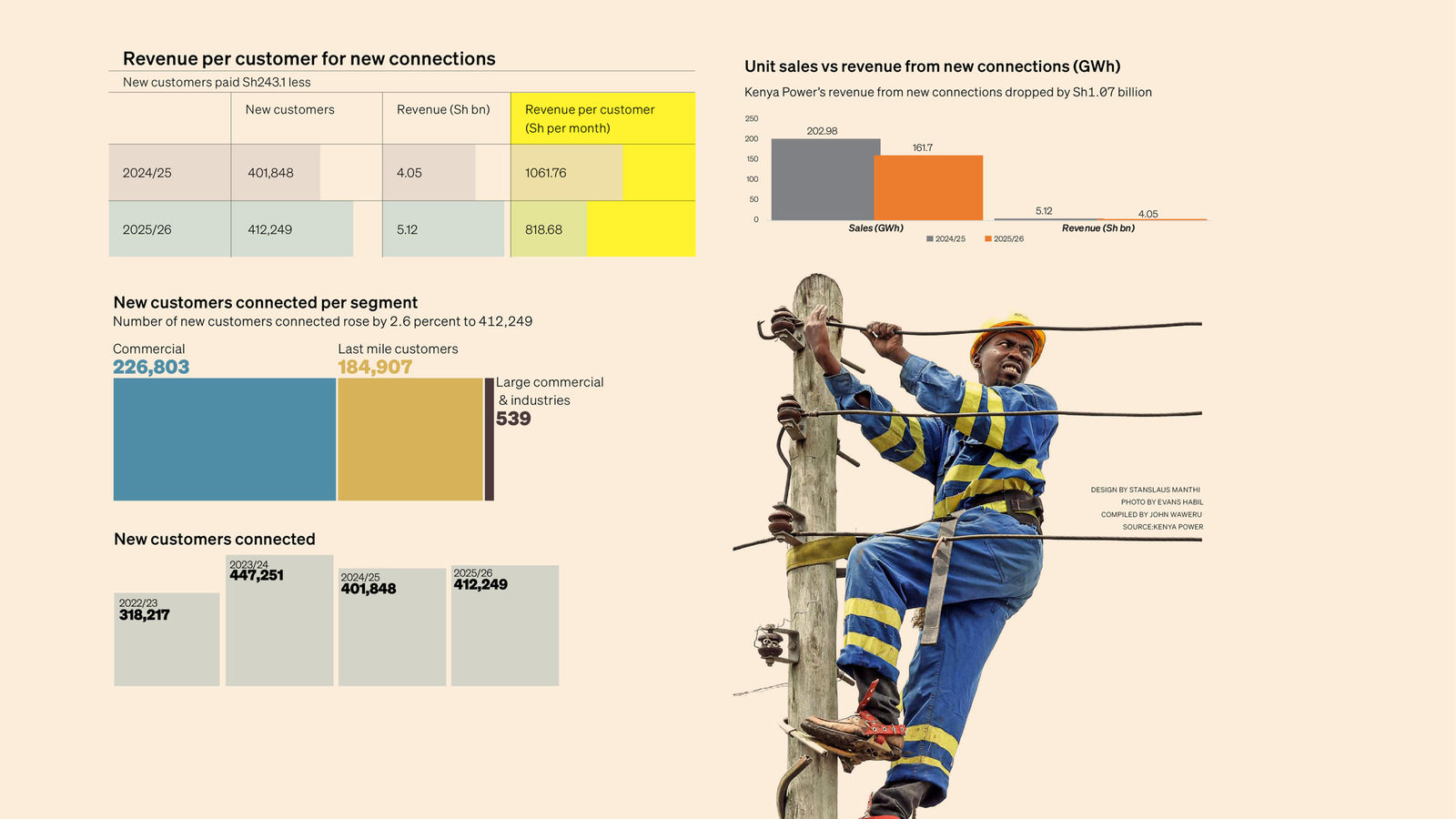
Monthly power bills of homes and businesses freshly connected to the national power grid have dipped below Sh1, 000, exposing the low living standards of households recently linked to the grid.
An analysis of official data shows that new customers that Kenya Power connected in the year ended June 2026 spent an average of Sh818.68 per month compared to Sh1,061.76 the previous year.
Most households recently hooked to the national grid under the subsidised scheme, Last Mile Connectivity Project (LMCP) lack home appliances such as electric cookers and refrigerators which are key drivers of electricity usage. The LMCP beneficiaries mostly use electricity for lighting, denying Kenya Power a quick return on investments.
Small businesses that are connected to Kenya Power via the LCMP also have low electricity usage due to minimal demand for services such as barber shops and salons, leading to a low use of energy at these premises.
Kenya Power’s earnings from new connections declined in the year under review, with revenues from this segment down to Sh4.05 billion from Sh5.12 billion a year earlier.
The overall new connections to the national grid include those in the commercial, big industries and those connected under the LMCP, a project that has turned out as more of a social good than a commercial venture for Kenya Power.
Most of the LMCP beneficiaries use the electricity for lighting and lack appliances like refrigerators, microwaves and electric heaters which are key drivers of power usage by households.
Besides low usage across LMCP connections, a high number of families and businesses also have back-up power systems, mainly solar, thus reducing their dependence on the national grid to power their daily operations.
The quest for reliable electricity supplies and reducing monthly power bills are major reasons why businesses and wealthy households are turning to backup electricity sources.
The LMCP was rolled out in 2015 as the then Jubilee Government, backed by development partners sought to connect homes to electricity at a subsidised rate of Sh15,000.
Kenya Power has in the past few years aggressively increased connections to boost revenues and also offset the impact of consumers who are turning to solar connections.
Increased connections and electricity sales have been critical in pulling Kenya Power from the loss-making territory in the last three years.
The utility posted a net profit growing to Sh24.9 billion in the year to June 2026 from Sh24.4 billion a year ago and a net loss of Sh3.19 billion in the year to June 2023.