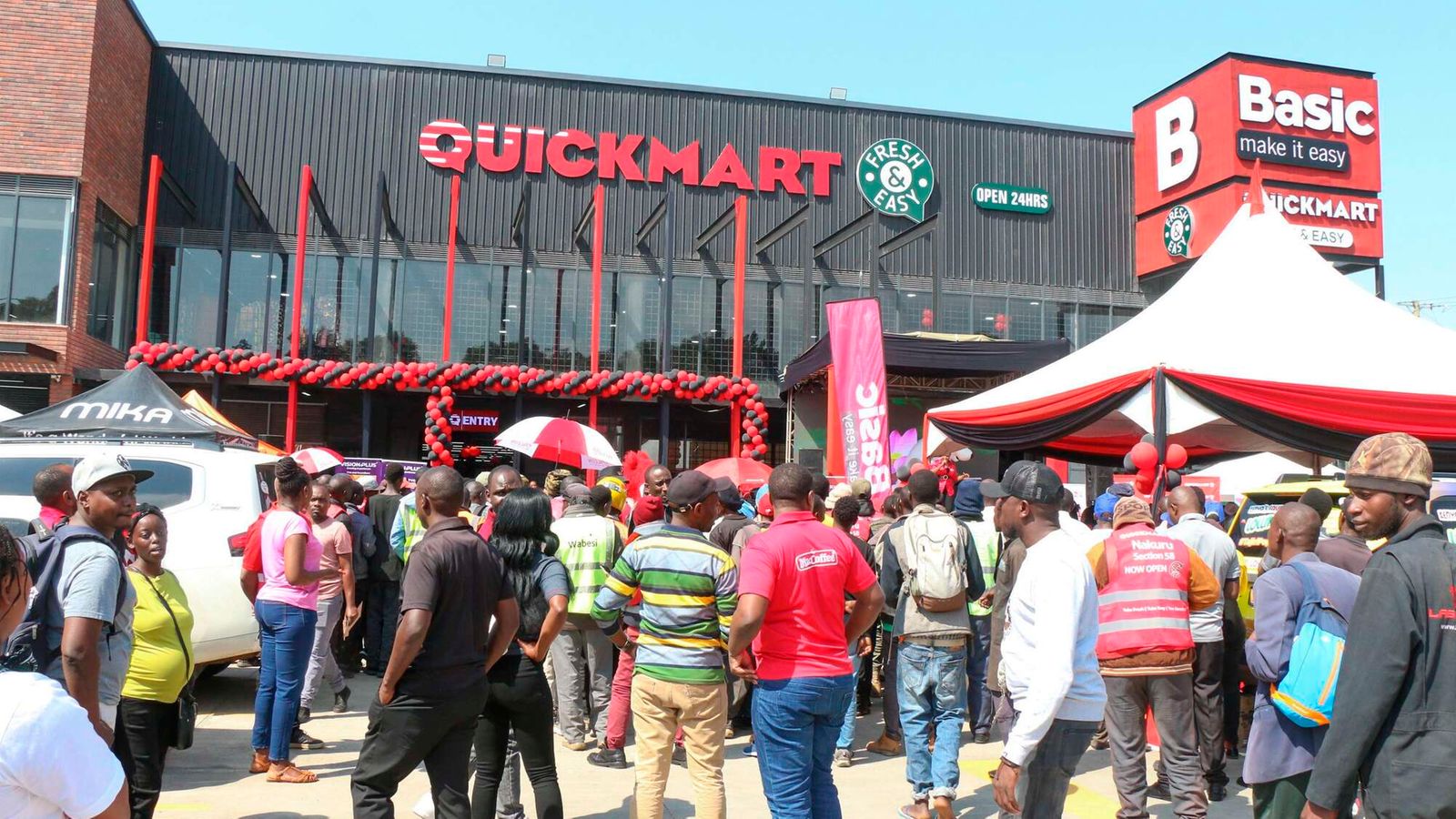
Supermarket chain Quickmart says it relies on friendly terms from suppliers to stock its stores, a move that has seen the company avoid bank financing for working capital.
The company, whose annual sales top Sh50 billion, had borrowings of only Sh6.8 million as of June 30, 2026, showing the extent of the favourable terms where suppliers deliver goods directly to its stores and are paid later.
At the end of the review period, the retailer owed suppliers Sh4 billion, which it did not need to finance.
“The company’s structurally negative working capital position, which stood at Sh4 billion as at 30 June 2026, reflects its rapid inventory turnover and favourable supplier payment terms,” Quickmart said.
“The company operates an asset-light model under which all stores are leased rather than owned, combined with a supplier-led direct-to-store distribution model under which suppliers deliver merchandise directly to individual stores rather than through a central warehouse. Together with rapid inventory turnover and efficient working capital management, this model supports a structurally negative working capital position and strong operating cash conversion.”
Working capital shows the surplus or deficit of funds after deducting a company’s short-term debt. While a deficit would ordinarily imply illiquidity, in the case of Quickmart it is the demonstration of the favourable terms the retailer has secured from its suppliers.
The company’s deal with suppliers saw it hold a net cash position of nearly Sh700 million as of June 30, 2026, excluding lease liabilities.
Quickmart did not publish its balance sheet—which lists all the assets and liabilities—in its intention to float (list) announcement.
Other retailers whose financial statements have been made public, including the collapsed Nakumatt Holdings, Tusker Mattresses and the debt-ridden Uchumi Supermarkets, have relied heavily on multiple financiers in addition to suppliers.
Such financiers have included banks and holders of commercial paper, which are short-term debt instruments.
The favourable terms suppliers have extended to Quickmart shows the growing prominence of formal retailers in controlling consumers’ wallets.
Naivas, Carrefour and Quickmart alone sell goods worth more than Sh200 billion a year, making access to their shelves a top priority for manufacturers and suppliers of fast moving consumer goods.
The supermarket chains continue to expand aggressively across the country, taking shopping convenience into the suburbs of cities and towns where consumer loyalty is courted with store points.
Quickmart is the second largest formal grocery retailer in the country by store count and turnover, with an estimated 15 percent share of the modern grocery retail market and 72 stores across 16 counties.
“The company recorded an average of approximately 5 million customer transactions per month during the six months to 30 June 2026 and is supported by approximately 2.5 million Q-Points loyalty members, who accounted for approximately 74 percent of sales during the financial year ended 31 December 2025,” Quickmart said.
The retailer plans to continue its expansion, with a medium term target of opening 10 to 15 new stores annually in Kenya.
Naivas, which was the first supermarket chain to hit 100 stores in the country, also continues to grow its footprint.
“Expansion is focused on urban, peri-urban, regional and coastal catchments and is expected to be funded primarily from internally generated cash flows,” Quickmart said.
Carrefour Kenya opened eight new outlets in Kenya last year bringing its footprint to 34, making it the third largest supermarket operator in the country.
Suppliers’ dalliance with the big retailers has not always been rosy, with manufacturers and distributors losing heavily from the collapse of the former retail giants Nakumatt, Tuskys and Uchumi.
When it was placed under administration in February 2018, Nakumatt owed suppliers Sh18.5 billion, making them the biggest class of the retailer’s creditors.
Other creditors included banks which claimed Sh6.9 billion and holders of commercial paper (Sh4.7 billion).
When Tuskys’ problems emerged in late 2020, its supplier debt was estimated at Sh6.2 billion. Uchumi has meanwhile reported trade and other payables of more than Sh7 billion.
The formal retailers stock a wide variety of consumer goods including toiletries, packaged food and stationery. Farmers and distributors of fresh produce, including vegetables and meat products, also make substantial sales in supermarkets.
The collapse of Nakumatt, Tuskys and Uchumi, which were owned by Kenyan shareholders, led to the rise of foreign investors in the current player dominating the market.
Mauritian conglomerate IBL Group bought a controlling 51 percent stake in Naivas from the family of the late Peter Mukuha while private equity firm Adenia Partners acquired its Quickmart stake from the family of the chain’s founder John Kinuthia.
Adenia had earlier purchased an interest in Tumaini Supermarket, which was subsequently merged with Quickmart under the latter brand. Dubai’s Majid Al Futtaim’s local Carrefour franchise was a greenfield investment.