When Anselm Croze was born, his mother had her ducks smuggled into the maternity ward and hidden under her bed, because they had refused to eat without her. The family lived on a houseboat in Oxford called “As the Crows Fly,” with a chicken called Marmaduke, Emma the cat, a python and three carrion crow fledglings.
Then a letter invited his father, Harvey, to go study elephants in the Serengeti. Four years later, in 1970, the family moved to Kenya, first to Limuru, where they lived in a double-decker bus, then in 1979 to Kitengela, flat land with a single tree, teeming with animals.
Anselm kept an Egyptian vulture. He slept in bed with a snake called Boa. There were other pets; a porcupine, dogs, a family of owls, crested cranes. An old photo shows him at six or seven, brushing his teeth beside a bathtub while a baby zebra stands next to him, perhaps waiting its turn. Odd was ordinary.
Animals and art ran in the blood. His grandmother drew, painted, sang, played the piano and wrote, and kept rabbits, ponies, a donkey, peacocks and parrots.
His mother, Nani, studied geese under a Nobel laureate, married Harvey, a young crow researcher, came to Africa, sculpted murals onto Nairobi’s buildings with a butter knife, painted, illustrated a children’s magazine and started Kitengela Glass, one of the world’s longest-running recycled glass studios.
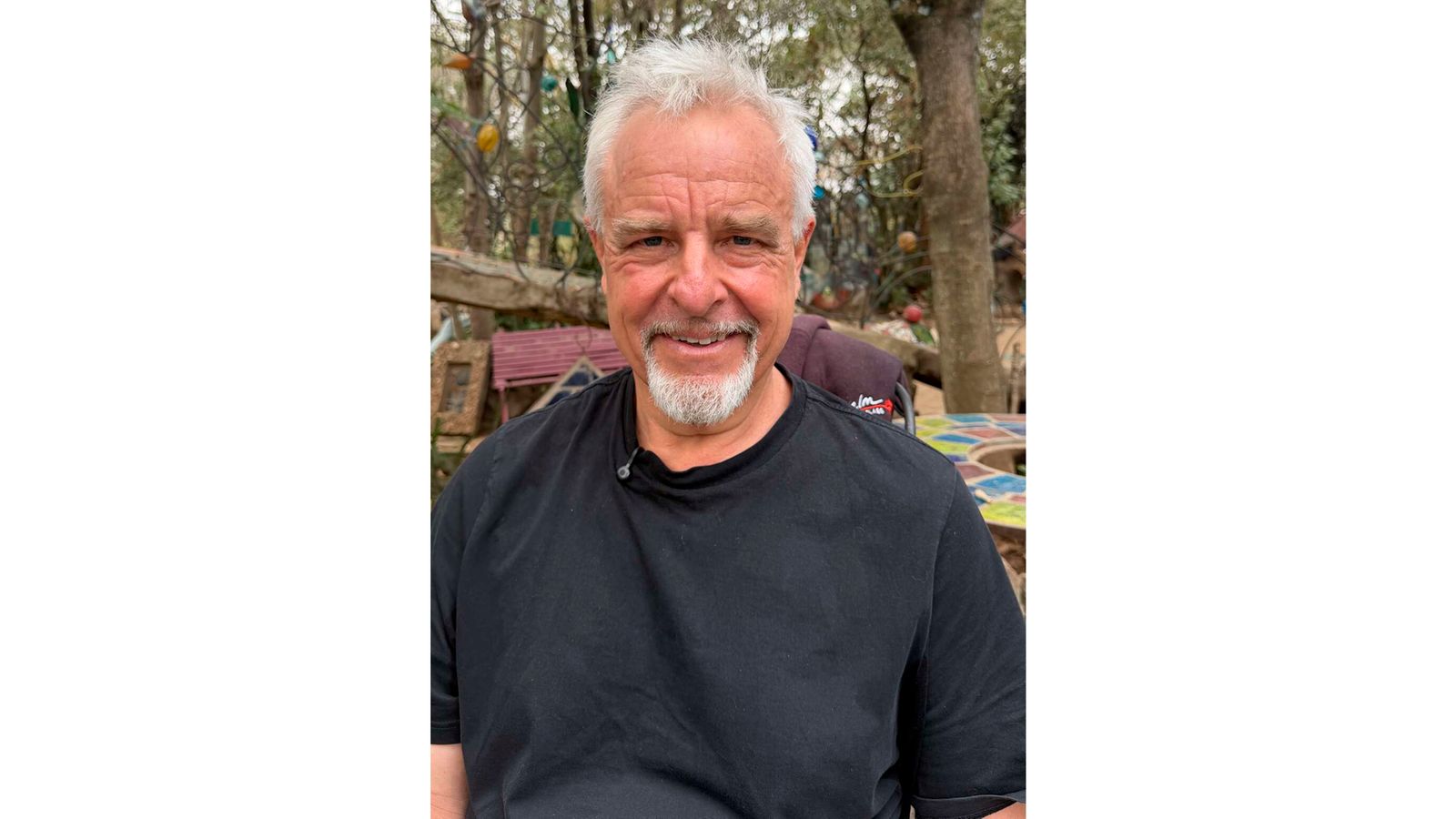
Anselm studied business, then learnt glassblowing in Holland. In 1992 he founded Kitengela Hot Glass, turning broken bottles into chandeliers and goblets. People pay more for handblown glass, he reckons, because of the tool marks. Somewhere in the glass, “you can read another human.”
His father lives on the edge of Karura Forest, fighting for it. His mother, now 83 and in a wheelchair, still holds court at Kitengela with her dogs. His sister makes jewellery, his brother is an architect. One son is a photographer, the other a mechanic with a savant’s feel for engines.”The artists are more mad,” Anselm grins. Croze. Crazy. Only two letters apart. And a whole world between.
Your childhood was very peculiar…
[Chuckle] It was. I had an affinity for birds, probably because of my mum. We always had geese and ducks around, and when you have that, you have the babies around. Maybe that’s what got me into birds, loving the little babies.
My dad was working at the UN at the time, and during some roof repair, a fundi found a nest of owls. My dad brought them home and, because I was the bird person, it was, “Here are five owls, look after them.” I loved those owls. I think some members of their family are probably still around here. We’ve got a lot of owls.
What fascinated you about birds?
I had a Thick-knee, for instance. I guess it was the character more than anything else. He was a lot of fun. I was doing my O-level project for classics, drawing a bunch of old Greek stuff, and he’d sit on my table, probably as bored as I was, and fall asleep. He’d fall over on his side, stretch one leg out and leave it there, then stretch the other, so he looked like a stuffed toy. He was very trusting and very personable.
Were there boundaries you weren’t supposed to cross as a child, seeing as you lived wild and free?
Your mum sounds fascinating, was she an artist?
Usually the artists are more mad. [Laughs] But there’s artistic heritage on both sides of my family, and that has informed a lot of my existence, my approach, and the way I look at things.
My mum’s dad was a famous German woodcut artist. He was also an anti-government activist, so he was rather persecuted by the Nazis. My granddad on my dad’s side was a notable photographer with multiple exhibitions.
My dad was an American scientist, basically. Also from the hippie era. He left the United States to dodge the draft and do his PhD at Oxford on animal behaviour. He started the elephant research project in Amboseli, which runs to this day. He’s lightly active in trying to protect Karura at the moment. They live on the edge of it, so it’s in their backyard.
Why do you think people like to buy handblown glass?
There’s a lovely little parable of the man who buys a drill bit. What’s he buying? Not a drill bit. He’s making a hole to put up a shelf for his wife’s cookbooks. So he’s actually buying his wife’s approval.
That made me think, why would you buy this glass, when you could go to Chandarana and spend a tenth of the money on a perfectly serviceable vessel? Because it makes you feel special. You can see it has tool marks, the marks of another human. There’s humanity embedded in it that we instinctively read. And colour. Humans are magpies. We like colourful, shiny things. If you’re stressed, blues and turquoises calm you. If you’re underpowered, fire colours energise you.
After the Covid-19 pandemic, a couple of clients came to me and said, “We’ve been dithering about this chandelier for five years. Now is the time, because who knows what’s happening tomorrow.” What really makes me happy? A shaft of light coming through a window, that puts a smile on my face. What’s the price of that?
You studied business. I’d have imagined you’d study art. Why business?
It was occupational therapy, more than anything else. It was the course available at USIU. I’d been at the University of Michigan and my plan to get in-state fees because I had an American grandmother living there, it didn’t work. They said I had to pay out-of-state fees. My dad said, “We can’t afford that. You’ve spent your money for the year.”
So I drove a taxicab for a while and messed around in the States, then came back needing something to keep my brain occupied. I was also helping my mum with the stained glass and managing her affairs here. I thought international business would give me some understanding of what was expected if we were to go international. I’m not sure how useful it was, but it kept me stable for a year or two.
When I was finishing my degree and doing the stained glass with my mum, I was sitting around having a glass of wine, looking at the green bottle and wondering why we couldn’t make it into a flat piece of green landscape for the window we were working on, rather than import extraordinarily expensive flat glass from Germany.
Then there was a chance to go to France for a week-long glassmaking course, and I jumped at it. When I was actually with the stuff, I realised this is something else. This is alchemy. It’s magic. This glowing mass of crystalline, light-catching incredibleness. I coveted it. Of course, at that stage you can’t do anything but make a lump. But even the lump was cool. It was an addiction, actually.
Is there anything else you’d like to be, apart from what you’re doing now?
[Pause] Thirty-five, 40 years later, it’s like, really, this is what happened? It wasn’t the plan. I had no idea what it was going to grow into, and perhaps that’s why it managed to grow into what it is. We meandered, and here we are, and who knows where we’re going to go.
We have a continent full of hungry youth looking for cultural meaning, personal meaning, existence meaning.
Glassblowing is a very strange craft. You need a lot of skill to make the most basic thing. Before you can start thinking about an artwork, you need years of training just making tumblers so you know how to manipulate the material. But it’s also incredibly meditative and focused. It’s dangerous, it’s hot, so you have to really concentrate on your piece.
I’d like to continue my current plan of showing how a little creativity and grit can produce products that are not just sellable for the sake of selling, but that you love to make because they’re fun and give you personal satisfaction. For youth across the continent looking for culture, identity and purpose, I think it’s a thing.
Have your children followed your path?
My two sons are 27 and 25. I was reluctant to burden them the way my mum, inadvertently or not, burdened me with her processes. I’ve considered carefully how not to attach this millstone to them. Let them do whatever it is they do, and if they come back wanting to do this or anything similar, well and good.
My eldest has definite artistic talent. Not because it’s innate, we all have it innate, but because he’s practised it. He’s an accomplished watercolourist and a very good photographer, in Australia at the moment. I believe these children have to get away from wherever they started, if they can, to get objectivity and realise the benefits of home, if they ever want to come home. And if they make a home somewhere else, well and good.
My youngest is a mechanic, like a savant when it comes to engines. He’s not bookish. That’s a whole other topic, education. To what end? To force you into a production line of productive, compliant members of society? Not that that’s not a good thing, but maybe, eyes open.
Wife of 25 years. She’s busy trying to extricate herself from the business, and trying to get me to retire, which I’m not sure is realistic. [Laughs] We’re looking at that together. She wants to grow plants. She loves trees. She’s a conservationist, so she’s busy preserving forests and mangroves and fighting that fight.
What really drives her up the wall about you?
She complains about my fashion sense, or lack of it, because I honestly could care less, but she cares. I have this theory that if it’s got a few holes in it but I can still wear it, then it’s fine. I get sartorial excellence and the whole fashionista culture and art thing, but personally it doesn’t bother me too much. It drives her crazy.
At 60, what are you most anxious about?
I feel I’m running out of time a bit. Every day I wake up, there are more things to do, fires to put out, routes to explore, pieces to make. I wish there were more hours in the day.
What are you most terrible at?
When I came here you said you were dealing with a lot from the authorities. What’s the nature of doing business in this environment?
That’s another part of impatience, isn’t it? A lot of what we’ve done here has been pioneering, not just in material but in product, style, artistic language and Kenyanness. And we’ve done it very open-heartedly.
To have a rapacious body, the government, the tax authorities, the council, whose only interest is extracting money out of you at whatever cost, even the thing you’ve built, I find tough. And it’s getting tougher. They are greedier.
It takes us out of the flow state we need for new ideas. It’s not just about making glass things. It’s about engendering a spark, the thought of, ooh, I can make something out of a rock or a piece of plastic. You can’t do that while dealing with the enemies at the gate, which our leaders should not be.
National Environment Management Authority (Nema) is another one. We are poster children for Nema. They use us as an example of how to recycle used oil, scrap glass, metal and paper. At the same time, they’ll double the fees for transporting that material, triple them for licences, come up with new licences. We spend millions a year just on licensing.
Does that affect the experience of creating art?
Absolutely. When we have to scramble accountants because there’s a KRA audit, a third one announced for tomorrow, with five people collating receipts, you spend a lot of time on yellow alert.
Yellow alert means you’re not in the flow state, which means you can’t create. That’s aside from the regular alerts of running an operation with 100 people. Those I accept. I actually enjoy that, because 100 people have roofs over their heads, children in school and meals on their tables because of it.
Is there a story behind your tattoo?
Yes. I’m a great believer in the balance of yin and yang, in understanding that there always have to be two sides to a thing, whatever the thing is, conceptual or actual.
Are you feeling balanced right now?
Right at this minute, yes, if teetering a little because of general global uncertainty. But that’s more of a news psyops problem.