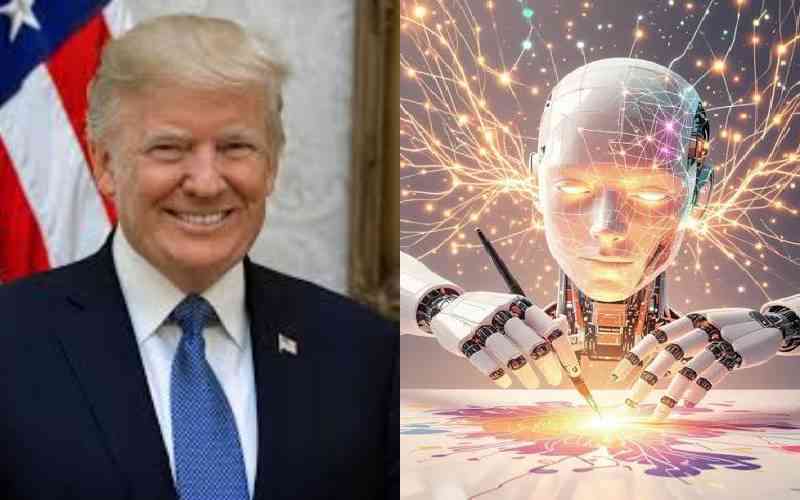
US President Donald Trump has said the US government will begin using the term “super intelligence” instead of artificial intelligence in official documents, BBC reports.
He made the announcement during his September 22 address to the UN General Assembly in New York, where he also rejected international efforts to regulate the technology.
“From this point forward, all of United States’ documents, and hopefully the world’s, will be changed to use the more accurate term ‘super’ as opposed to ‘artificial’. So it’s ‘super intelligence’,” Trump said.
Trump argued that the word “artificial” makes the technology sound fake or less important than it is. He said “super intelligence” was more accurate and better reflected the fast-growing abilities of modern AI systems. The president added that the new short form would be “SI” and said he hoped other countries would also adopt the wording.
The decision followed public polls conducted by Trump on X and Truth Social. “Super intelligence” reportedly beat other suggested names, including “superior intelligence,” “extreme intelligence,” and “supreme intelligence”.
Trump used the announcement to repeat his opposition to international controls on AI. According to The Washington Post, he described proposals for global supervision as a “globalist scheme” and said the United States would not support efforts that could slow its technological development.
Instead, he said America should allow the sector to grow quickly in order to remain ahead of rivals, especially China. Trump told world leaders that his administration would monitor the industry through the Justice Department if action was needed, rather than support new international regulatory bodies.
His remarks came as governments, researchers, and technology companies continue to debate how AI should be controlled. Many experts have called for stronger safeguards because of concerns about misinformation, job losses, privacy, cybercrime, and the possibility that highly advanced systems could become difficult to manage.
However, the new language may cause confusion within the technology industry. In AI research, “superintelligence” already has a specific meaning: a theoretical system that would be far more capable than humans in nearly every mental task, including science, communication, and problem-solving. Most AI systems used today, including chatbots, image generators, and workplace software, do not meet that standard. They can perform some tasks very well, but they are not generally considered smarter than people across all areas of thinking.
Technology experts say Trump’s change is mainly political and administrative, not scientific. It does not create a new type of technology, alter how existing systems work, or automatically change the rules that currently apply to AI companies. There was also no confirmed executive order or detailed government plan immediately setting out when federal agencies must replace the phrase “artificial intelligence” in all records, policies, and public communication.
The announcement is another high-profile naming move by the Trump administration. Whether “super intelligence” becomes widely accepted outside US government messaging remains uncertain, since researchers and technology companies are likely to continue using AI as the standard term.