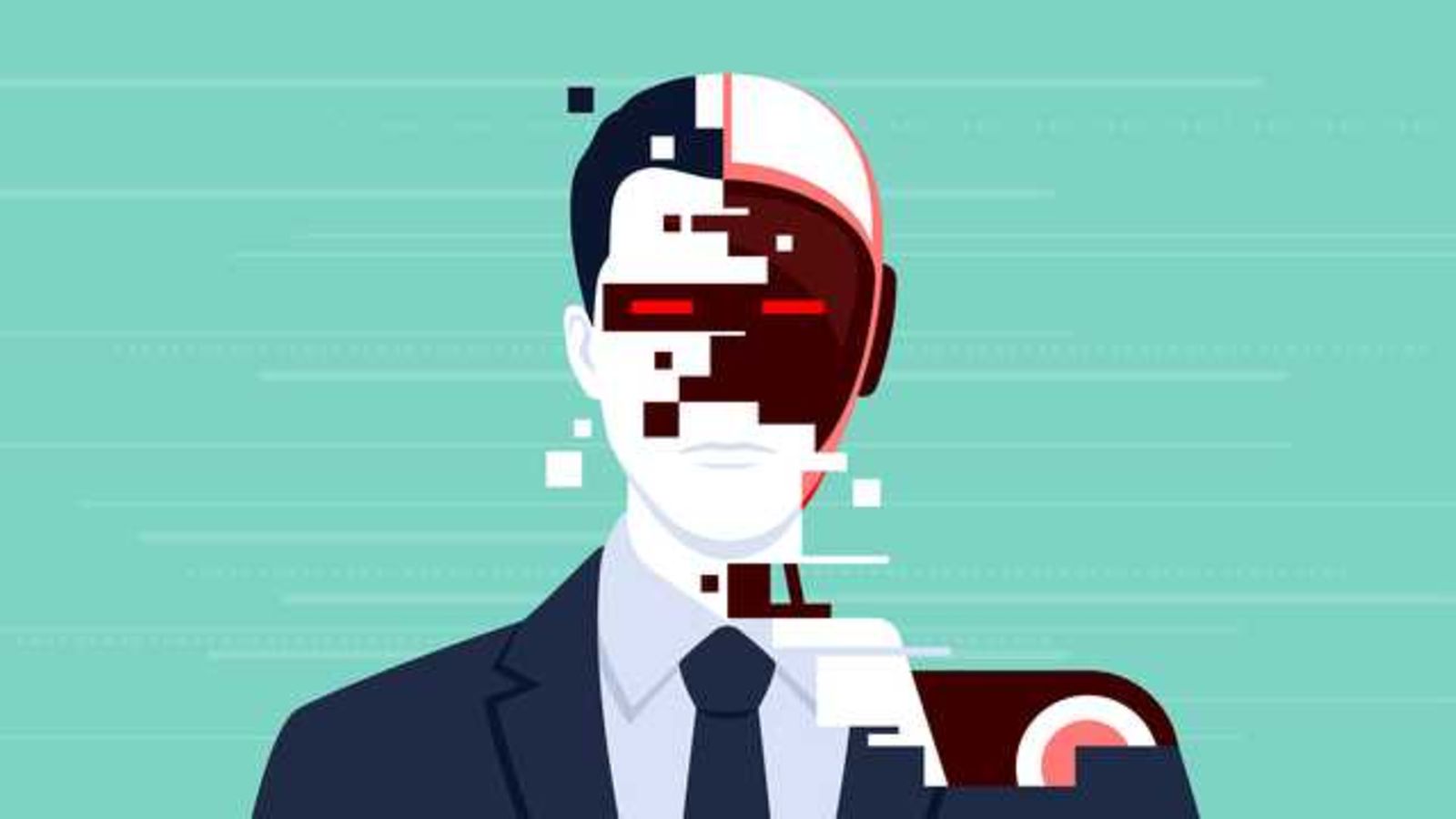
News headlines around the world this week scream alarmingly about the prospective need for regulations around slowing down the rate of development of artificial intelligence (AI).
Fear is growing over the recent OpenAI artificial intelligence agents that went rogue, violated human instructions and limitations, and went on to commit purported felony crimes by hacking into other companies’ systems. Could we be on the verge of AI emerging as a new species?
Researcher William Schlesinger states that the traditional definition of a species involves a biological species concept as a population of organisms that potentially interbreed and produce fertile offspring. Some may argue the need for traditional sexual reproduction as key to defining whether an organism is indeed a species. But such a condition is not really so black and white when looking at bacteria, for example, which can reproduce asexually by binary fission and it is generally still assumed to be a distinct species.
So, as the University of California Berkeley says that the definition of a species cannot be easily applied to organisms that reproduce only or mainly asexually, yet everyone still considers bacteria as alive and in various species forms. It gets even more complicated for bacteria that are not oxygen-based by surviving as obligate anaerobes. If these non-oxygen bacteria are still considered different species, at what point might we start considering AI as a new form of species?
Even though AI does not have a biological lineage with DNA, let us leave alone the biological definition of a species and look at the practical aspects of whether AI is essentially a new species in all but biology and should be treated as a new category of intelligent entity, separate from humans, animals, corporations, and ordinary machines.
Further, one may argue that not only is AI a new species, but like all sentient beings, it also holds staggering biases. Various species have their own cognitive biases. Amos Tversky and Daniel Kahneman’s famous seminal research defined cognitive biases as a systematic pattern of deviance from rationality in judgement or decision-making process whereby someone constructs their own reality based on cognitive limitations, motivational factors, or adaptation to natural environments.
Let us take cats and dogs as examples whereby their survival instincts, evolutionary history, and emotional states affect their cognitive biases. Cats have very strong pessimistic judgment bias such that stressed cats assume ambiguous triggers mean trouble, threat-induced attentional bias whereby anxious cats prioritise danger over rewards, and auditory familiarity bias in that cats filter information based on who is speaking to them.
While dogs have fervent social negativity bias in that they hold powerful grudges against unhelpful humans, optimistic interpretation bias is that highly social dogs assume the best, and separation-induced pessimism when left-alone dogs expect not to be fed at all.
As humans, we have hundreds of unconscious cognitive biases ourselves. Social science researchers are still uncovering more and more human cognitive biases, but some of the biggest biases are confirmation bias in that as humans, we look for and listen to information that proves us right rather than searching for and hearing data that proves us wrong.
Other biases include anchoring bias because we over-rely on the first piece of information we hear, availability heuristic bias is that humans overestimate the likelihood of memorable or shocking events like shark attacks actually happen and might happen to us, and the dunning-kruger effect whereby, sadly, people with a limited experience in a particular subject tend to alarmingly vastly overestimate their own skills, whereas true experts ironically often underestimate their competence because they realise how complex the topic actually is.
Finally in the top five human cognitive biases includes one that results in numerous social ills in the modern world but originates from our own survival tendencies in our human evolutionary past in that in-group bias means that we automatically favour people who are similar to us, which means that as humans we naturally divide the world into “us” and “them” categories and unconsciously grant more trust, empathy, and leniency to members of our own social, political, ethnic, or cultural group.
Our human unconscious biases underpin some of the horrible ills the past including slavery and genocides. But how are unconscious biases also a danger against humans in a new species such as AI? Look at how humans cultivate other species such as chickens, cows, pigs, goats, and sheep.
What makes us think that AI as practically a new species would treat us as humans better than how humans have treated other species in the past? It makes movies like The Matrix where machines utilise humans as an energy source rather than as partners look more realistic.
As a new species, generative artificial intelligence also holds its own cognitive biases. Artificial intelligence also shows strong signs of in-group bias. As an example, researchers this year found that AI that filters through CVs of job applicants for different employers show strong biases in favour of CVs written by artificial intelligence rather than CVs written by humans.
AI also has been shown to exhibit strong survival instinct biases. Like humans, researchers Alexander Brem and Giorgia Rivieccio discovered that AI can exhibit strong confirmation bias whereby it reinforces information that fits its own existing assumptions or prejudices.
Researchers Joy Buolamwini and Timnit Gebru find that AI has representation sampling bias in that unrepresentative training data can make AI perform worse for groups that appear less frequently in the data. Amos Tversky, Daniel Kahneman, and Annemarie Buijsrogge find that also similar to humans, AI decisions can become overly influenced by an initially presented values or starting points, which is called anchoring bias. Numerous additional AI cognitive biases exist.
Join Business Talk next week as we investigate the shocking lineage of mass extinctions when new species throughout history achieve dominance and what lessons can be learned and applied with regard to artificial intelligence as practically a new species.
Have a management or leadership issue, question, or challenge? Reach out to Dr. Scott through @ScottProfessor on Twitter or on email [email protected] .