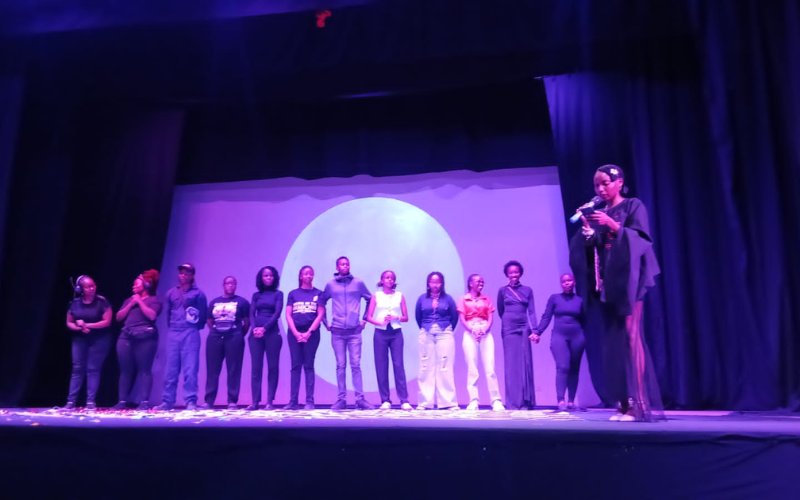
Eldest daughters who have grown up carrying responsibilities beyond their years will see themselves in Womb Opener, a play that is deeply personal and widely recognisable.
It is a one-woman biographical play based on the life of performer Njeri Wangari, who also performs the story on stage. Written by Helga Muinde, produced by Wangari Gitau and directed by Jante Juma, the play was staged at the Braeburn Theatre on Gitanga Road on September 5.
It explores the experiences of firstborn and parentified daughters through Njeri’s story, using an imagined game show to examine family expectations, motherhood, childhood and the burdens she carried as the eldest daughter.
Nje (Njeri Wangari) is a firstborn daughter who has spent much of her life caring for her family and carrying responsibilities that were never meant to be hers. Through an imagined game show, she revisits her childhood, her relationship with her mother and the expectations placed upon her as the eldest daughter.
“I did a narration of an entire story to Muinde. I had specific themes that I feel cut across all firstborn daughters. Since it is a one-woman show, she had the creative freedom to decide what form the play will be in,” she says.
This leads to Womb Opener Games, a fictional competition that is the vehicle through which Nje examines the experiences of her life.
The games exist in Nje’s mind. Among them are Genesis, Armery Selection and Blame Relay. They offer her a way to release, play and reflect on experiences she has not previously allowed herself to examine.
“As the play begins, she excuses negligence. When she starts playing the games, it becomes intense, and she takes the blame from herself and places it on those responsible,” she says.
The blame extends beyond her mother to the systems that shape the lives of firstborn daughters, including patriarchy, government, medical institutions and the school system.
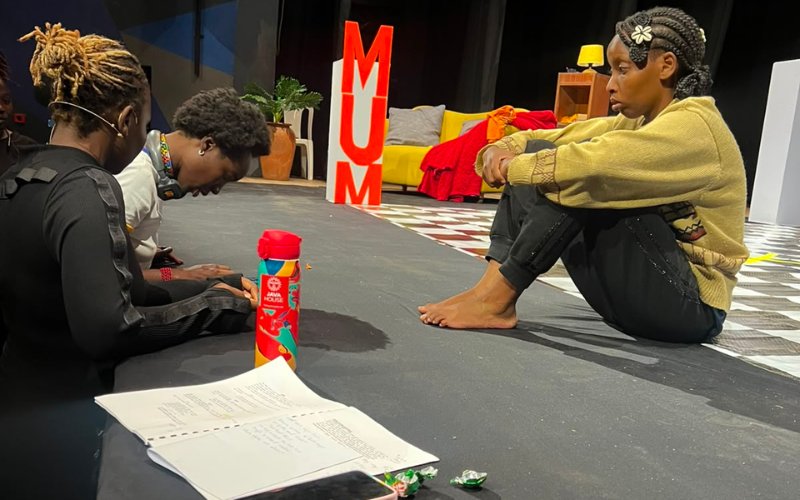
Muinde says that since it is a one-woman show, she had the creative freedom to decide what form the play would take. She decided to put it in a game-show format. It was a deliberate way of packaging painful material in a form that could allow audiences to engage with it without being overwhelmed by its heaviness.
“When Njeri approached me with her story, I thought about what concept would go with it. It was about how to package her pain and her experience. Some of it was very deep,” she says.
Muinde adds that she wanted to find a lighter way of telling the story. The format draws on familiar television competitions such as Tusker Project Fame and America’s Got Talent, but the challenges are drawn from Nje’s life.
In one challenge, Nje is asked to answer questions from her mother’s perspective. Another, Armery Selection, explores the experience of being over-disciplined by a mother.
Blame Relay is a game within the game, with several stations examining different sources of blame and responsibility.
Another challenge, Build a Childhood, presents Nje with an ideal childhood only for it to be taken away.
“The games were the fictional part, but the experiences and words were real-life stories,” Muinde says.
Performing the imagined challenges needed her to repeatedly return to her own memories. The emotional intensity during the technical run on the day of the performance was difficult.
“The play is based on my life as a firstborn daughter. It wasn’t easy because I had to relive the moment. It took me very deep into the ocean, and I had to stay intact for the performance that was to run on the same day,” she says.
Psychosocial support was provided by Masterpiece Kenya, with a therapist checking in with the team during the final days of rehearsals.
Wangari also found strength in the people around her. Some of them were firstborn daughters, and she had people around her who had an idea of what that means. Being very intentional and grounded helped. The games, she says, are not ultimately about winning.
“The games were an outlet to reflect. The way someone would use journaling, swimming or something else. The game was something for her to interact with reality and other depths she has not allowed herself to go deep.”
Putting her life on stage was simultaneously freeing, vulnerable and empowering. She says that now it is not just in her mind, but she has other people to share this with and acknowledge that it happened to them.
However, there was also discomfort in revealing intimate family experiences publicly. As a firstborn daughter, Nje has been conditioned to protect the image of her family, even when doing so means suppressing her own experiences.
“There was the bit of feeling that I was airing dirty laundry, that I had said too much about my family and my relationship with my mother. Your life is your own narrative. You write it how you want it to be,” Wangari says.
Nje is described as a “female womb opener”—the first child to enter a family and, with that position, the first to encounter many of its expectations.
“She is a woman who has been compliant with being a parentified child, and it is just dawning on her that she has been breaking bits and bits of herself so that she can keep her family and other people warm.”
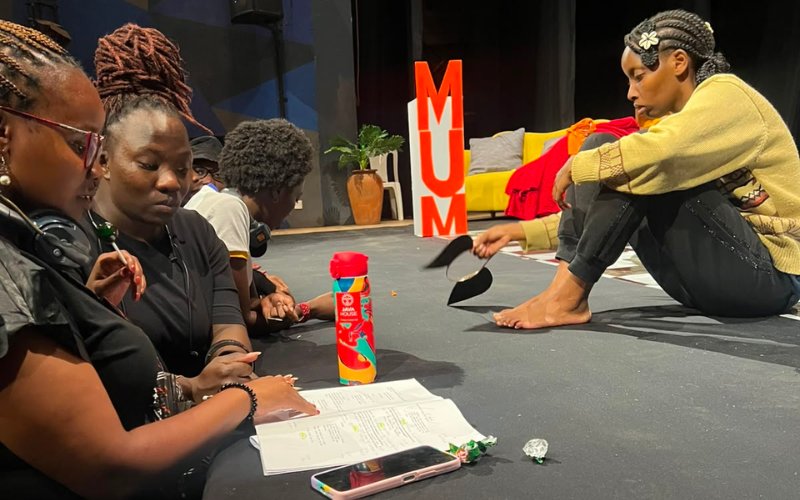
At the beginning of the play, Nje wants to release some steam. The game provides an outlet, a space where she can participate, play and escape reality. But as the story progresses, she realises she may have taken on more than she can bear.
She begins confronting what it means to speak publicly about her mother’s actions while simultaneously carrying the expectation that, as the eldest daughter, she must protect the family.
In Womb Opener, being a firstborn daughter is more than being the eldest child.
“It means the first fruit of the womb. It means the person who gets to carry responsibility and inherit expectations and doesn’t have people who came before her to carry the burden for her,” she says.
To be a womb opener, she explains, is to be the first person to encounter and absorb expectations without necessarily having anyone to shield you from them.
The play examines parentification such as the experience of being expected to assume adult responsibilities before one is developmentally ready.
“It is being expected to be more mature than you are. Being forced to be an adult before you are actually an adult,” Wangari says.
That parentification manifests in Nje caring for her siblings and assuming a maternal role within the family. Yet beneath the responsibilities is a child who still wants to be seen, have fun, escape her circumstances and remain hopeful.
When Nje begins challenging the expectations placed upon her, she is surprised by what follows. She starts recognising what she had allowed, what she had excused and what had been taken from her.
“She gets to notice how much her childhood was robbed from her. She thought she was there for fun and games, but it was a cost that has been too high,” she says.
Throughout the story, Wangari explains that Nje becomes like an onion, peeling back layers of herself and exposing the most painful parts of her life. She also confronts her own role in perpetuating the situation.
“As a firstborn daughter, you are wearing your heart on your sleeve. Why are you still taking burdens that don’t belong to you? You don’t have any business having carried such burdens in such magnitude,” she says.
Nje faces her compliance and asks what might have happened if she had refused to carry the burdens placed upon her. Playing Nje also changed Wangari’s understanding of firstborn daughters.
“One, we are not victims. Secondly, we have such a power that if we are able to harness the power properly, it can give more life and power to ourselves and the people around us,” she says.
The role also prompted her to examine the expectations she had inherited and how she had dealt with them.
“It gives me another eye to think about what I have inherited, how I have been handling what I have inherited and how much I have given of myself and how much I have starved myself,” she says.
Wangari hopes that it will encourage reflective conversations, relationship repair and courage, especially within families.
“You can say, ‘Even if she is my mother, she hurt me, and I would like a hug or a sorry,’ while also recognising what she was going through,” she says.
Producer Wangari Gitau says that Womb Opener was always intended to create visibility and validation for eldest daughters.
“It accomplished what I had to do. Four teenage mom organisations brought teen moms to watch the show. That was one of our goals. We wanted eldest daughters to be seen and represented and validated.”
The story is based on Wangari’s own experience of growing up as the daughter of a teenage mother in an informal settlement and helping care for six siblings.
Gitau describes the physical burden of carrying younger siblings and caring for them while their mother went to work.
“It is a story that Njeri wanted to protect because of her loved ones. It was very intrusive to her until the day of the show, when some of the memories would come up and she would get really emotional,” she says.
Healing firstborn daughters was therefore part of the production’s purpose. Gitau says that she does not believe anyone could have told the story better than Wangari herself.
Gitau had worked with Wangari on other productions but had never produced one of her projects. Being entrusted with such a personal story was both challenging and humbling. She says that she found her grounding and had a beautiful team, a capable team, many of whom were firstborn or parentified daughters.
“Most of my female friends are parentified or firstborn daughters. Even those who say they are third-born are like firstborn daughters in their homes. We telepathically speak to each other,” she says.
Producing a one-woman production came with its own difficulties, around marketing, sponsorship and finances. Some contracted partners did not meet expectations, while internal conflicts emerged as personalities differed. Finding sponsors was also challenging.
Financial limitations meant the team had to abandon some ambitions, including a professional photoshoot, billboard advertising and a media tour.
Gitau, however, drew heavily on her relationships within the theatre community. Friends offered support, and some collaborators did not charge market rates.
The set, lighting, sound and graphics were designed to reinforce the game-show concept and, at the same time, reveal Nje’s inner world. Graphics created by Jante Juma helped construct the fictional competition.
Supporting Wangari through the process was important by repeating affirmations. The production team held small workshops and repeatedly reminded Wangari of her central role.
“I have known so much more about her growing up in the past three months than I have in the past 15 years. Producing the play gave her a new understanding of Wangari’s life,” she says.
Gitau says that the play is about parenting because it is parents that raise and condition children. She argues that firstborn daughters are raised to become needed and be hyper-independent.
“That conditioning can extend into adulthood, shaping friendships, romantic relationships and how women understand their responsibilities towards others. The standard is not the same for male and female eldest children,” she says.