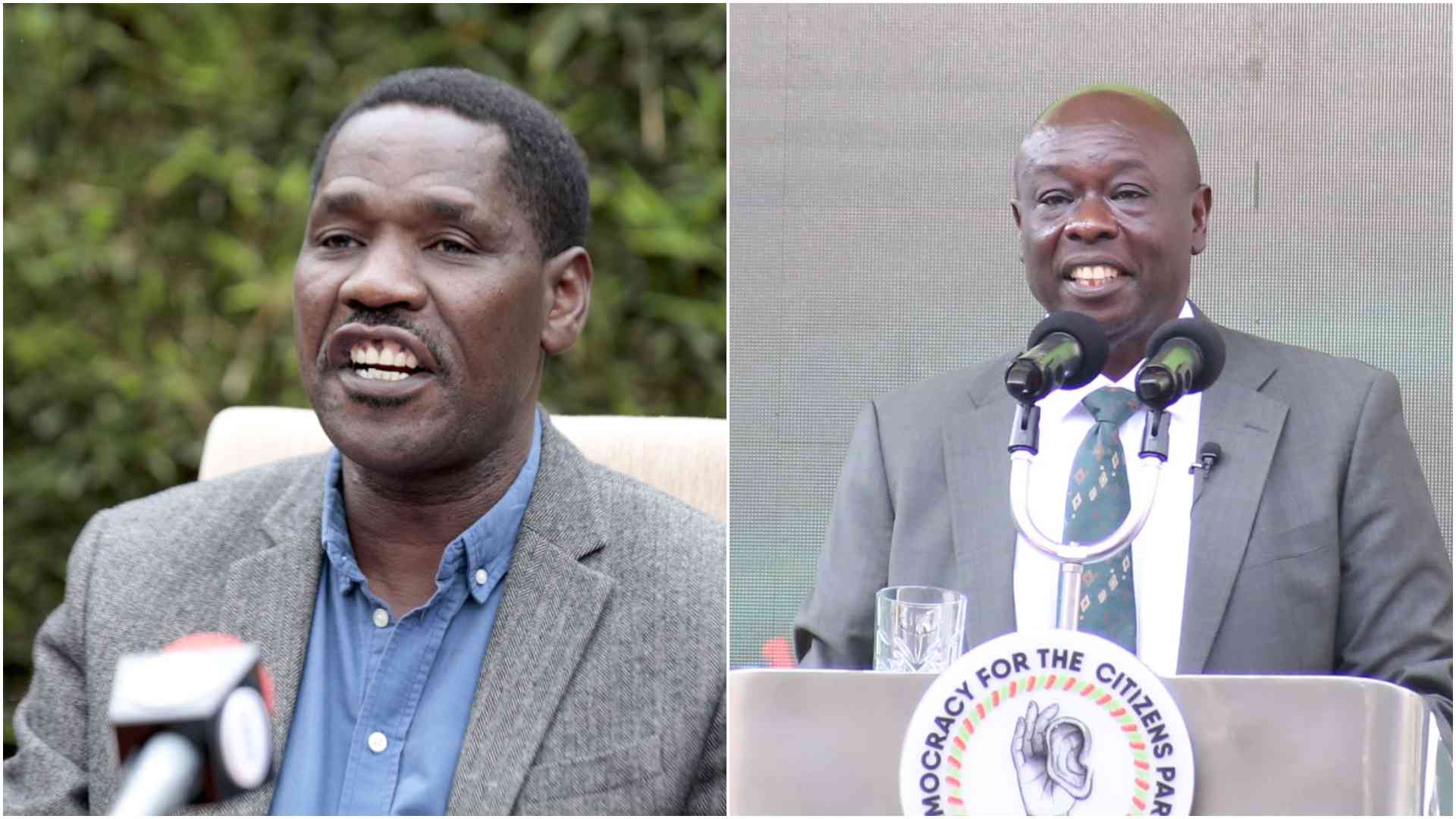
You have accused Democratic Congress Party (DCP) leader Rigathi Gachagua of using demeaning and condescending language against other opposition leaders. What exactly is your concern?
Our concern is that we all want to build a united opposition that can compete effectively in the 2027 General Election. Gachagua has done a lot in promoting opposition politics and exposing the failures of the current government, and I respect him for that. But there are serious weaknesses in the way he deals with other leaders. When you tell people they have no votes, that they should go and find people before coming to the table, or describe them as walking around like ants or sticks, that is demeaning. It does not create an environment in which opposition leaders can sit together and agree on how to move forward. I am asking him, respectfully, to tone down his language, stop the name-calling and embrace a more structured and inclusive approach.
You have described him as a bully. Is that not too strong?
I said he is a bully because of the manner in which he addresses other leaders. This is not something I say out of personal hatred. I have no personal problem with Gachagua. When he was Deputy President, I never quarreled with him. In fact, I was a good friend of his late brother. I visited his brother in hospital in the UK and represented governors during his funeral. So there is nothing personal here. We are talking about his conduct in politics and how it affects the wider opposition.
Have you tried to address these concerns privately with him?
Sometimes you speak to somebody privately and realise nothing is changing. At some point, you have to express your concerns publicly, particularly when the statements being made affect your party and other opposition parties. We consulted among ourselves and decided that we needed to tell him that we cannot build a united opposition through insults and threats.
But he is adamant that political parties should come to the table with people and political strength. Do you agree?
Politics is about winning and losing. You can win today and lose tomorrow. You cannot use one electoral victory to demean everybody else. He has won elections and we have congratulated him. DCP won in Ol Kalou, and we acknowledged that as an achievement for the opposition. But that does not give anybody the right to say other leaders are politically worthless. Let the people decide during elections who has supporters and who does not.
You have defended Party of Nation Unity’s existence quite strongly. Why are you opposed to the dissolution of smaller parties?
Kenya is a multiparty democracy. People have a constitutional right to associate, participate in elections and belong to parties of their choice. PNU has historically defended that principle. There was a time when parties were being merged to support President Uhuru Kenyatta’s re-election. We refused to dissolve PNU and even went to court to protect the party. We believe Kenya needs a multiplicity of political parties so that ideas can compete. If you create a monolithic political system where everybody is expected to belong to one party, you risk taking the country back to the days when KANU dominated everything. There is nothing wrong with a big party, and there is nothing wrong with a small party. What matters is the right of Kenyans to participate.
But isn’t there a danger that too many parties could fragment the opposition vote?
That is why we are talking about a structured coalition. We can have different parties but agree on one presidential candidate. Nobody is saying that parties should not compete. They can compete for governors, MPs and MCAs. But for the presidency, we need a transparent and agreed mechanism for selecting one candidate. The problem is when one person assumes that everybody else must dissolve and join his party.
Gachagua has indicated that opposition parties are welcome to work with DCP. Why are you uncomfortable with this proposal?
Because the language matters. You cannot invite people to a negotiation table while telling them that their parties are worthless or that they have no people. You need to create an atmosphere of trust. If we want to defeat the current government, we must treat one another with respect and recognise that every vote matters.
Do you believe the opposition can unite within the remaining 12 months?
Absolutely. Twelve months is a long time in politics. The differences are not insurmountable. We have already started discussions. The Azimio coalition has been reorganising and reaching out to other parties. What we need is an inclusive structure where all opposition forces feel comfortable. We need neutral venues where people can sit down and discuss the future of the country. We cannot have national political decisions being made in somebody’s private home. The process must be structured and transparent.
You are on record warning that the Opposition could repeat the mistakes of 2002 or 2022. What do you mean?
The danger of division is always there. Governments will always try to divide opponents. Remember the 1992 experience when the opposition was divided between different leaders. That division helped the incumbent government. We must not allow history to repeat itself. In the last election, Azimio lost by about 200,000 votes. That is not an enormous margin. You can lose an election by 50,000, 20,000 or even by a smaller margin. Some of the people being dismissed as politically insignificant could have delivered those votes. That is why we are telling everybody: respect all leaders and all communities.
What about the argument that Mount Kenya itself is divided between East and West?
I don’t think the Mountain is fundamentally divided in terms of how it will vote for the presidency. The people of Mount Kenya have historically tended to vote together when it comes to the presidency. The real issue is that the people of the mountain do not like being dominated or dictated to. They value their freedom. We have seen attempts during the Kibaki and Uhuru eras to consolidate the region under one political party, but those attempts never fully succeeded. The people want the freedom to choose their political parties and leaders.
But CS Geoffrey Ruku thinks it is high time for the Mt Kenya political cousins to part ways. Do you think his push for a split is genuine?
I see it as a political narrative designed to take advantage of perceived grievances. The economic problems facing Kenyans are national. People are suffering. Businesses are closing, incomes are falling, healthcare and education are facing serious challenges. People are increasingly thinking nationally rather than simply through the lens of their region. So the issue is not whether Mount Kenya East or West is being favoured. The issue is whether the government has delivered.
What is your assessment of Deputy President Kithure Kindiki’s impact on Mount Kenya politics?
I have nothing personal against Kindiki. But the people of Mount Kenya have not felt a significant impact from having one of their own in the senior leadership of government. Take insecurity in Meru. People have been killed, livestock stolen, homes lost and women attacked. These problems have persisted.
You have recently been admitted to the Azimio Coalition Council. What does that mean to you and PNU?
The Governing Council is the top decision-making body of the coalition. PNU was previously part of the coalition, but I was not represented in the council because I was a Cabinet Secretary at the time and had resigned from party leadership. I have now returned and been admitted to the council. We believe we should strengthen an existing coalition rather than create multiple new outfits. The coalition can be rebranded, its structure can be changed and other parties can join. The objective is to create a formidable national movement capable of competing with the government in 2027.
Will you run for Governor of Meru again?
Yes, I am running as the PNU candidate. I am not asking to be the candidate of the entire opposition. Other parties can field their own candidates. Let us compete fairly and let the people decide. I have been in Meru consistently where I have been meeting people and mobilising support. Nobody should imagine that I am sitting somewhere waiting for other politicians to build my support. I believe I can win the governorship.