There are places in Ontario that can make you feel as though you have travelled much farther than you actually have. The Cheltenham Badlands, in Caledon, is one of them. Less than an hour from Toronto by car, this striking landscape of rolling red hills, exposed rock and deep gullies feels remarkably different from the city, making it an easy destination for a day trip when you want to get out of Toronto without spending the entire day in the car.
The drive from Toronto to the Cheltenham Badlands is roughly 60 kilometres and can take about an hour, depending on where you are starting and traffic conditions.1 For this trip, I borrowed the new 2026 Mazda CX-5 from the Mazda Canada press fleet and headed west from Toronto toward Caledon. The CX-5 made a comfortable companion for the drive, particularly on the quieter roads approaching the Badlands, and the redesigned model has a more spacious cabin and cargo area than the outgoing version, along with new technology including Google built-in.2
A landscape shaped millions of years ago
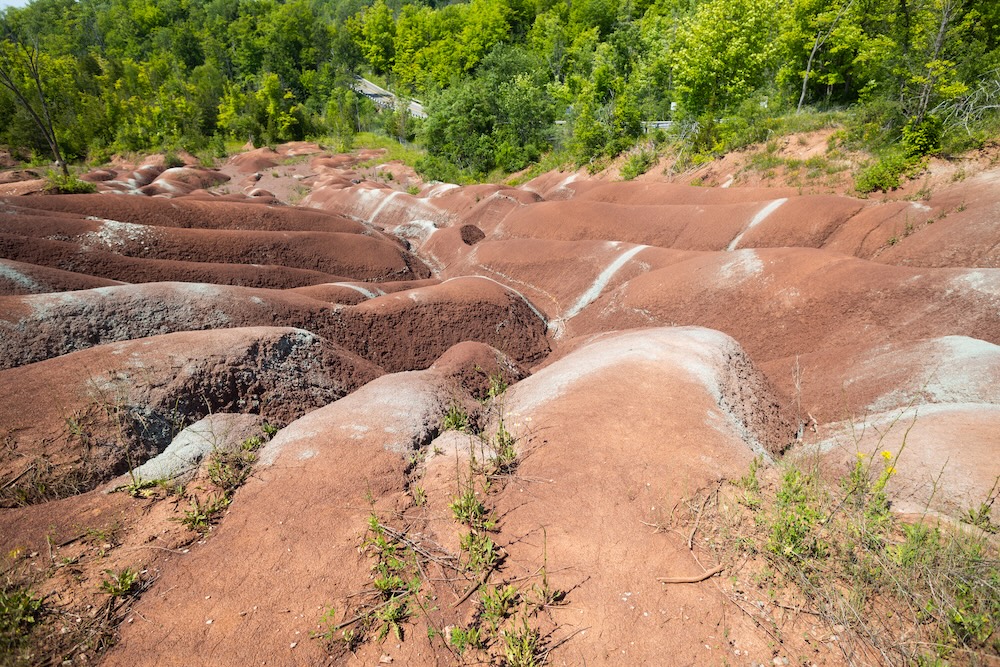
The first thing that stands out when you arrive at the Cheltenham Badlands is the colour. The exposed landscape has a distinctive reddish-brown appearance, with waves of shale forming ridges and gullies across the hillside.
Although it looks almost otherworldly, the story of the Badlands begins much closer to home and much farther back in time. The underlying Queenston Shale was deposited at the bottom of an ancient sea roughly 450 million years ago. The landscape visitors see today was created much more recently, after vegetation was cleared for farming and livestock grazing, exposing the shale to erosion from rain, snowmelt and freeze-thaw cycles.3
The result is one of Ontario’s most distinctive examples of badland topography. About 20 per cent of the 36-hectare property is made up of the exposed badlands, while the rest includes forests, wetlands and regenerating woodland.3
Why you cannot walk on the Badlands
If you remember visiting the Cheltenham Badlands years ago, the experience today is somewhat different. Visitors are no longer allowed to walk across the exposed shale itself.
That is not simply a matter of keeping people behind a fence. The shale is extremely vulnerable to erosion, and increasing numbers of visitors were contributing to the deterioration of the landscape. The site was closed to the public in 2015 in part because of accelerated erosion before reopening with conservation measures in 2018.3
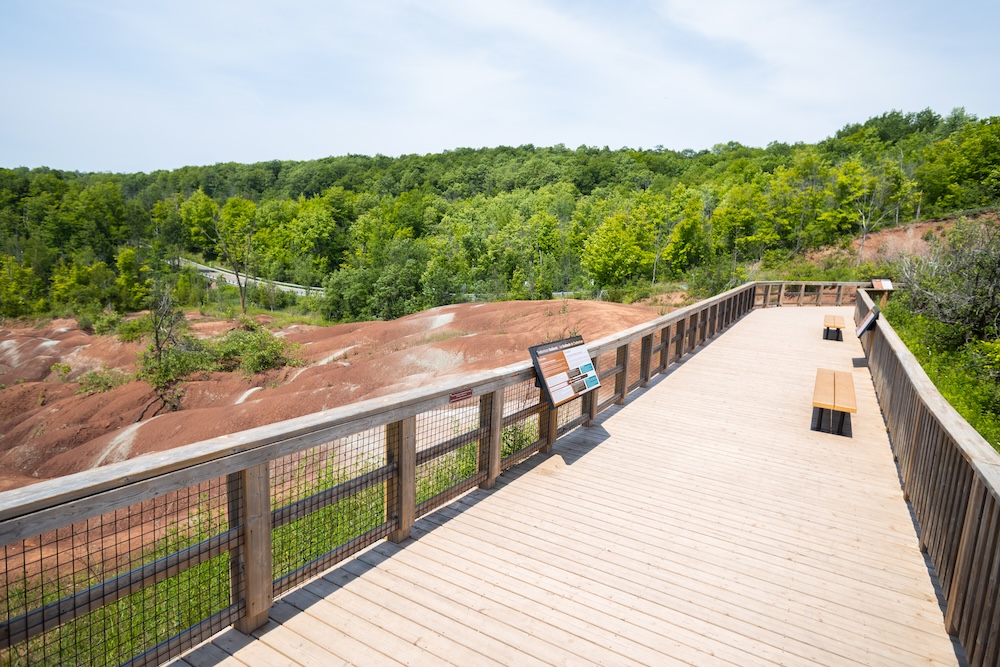
Today, a viewing platform provides a way to get close to the landscape without walking on it. The Ontario Heritage Trust, which owns and operates the property, asks visitors to remain on designated trails, boardwalks and sidewalks. Walking directly on the Badlands is prohibited.3
In some ways, the restrictions make the visit more interesting. Instead of simply wandering over the shale, you can take time to look at the shapes, colours and patterns created by millions of years of geological history and the more recent effects of erosion.
Walking the trails
The Badlands are more than a viewpoint. There are trails on the property, including the short Badlands Trail, which connects the Bruce Trail with the viewing area. The Ontario Heritage Trust describes the Badlands Trail as approximately 320 metres long and notes that it passes through forest before reaching the viewing platform.3
The Bruce Trail also crosses the property, providing an opportunity to turn a quick sightseeing stop into a longer walk. The section through the property is approximately 1.33 kilometres, passing through woodland and across a tributary of the Credit River.3
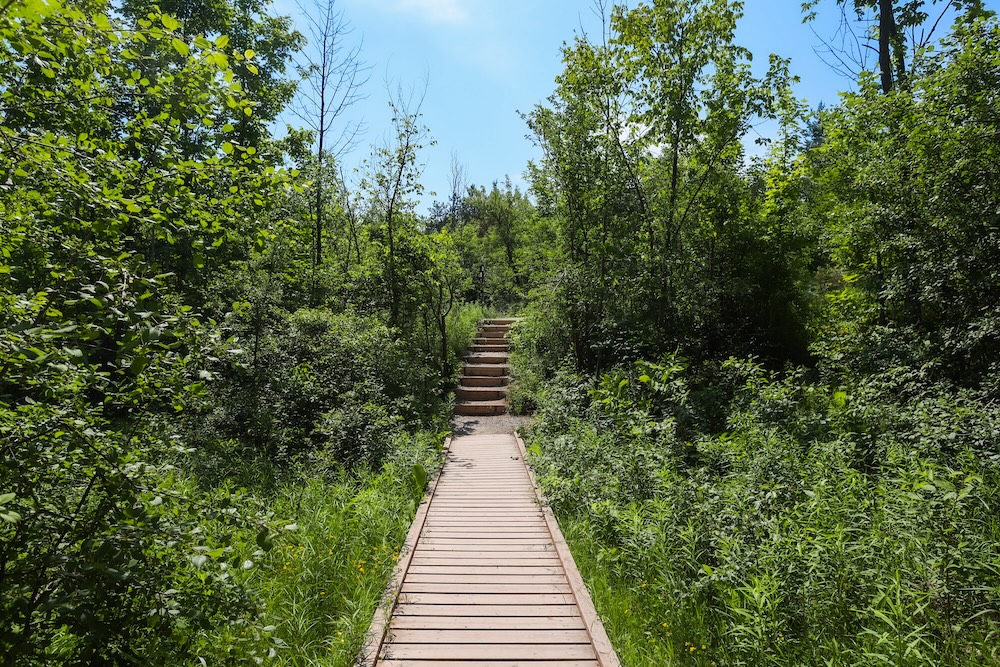
If you are visiting primarily to see the Badlands, you do not need to be an experienced hiker. The short trail and viewing platform make this an accessible stop for a day trip, while the Bruce Trail gives hikers the option of extending their walk.
Planning your visit
The Cheltenham Badlands are located at 1739 Olde Base Line Road in Caledon. If you are driving from Toronto, the car is by far the simplest way to get there. The site has a dedicated parking area, but you should not simply arrive and expect to find a spot.
Reservations are required in advance through the Ontario Heritage Trust’s ParkPass system. Current visits are generally booked in 90-minute periods, with a limited number of three-hour reservations also available.3
At the time of writing, the current fees are $10 plus HST per vehicle for a 90-minute weekday visit and $20 plus HST on weekends and holidays. Three-hour visits are $18 plus HST on weekdays and $35 plus HST on weekends and holidays.3
The Trust currently lists the property as open from dawn to dusk during its seasonal operating period, with access by reservation only. Because hours and reservation availability can change, it is worth checking the Ontario Heritage Trust website before leaving Toronto.3
There are portable washrooms on site, and the property has partial wheelchair accessibility. The viewing platform is designed to provide protected access to the Badlands, while the forest trail can be muddy because of the area’s clay soil.3
Bring your camera
The Cheltenham Badlands are one of those places where it is difficult not to take photographs. The contrast between the red shale, green vegetation and changing Ontario skies gives the landscape a different appearance depending on the season and weather.
The elevated viewing platform is particularly useful for photography because it lets you see the ridges and gullies from above rather than simply looking at them from ground level. Photography is permitted at the site, although visitors should remember that drones are not permitted and the Badlands themselves are off limits.3
A little more than just a geological attraction
There is also a human history to the property. Ancestors of the Mississaugas of the Credit came to the area to hunt, fish and forage, establishing small temporary villages on the river flats and practising horticulture. European settlement later brought homesteads and agriculture to the property, with crops including winter wheat, oats, potatoes and peas grown here between roughly 1850 and 1950.3
Some reminders of that agricultural history remain on the property, including evidence of an apple orchard and the stone foundation of one of the original buildings.3
The site is now recognized as a provincially significant Earth Science Area of Natural and Scientific Interest. It is also considered environmentally significant because of its groundwater discharge and the cold-water stream that runs at the foot of the exposed Badlands.3
Making it a full Caledon day trip
One of the best things about visiting the Cheltenham Badlands is that you do not have to make it the only stop of the day. Caledon is made up of a collection of small communities, countryside and natural attractions that lend themselves well to a slower road trip.
The Town of Caledon suggests combining Cheltenham with stops in nearby Inglewood and Caledon East. Inglewood is a good place to slow down after visiting the Badlands, with cafés, a heritage walking tour and the Inglewood Antique Market among the options for visitors.4
You can also build a longer outdoor-focused day around the area by exploring sections of the Bruce Trail or visiting other natural attractions in Caledon. The region’s combination of rolling countryside, small villages and trails makes the drive itself part of the experience rather than simply a way to reach the destination.
The drive in the 2026 Mazda CX-5
For this particular day trip, I was behind the wheel of the all-new 2026 Mazda CX-5, which I borrowed from Mazda Canada’s press fleet. The third-generation CX-5 has been redesigned with a focus on a quieter, more refined cabin, additional rear-seat and cargo space and updated technology.2
For a drive like this, the CX-5’s size felt well suited to the job. It is large enough to comfortably carry passengers and whatever you pick up along the way, without feeling oversized on the smaller roads around Caledon. The updated interior also puts more emphasis on technology, with a large centre display and Google built-in features designed to make navigation and other functions easier to access while driving.2

Mazda has also equipped the 2026 CX-5 with a broad range of standard driver-assistance and safety features, including Mazda Radar Cruise Control, Traffic Sign Recognition, Blind Spot Monitoring, Rear Cross Traffic Alert and various braking and lane-keeping technologies.2 On a day trip where the destination is as much about the journey as the attraction itself, those features add to the overall sense of comfort.
A worthwhile escape from Toronto
The Cheltenham Badlands are not a destination that requires a weekend away or an elaborate itinerary. That is part of their appeal. From Toronto, you can leave in the morning, spend time exploring one of the province’s most unusual landscapes, continue into Caledon for lunch or coffee and still be home in time for dinner.
More importantly, the Badlands offer something that feels surprisingly rare so close to the city: a chance to stand in front of a landscape that looks completely different from the Ontario you may be used to seeing.
It is worth remembering that the Badlands are a fragile geological feature rather than a playground. Staying on the boardwalks and designated trails helps preserve the landscape that brought you there in the first place. With a little planning and a reservation before you leave Toronto, the Cheltenham Badlands make for an easy, scenic and genuinely memorable Ontario day trip.
Sources
- Travel distance and estimated driving time from Toronto to the Cheltenham Badlands: Rome2Rio.
- 2026 Mazda CX-5 technology, design, interior space, safety and product information: Mazda Canada News.
- Cheltenham Badlands geological history, Indigenous and agricultural history, conservation, reservations, fees, trails, accessibility and visitor guidelines: Ontario Heritage Trust.
- Caledon day-trip ideas including Cheltenham, Inglewood and Caledon East: Visit Caledon.
- Information on the Cheltenham Badlands, Queenston Shale, Bruce Trail and site stewardship: Caledon Hills Bruce Trail Club.
- Cheltenham Badlands Trail information and trail details: Ontario Trails Council.
- Additional visitor information and transportation details: Destination Ontario.