Audio By Vocalize
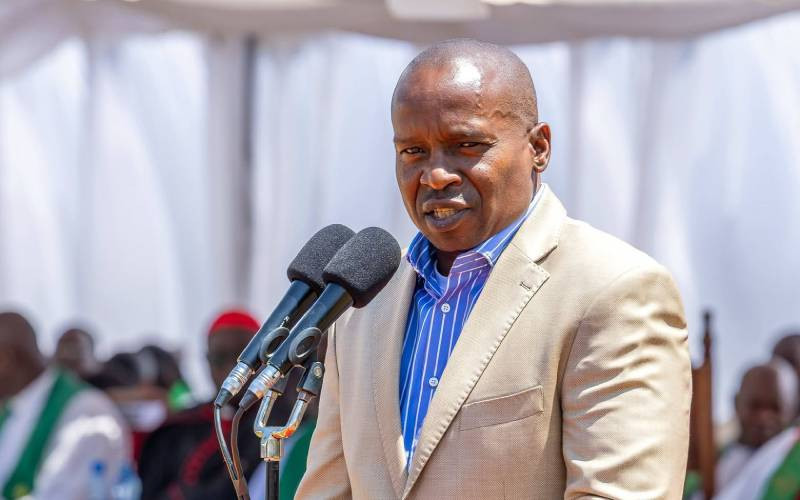
Deputy President Kithure Kindiki has defended the Kenya Kwanza administration, dismissing attempts to fracture the Mt Kenya region politically.
Speaking during the 36th anniversary thanksgiving service of the Anglican Church of Kenya (ACK) Diocese of Embu at Kigari Teachers Training College on Sunday, Kindiki appealed for unity, humility and peaceful politics, while reaffirming the government’s commitment to working closely with the church.
In what appeared to be a direct response to opposition efforts, Kindiki assured residents that there was no crisis within the government or the region.
“There are people speaking as though the world is coming to an end. There is no problem. We are here, and we are not going anywhere,” he said.
His remarks came amid heightened political activity in the Mt Kenya region, where opposition leaders have intensified campaigns aimed at consolidating the vote-rich bloc ahead of the 2027 General Election.
The DP’s address also followed the United Democratic Alliance’s (UDA) defeat in the Ol Kalou parliamentary by-election, a result that has fuelled speculation over Kenya Kwanza’s political standing in Central Kenya and sparked debate about Kindiki’s future as President Ruto’s running mate.
He also sought to reassure the Mt Kenya community that he would resist attempts to sow division, saying unity remained his priority.
“I come from this region, and I do not want our communities to be divided. We are one people. Those who think they will bring confusion to Mt. Kenya by making people speak in different voices and dividing them should relax.”
Known in recent months for his robust defence of the Kenya Kwanza administration—earning him the nickname “fireman”—Kindiki adopted a noticeably more measured tone, urging leaders to embrace humility and avoid political arrogance.
“There are people we see speaking with pride that starts here and stretches all the way to the Indian Ocean. This world belongs to no one; the owner is Almighty God. Relax.”
Drawing from Kenya’s political history, Kindiki recalled the 2013 General Election, when then-presidential candidates Uhuru Kenyatta and William Ruto won despite facing cases before the International Criminal Court (ICC) in The Hague.
“Many people told us, ‘You are finished.’ But God surprised everybody. Those who were beating their chests were humbled, and Kenyans elected them.”
The Deputy President maintained that the government’s fate in 2027 would ultimately depend on its delivery to wananchi rather than political exchanges.
“What will save the President, the Deputy President, governors, Members of Parliament and all leaders is the work they have done for the people, not the noise being made.”
Kindiki also underscored the government’s willingness to receive guidance from religious leaders, saying churches remained critical partners in national development.
Stay informed. Subscribe to our newsletter
“Whatever you want us to improve or correct in leadership, we will do so. We will listen because we are human beings, and government is a human institution that can always be improved through your guidance and input.”
He hailed the church’s longstanding contributions in education, healthcare, water projects and youth empowerment, noting that the government shared the same vision of improving citizens’ livelihoods alongside their spiritual wellbeing.
The Deputy President called for national cohesion in the country despite political stands.
“Kenya is our homeland, and we must protect it, love it and live together in peace. We are one community and one country, and we have no other home to go to.”
Kindiki and insisting that President William Ruto’s government will seek re-election in 2027 based on its development record rather than political rhetoric.