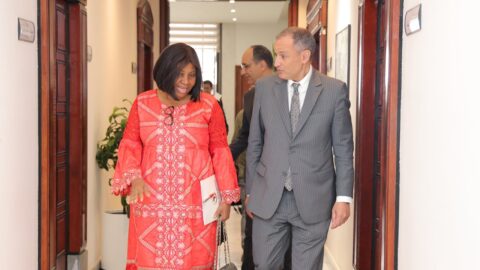
National Treasury Cabinet Secretary John Mbadi faces a new dilemma in funding the Sh4.8 trillion 2026/27 budget in the wake of a shaky revenue base because of the negative impact of the US-Israel war with Iran, which has triggered tax concessions amid higher spending needs.
The National Treasury has been forced to halve value-added tax (VAT) on fuel and could potentially make pay-as-you-earn (PAYE) rate reductions to cushion workers even as it is faced with pressure to mobilise more resources for projects.
A year ago, Mbadi was forced to settle for less aggressive tax proposals in the backdrop of youth led/Gen Z protests in June 2024, where measures proposed to mobilise only an extra Sh30 in the 2025/26 fiscal year at the Treasury sought to avoid repeat violence.
This was after his predecessor Prof Njuguna Ndungu, and President William Ruto were forced to discard the Finance Bill, 2024, which had sought to raise an additional Sh346 billion. This marked the first-ever withdrawal of the annual tax proposals.
The current Finance Bill 2026 has proposed mobilising up to Sh120 billion from new tax measures, but the bulk of the proposals are restricted to the expansion of the tax base and sealing revenue loopholes, especially by firms.
While the hangover of the deadly street protests persists, Mr Mbadi’s second budget statement on Thursday afternoon comes amid intense public pressure to announce measures alleviating the high cost of living associated with the new Middle East war.
To actualise major State projects like roads and infrastructure, Mbadi is instead betting on off-budget financing measures such as public-private partnerships (PPPs) and securitisation of State levies.
Proceeds from the Sh106.3 billion sale of the government’s stake in the Kenya Pipeline Company (KPC) are, for instance, to be placed in the National Infrastructure Fund (NIF) to catalyse private financing.
The State Department of Housing and Urban Development is meanwhile moving to securitise receivables, including the Affordable Housing Levy, in an expected ramp-up of affordable home projects.
The exchequer has already tabulated a revenue loss of Sh12.9 billion in three months to the middle of June after halving the rate of VAT on fuel to mitigate the surge in price of the commodity from the US-Israel war on Iran.
On April 15, 2026, the Treasury announced emergency measures to cut VAT on fuel from 16 percent to eight percent for the next three months in response to public outcry that followed the sharp rise in pump prices a day prior.
Kenya collects about Sh328 billion annually from VAT, where fuel accounts for nearly one-third of the collections at Sh100 billion.
This makes the revenue forgone from the halving of fuel VAT significant.
The Treasury is also under pressure to make good on its promise to slash payroll taxes for low-income earners as Kenyans face reduced disposable incomes due to higher inflation.
Kenya’s inflation rate rose to a 28-month high of 6.7 percent in May 2026 from 5.6 percent in April as higher fuel costs pushed up the cost of transport, food, housing and heating/lighting.
PAYE cuts had been previously proposed as part of the Medium-Term Revenue Strategy (MTRS), but there is now pressure to deliver the payroll reliefs immediately as tougher times dawn.
Mr Mbadi recently appeared to have given in to the demands for lower PAYE rates for low-income earners, including raising the threshold of tax-free earnings from Sh24,000 to Sh30,000.
“I have spoken to this (PAYE) matter before and said that there are going to be implications because it’s going to leave us with a budget hole. A report has been presented to me, and we must now make that decision which is for me upwards (and those above me to make),” Mbadi said last month.
The indicated PAYE review would cover low-income earners with gross salaries of up to Sh50,000 per month who currently attract a top tax rate of 30 percent.
The Treasury has projected a Sh35 billion annual revenue hole from the proposed payroll tax cuts, further widening the budget deficit, which is already plagued by persistent revenue underperformance.
Mbadi commissioned a technical working committee to assess the impact of PAYE adjustments and propose offsetting measures as the exchequer looked to avoid revenue losses from the major tax head.
Payroll taxes make up the largest share of Kenya’s ordinary revenue, with collections reaching Sh560.5 billion in the financial year ended June 30, 2025.
“Our assessment is that we are going to collect less by Sh35 billion. If that is the case, where do we get revenue to compensate for this? What do we do? Do we cut expenditures to compensate?” Mbadi paused.
“The National Treasury remains committed to maintaining a balanced fiscal framework that supports revenue mobilisation, economic growth, investment, innovation and long-term economic sustainability while taking into account prevailing economic conditions and public concerns.”
President Ruto appeared to support the PAYE tax cuts by underplaying the impact of the budget hole expected from the reduced payroll tax rate on low-income earners.
“Some people in the National Treasury came back and said that it is going to be costly for us in the budget, but I told them, ‘Let’s do it!’”, President Ruto said last month.
The Treasury expects ordinary revenue or taxes and non-tax revenues such as fines and penalties to rise from Sh2.784 trillion in the fiscal cycle ending June 30, 2026, to Sh2.985 trillion in the year to June 2027, helping it finance the bulk of the Sh4.8 trillion 2026/27 budget.
This will leave behind a budget deficit of Sh1.1 trillion after the inclusion of Sh43.6 billion from grants and other items.
Up to 90 percent of the deficit, or Sh995.7 billion of the hole, will be plugged by net domestic borrowing, with only a paltry Sh116.2 billion representing the next external financing.
The budget framework assumes no spending or revenue slippages, even as history reveals a consistent pattern of missed tax targets, a factor expected to be exacerbated by the handing out of concessions like the halving of VAT on fuel and PAYE cuts.
Revenue mobilisation for the 2026/27 fiscal cycle will commence from a lower base as targets are missed for the concluding period to June 30, 2026.
Ordinary revenue collections through nine months of the current fiscal year to March were off the mark by Sh161.9 billion at Sh1.818 trillion against a target of Sh1.98 trillion.
“All ordinary revenue categories recorded below target performance during the period under review except import duty and other revenues,” the Treasury said in its Quarterly Economic and Budgetary Review Report (QEBR).
The Kenya Revenue Authority (KRA), the government agency tasked with tax collection, will be leveraging measures to expand the tax base and improve administrative processes to meet the expanded tax target.
Any subsequent shortfalls in revenue collection outside the Sh1.1 trillion set deficit will likely be plugged by higher domestic borrowing.