After the successful staging of Tom Mboya in 2024 and Badassery in 2025, Too Early For Birds (TEFB) returns with a historical and biographical play, Wangari Maathai. The troupe is known for its in-depth research and meticulous writing of historical theatre pieces.
For its ninth edition, TEFB explores the life of environmental activist Wangarĩ Maathai. The play runs from April 10 to 12 at the 800-seater Jain Bhavan auditorium in Loresho, Nairobi.
Anita Murage, the lead researcher, says the process began with Wangari Maathai’s own words. The team read her memoir Unbowed, her philosophy in The Challenge for Africa, and Tabitha Kanogo’s Wangari Maathai from the Ohio Short Histories of Africa series.
“We led by reading her core works; the stories she told of her life were most important. These were our key reads,” Murage says.

The research team, consisting of Murage, Meran Randa, Muthoni Mwangi, and Kimemia Macharia, then delved into archives, academic papers, media records, documentaries, speeches, and government documents.
Murage notes that both institutional and grassroots sources were vital. The Green Belt Movement (GBM), founded by Wangari, shared resources, access to people, and documents. They also interviewed individuals involved in the GBM from its inception. Along the way, the team uncovered unexpected findings.
“These surprises humanised her journey more and enlightened us on some of the struggles she had to overcome to protect the people’s right to better environmental conditions,” she says.

Research continues as needed to support director Martin Kigondu and evolving production needs. The team also collaborated daily with the writers to explore curiosities beyond the books, selecting stories that demonstrate Wangari’s impact today.
Abigail Arunga, head writer, says Wangari’s life was compelling enough that the challenge lay in adapting it for performance. “We tried to pick moments that would jump out on stage, that would be super interesting to see people act out. There are plenty of highlights,” she says.
Arunga adds that gaps between historical records and performance storytelling had to be bridged. “Her book wasn’t a tell-all, so the researchers gave us enough material to decide what should make it to the play.”
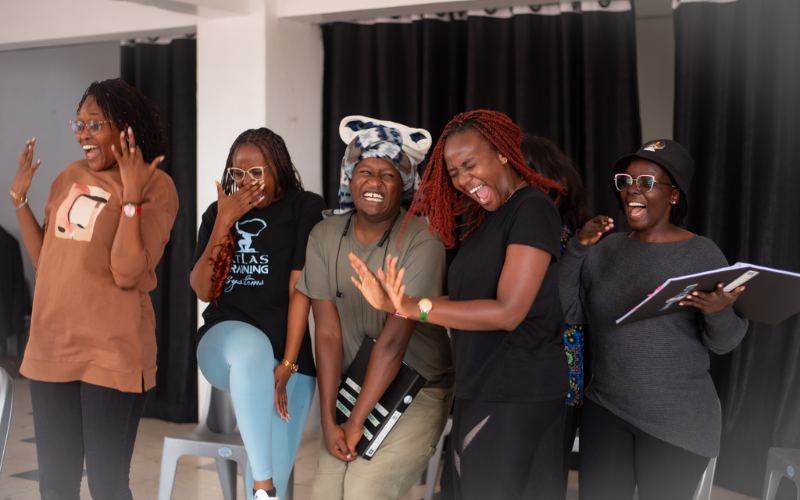
The writing team includes Ras Mengesha and Wacuka Mungai, with Ndinda Kioko and Ngartia as editing writers. Arunga explains that they spent months together crafting the story, then separated to write individual sections that spoke to them.
Past scripts and the insights of former TEFB writers informed their approach.
“We read the old scripts, and past writers like Ngartia and Nyaguthii Murage, who were in the room, also lent their wisdom and views on how we’re writing and how it sounded,” she says.
The role of Wangari is shared by Red Brenda and Akinyi Oluoch. Oluoch describes one of the most challenging scenes: Wangari’s imprisonment.

“I was thinking of how she could sleep on a dirty cell floor in such inhumane conditions with no food or water for standing against a regime that was not equitable for the people,” she says.
Red Brenda says playing Wangari reshaped her understanding of activism.
“I feel Wangari wanted people to see themselves as trees. When we look at our hair and our bodies, a tree is like a person that grounds itself. We should not see the difference between us and trees. If you cut down the trees, we cut down our spaces to exist,” she explains.
Brenda adds that the role offered a chance to experience the world through Wangari’s eyes, seeing her struggles and dreams for the environment. “There is always an expectation that people have with a story about a famous hero. But it is knowing that I was born for the art and I have something that Wangari wanted to use from me,” she says.
Photos: Courtesy