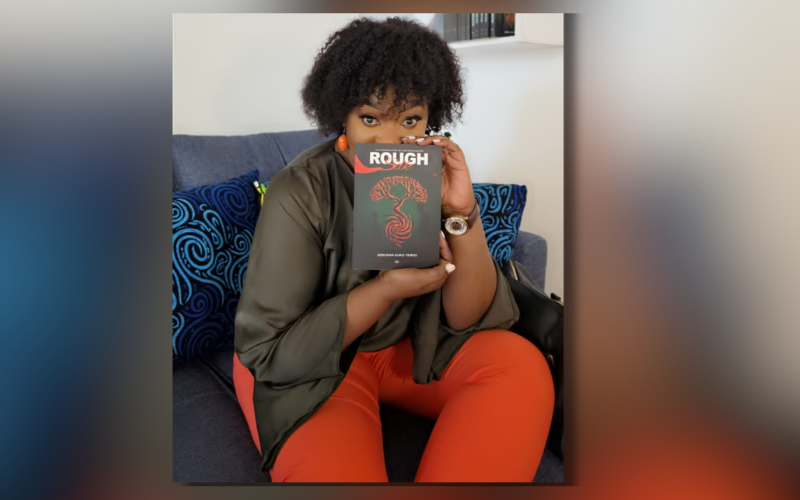
When writing the biography Rough Silk, Deborah Auko Tendo thought publishing it would be easy. However, once she started circulating her manuscript, publishers rejected it because it was based on a person, her father, George Auko, whom nobody knew.
Tendo says they didn’t care about the depth of the book; therefore, she walked the difficult terrain of self-publishing. The challenges didn’t stop there; only Textbook Centre and Nuria Bookstore stocked the book on their shelves. The book has been a national bestseller for three years consecutively now.
Rough Silk, which has now been picked up by a publisher, eKitabu, for publication of its second edition, is a rare case of a self-published title crossing into mainstream success. It will be republished on April 4.
“It is hard for a self-published author to secure a deal with a traditional publisher. Many self-published authors still struggle to get a publisher. This book will tell what the future holds for us when it comes to publishing,” she says.
Rough Silk is a 356-page biography of her single father, who died on March 25, 2016, of cancer. Following his death, Tendo was tasked with writing a eulogy for his requiem, but she felt it was impossible to capture all aspects of her father at once. So she wrote only four lines, which surprised her family. At this point, she knew she would write an in-depth book about her father.
She and her father had jokingly discussed her writing his biography just before he was diagnosed with cancer. She had listened curiously as her father told tales about their ancestral history. When he had cancer for about a year, she lived with him in India during his medical treatment. They talked more about his life, and he jokingly told her to write a book about him. Tendo laughed and asked him who will read the book since he isn’t famous.
The book, which spans seven decades, expands to include historical and cultural times such as Luo cultures, Raila Odinga, Gor Mahia and rhumba music.
Tendo starts the book by tracing her family’s roots to the Suba community, showing the migration from Suba land in Rusinga and following the topography of the lake, and settled in Sori. Her curiosity about identity began early, with visible differences from the people they found living in the place. She would pose questions to her father, for instance, on why they looked different from the people in Sori. Describing herself as a daddy’s girl, their closeness formed the foundation of the book.
Her father’s life—born into a polygamous family, raised by stepmothers after losing his own mother at birth—opened up conversations about culture and gender.
“As much as it is the story of man, it has depth when it comes to women. I talk about mortality rate, childbirth, and whether to save the child or the mother,” she says.
The issue of polygamy is in the book—how it is now and how it was then. While she is personally against it, she writes about the historical reasons for how polygamy was designed initially to protect women. She contrasts that past with present-day’s economic independence and high mortality rate.
The book continues to follow her, Auko’s life: how he started a family and how their mother left when she was three years old, leaving him to take care of two children as a single father.
Rough Silk also situates his life within the bigger story of the Luo community politically and culturally. She delved into the modern practices like Gor Mahia and Raila Odinga as the community king. She reflects on historical injustices and Odinga’s strong political leadership in them.
“We have faced economic and social injustices, and we always fought for ourselves, and the one who was at the forefront was Raila. We used to voice our dissent through him,” Tendo explains.
Music, too, is a cultural phenomenon, particularly the rumba, which is a source of joy and escape. The book also confronts painful histories, including the HIV/AIDS pandemic. She says some Luo cultural practices, like polygamy, have worked against them, going by the high number of Luos who died of HIV in the 1990s, leaving many people destitute and orphaned.
The book’s impact is its unfiltered honesty, which Tendo says has irked some readers. She captured her father truthfully, a man facing job loss, marital breakdown, polygamy, and hardship, leaving the village and living in a Nairobi slum.
“I shared everything, and it is part of the controversy when it comes to the book. Bios are superficial because they speak about the good things. Not only has it been a bestseller, but it continues because of the power of the truth inside it,” she says.
Writing the book also changed her understanding of her father, and she stopped judging him for his actions. He made bad decisions when he moved from the village to live in Nairobi.
“My father never had an early intimate life because he wasn’t raised by his mother. While his stepmother never mistreated him, he grew up without the love and comfort of a woman,” she says.
The book also became a tool for healing past traumas for her and his brother through seeking therapy and reliving the experiences.