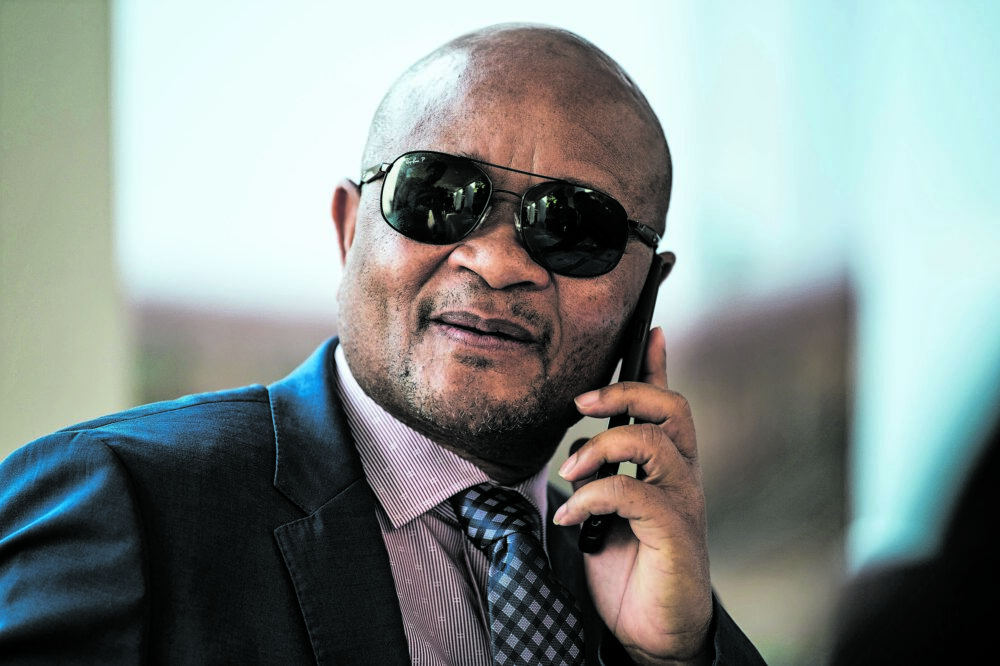
Suspended police minister Senzo Mchunu. Photo: Delwyn Verasamy
National police commissioner Fannie Masemola said suspended police minister Senzo Mchunu had ample time to brief him of his intention to disband the political killings task team (PKTT) but had never brought it up.
“We had not yet agreed. I said ‘gradual’, the minister said ‘immediate’,” Masemola said.
Speaking at the police ad hoc committee, Masemola confirmed previous testimony by deputy national commissioner for visible policing Tebello Mosikili, who said the national commissioner had been on annual leave when Mchunu had sent a disbandment letter via whatsapp.
Senior police officials have told the committee, which is investigating KwaZulu-Natal police commissioner Nhlanhla Mkhwanazi’s claims of police corruption and political interference, that they read the letter on social media.
Masemola said the objective of Mchunu’s disbandment was to stop the operations of the Gauteng crime intelligence investigations, which were closing in on businessperson and alleged leader of the Big Five cartel, Vusimuzi Cat Matlala.
“It is still my evidence that the minister never consulted with me about the directive or even before he issued the directive. I can add that I was with the minister for most of that week,” said Masemola.
Mosikili previously testified that Mchunu and Masemola had been part of a cross-provincial festive season safety campaign and had attended the funeral of a police captain several days before the disbandment of the political killings task team.
“Still I stand by what I said; at no stage did he hint or indicate there’s this imminent disbandment of the PKTT,” he said.
There had been ample opportunity to discuss the matter, especially the urgent disbandment instructions, Masemola said.
He said that in a virtual meeting in December 2024, Mchunu had raised concerns about Matlala’s controversial R360 million police healthcare contract with Medicare24 and had never raised concerns about the political killings task team, which was investigating Matlala.
Masemola had cancelled the contract in April 2025 after reports about complaints concerning poor Medicare24 service delivery.
Masemola said that when he had received Mchunu’s disbandment letter, he had briefly read it as he thought it was not a legitimate document. Once confirmed, he had requested departments to write reports based on the directive.
Masemola has previously testified before the ad hoc committee and Madlanga commission, which is investigating similar allegations, that he had advocated for a gradual wind-down of operations instead of an immediate shut down if disbandment was unavoidable.
He said he had received a letter from deputy national police commissioner for crime detection Shadrack Sibiya who had instructed the removal of 121 dockets from the task team as part of Mchunu’s disbandment order.
“I engaged General Sibiya in terms of how I would want to approach the matter, which I said: ‘I’m not going to do it as an immediate disbandment. If … we do it, we should wind down the team instead of doing it abruptly,’” he said.
Sibiya had told him the task team would be disbanded in a similar way to how the Scorpions had been disbanded as he had been a member, adding that dockets had been taken from the officers.
“I told him that: ‘No, no, no, but that for me is very irresponsible. You don’t even know what is in the dockets. You [can’t] just pack the dockets and say people must go.’
“I said: ‘I’m not going to do it [in] that irresponsible way. I will do it my way and my way is this way of winding down. So, I don’t want your Scorpion plan, go and do the plan, my plan of coming with a proposal of winding down the team.’”
He said Sibiya had submitted a plan, which still emphasised the immediate disbandment of the task team.
“I said: ‘No, for some reason maybe you don’t understand what I’m saying.’ I then tasked [crime intelligence head Dumisani] Khumalo to do the same”.
On 22 January, he had submitted the report drafted by Khumalo and the SAPS legal services recommending a structured shut down of the task team to Mchunu.
Masemola had subsequently met President Cyril Ramaphosa in person to brief him on the events.
“It was an arranged meeting which I requested from the president. The agenda was to talk basically about the disbandment of the PKTT, where I alerted him that there’s this thing that is happening, the PKTT was being disbanded and we don’t know why,” he said.
Ramaphosa had seemed surprised and stated that he would talk to Mchunu, said Masemola.
During a subsequent managerial meeting, Masemola had requested Mchunu to justify the disbandment of the PKTT.
“There, I said to the minister: ‘Minister, these are the senior managers of SAPS. Can you take them into your confidence? What are the reasons that we are disbanding this team?’”
Masemola had noted that Mchunu had responded at the end of the meeting.
“And later in the meeting here indicated one of the reasons why this team must be disbanded is that there’s no political killings, they happened pre-1994. For now there’s just killings,” he said.
Masemola said that had shown a clear division between those who supported the disbandment and those who did not and were forced to advocate for a gradual wind-down instead.