By Folarin Kehinde
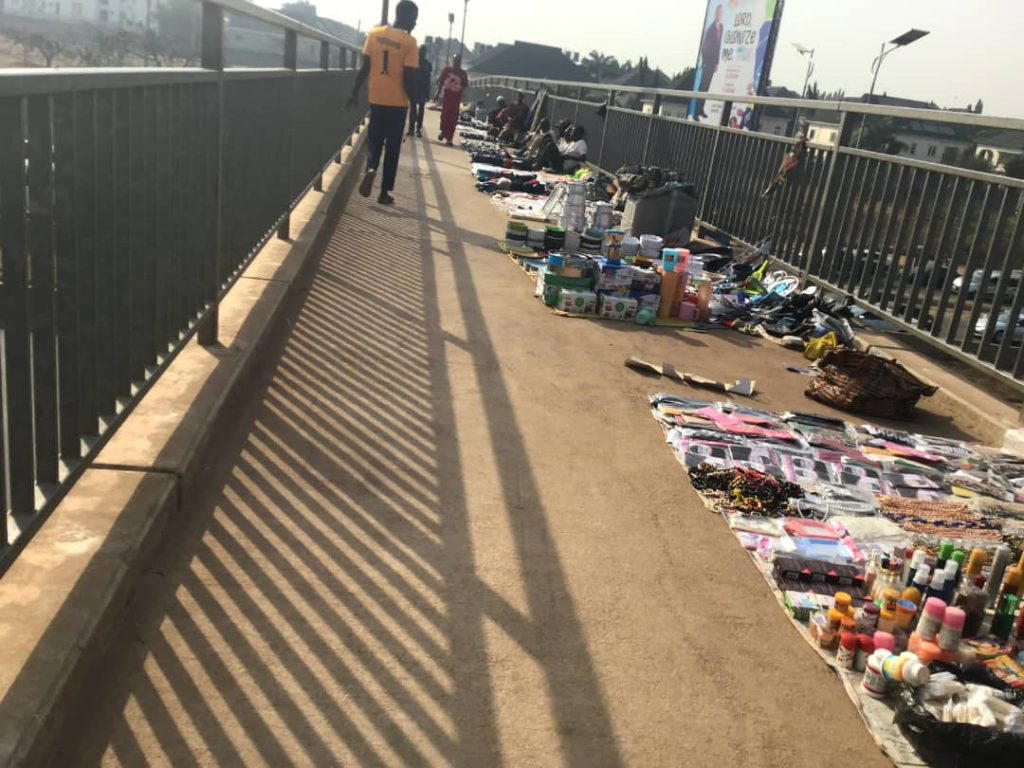
Rising shop rents across markets in the Federal Capital Territory, FCT, are forcing some small business owners to operate on bridges and other informal locations, as traders struggle to cope with increasing operational costs and declining customer patronage.
A business owner, Adamu Mustapha, who sells his goods on one of the Airport Road bridges, told Vanguard that he resorted to roadside trading due to the high cost of renting shops in nearby communities.
According to him, the additional cost of transporting goods daily also affects the prices customers eventually pay.
“Items that I am supposed to sell for N300, I end up selling for about N500 because I transport my goods from my house to the bridge every day,” he said.
In a separate interview with Vanguard, the Managing Director of Rural Homes Limited (RHL), Sa’adatu Aliyu, developer of the Karimo District Market, said the market was designed not just as a retail centre but as a structured investment asset.
Aliyu disclosed that rental spaces in the market range from about N100,000 per annum for smaller stalls to between N2 million and N3 million annually for larger units.
She added that shop purchase prices start from about N7 million, while warehouses measuring about 100 square metres with up to 14 metres in height range from N60 million to N80 million.
However, traders say such costs remain beyond the reach of many small and medium-scale business owners.
A shop owner at the Wuye Modern Market, who spoke to Vanguard on the condition of anonymity, described high shop rents as one of the biggest challenges currently confronting entrepreneurs in the FCT.
“As a shop owner in this ultramodern market, one of the major challenges we face is the high cost of shop rent,” the trader said.
According to the shop owner, securing a shop space alone requires a huge financial commitment that often takes a toll on business capital even before stocking goods.
“It is one thing to get the shop space, it is another thing to stock the shop with products. Paying for the shop alone takes a large portion of our capital,” the trader said.
The trader also noted that the country’s current economic realities have worsened the situation, as many consumers now prioritise basic necessities such as food, transportation and household items.
“People now focus more on essential needs. For those of us in the fashion sector, spending on non-essential items has reduced significantly. Businesses like ours are experiencing a noticeable decline in customer patronage compared to previous years,” the trader said.
According to the trader, the rising cost of materials has further compounded the difficulties faced by small businesses.
“Two days ago, fuel that we used to buy for about N800 is now over N1,000. Small business owners are dealing with increasing costs of materials, rent, staff salaries and electricity while sales remain slow,” the trader said.
The trader added that prolonged periods of low sales affect not only the businesses but also the livelihoods of employees and families who depend on them.
“Small businesses are an important part of the local economy, and when we struggle, the wider economy also feels the impact,” the trader added.
Despite the challenges, the trader said many entrepreneurs continue to adapt by improving services, strengthening relationships with customers and exploring online marketing strategies.
However, the trader called on the Federal Capital Territory administration to review policies around shop rents in order to make them more affordable for small business owners.
“We want the Minister of the FCT to look into the issue of shop rents in Abuja. There should be policies that make shop spaces more affordable for small businesses so that we can operate without excessive financial pressure,” the trader said.
The trader noted that more supportive policies would help businesses grow, increase market activity and ultimately benefit the wider economy and the community.
The post Abuja traders turn to bridges as shop rents skyrocket appeared first on Vanguard News.