—First to Flames, Then to Burial
The Cost of ProofOn Monday, grief hung heavier than the crowded stalls and makeshift shelters where the displaced families of Yelwata had survived for months. This was not ordinary fatigue. It was disbelief curdling into heartbreak, anger folding into helplessness, the crushing pain of a community that had lost more than two hundred lives in a single night. And now even the dead were being asked to speak for themselves.

Word spread quickly through the IDP camp in Makurdi. The Guma Local Government chairman had arrived with security personnel whose unease was visible. Even they admitted they felt unprepared and unsafe. The message was direct. Exhumation would be carried out. Reports denying that the Yelwata massacre ever happened were circulating, and the graves would have to answer.
For many survivors, that announcement was another blow. Mothers clutched the tiny shoes of children who would never take another step. Fathers stared into nothing, their shoulders bent as if grief had weight. Women held worn photographs of brothers and sisters who would never return. Every tear carried a name.
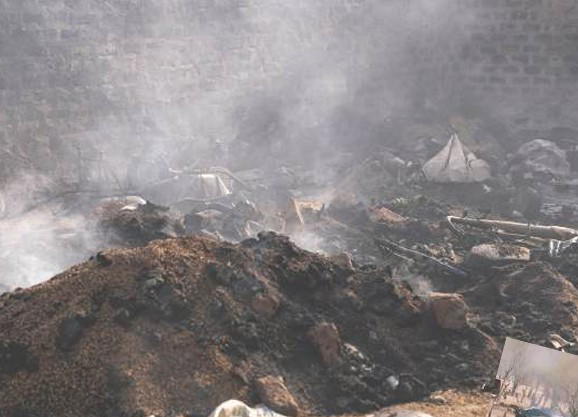
The night of June 13 to 14, 2025, is not a rumor. Armed men descended on Yelwata and surrounding communities. Homes were set ablaze. Families were trapped. Entire households disappeared before morning. When the smoke cleared, what remained were bodies and silence.
Those who survived did not return to normal life. They came to camps. To queues. To borrowed mattresses. To a future that had already been torn.
Now they are being asked to watch the earth open again.
Some have refused. Others have retreated back to the camp to avoid seeing graves disturbed. The chairman insists it is necessary. Denial has traveled beyond Benue. Proof is demanded. The living must now carry memory and verification at the same time.
It is a cruel balance.
How do you defend the truth without breaking the people who survived it?
Jerry Ayem does not cry the way people expect grief to look. Sometimes she goes completely quiet, as if her body has stepped aside to survive what her mind remembers.
But when she speaks, the quiet fractures.
She and David Ukeyima watched their worlds burn from the roof of a building already on fire. From that terrible height they saw flames swallow rooms that once held laughter. They heard voices calling their names. They could not reach them.
Jerry told me, in a voice that sounded worn thin, “I still remember the different cries. My children. My husband. My mother. Each voice was different. I hear them separately. It comes back every second.”
She did not dramatize it. She spoke as someone describing something permanent.
“I wish God had taken me with them,” she whispered. “So I do not have to feel this.”
She has fainted more than six times since that night. Her body shuts down when memory becomes too loud.
She is an only child. No father. No siblings. Her husband and mother were her only family. Her daughters were the sisters she never had. She built her world early so she would never be alone.
Now she sits in a camp with nothing but memory.
Days before the attack, her mother and the children had escaped violence in another village and ran toward Yelwata believing it was safer. They thought they were running toward life.
They were running toward the end.
Ukeyima carries his grief differently. He watched his wife and children killed. There was no time to plan. No time to think. When the attackers moved through the rooms, he ran into one hoping he could gather his family there. The building was set on fire. He and Jerry were inside.
They thought they would die. When the attackers moved on, assuming the flames would finish their work, Jerry and Ukeyima jumped down with burns already cutting into their skin. They ran to a police checkpoint and were told to hide.
He told me that every child he sees now looks like his own. Sometimes he follows one for a few steps before realizing it is someone else’s son. He stops, confused, then embarrassed.
“There was no time,” he said when I asked why he did not climb the roof with the others. No time to choose. No time to calculate. Only time to run.
These are not just displaced persons. They are people whose nights do not end. Sleep is not rest. It is return.
And now, to open the graves of their loved ones in order to prove they died feels like tearing at skin that has not healed.
Two days after I wrote about their tears, my phone rang.
It was Ukeyima.
His voice was steady in a way that frightened me.
“Good afternoon ma,” he said. “I went to Yelwata yesterday. They removed the bodies of my children and my wife.”
I asked him if he saw them.
“I was there,” he said. “They gave me something to cover my face and nose. Since I came back, I have not gone outside.”
He paused.
“They first removed my first son, Samson Ukeyima.”
“My wife and my other kids.”
A father stood there and watched the earth return what fire had taken.
I asked who sent them.
They brought their own team,” he said. “They came from the Federal Ministry of Justice and the IRT of the police.
Jerry called me this morning and said she couldn’t go there to witness that,she’s a woman and there’s so much a woman can take without breaking down.
Officials. Procedure. Documentation.
And in the middle of it, a father watching his child lifted from the soil.
How many times must a man lose his children?
First to flames.
Then to burial.
Now to exhumation.
Since that day he has stayed indoors.
This is what proof looks like.
We speak about verification. About reports. About conflicting claims. But somewhere in Makurdi, a father cannot step outside because he has just watched his son come out of the ground.
What is left of humanity when the living must defend the dead?
In the camp, the crying is not loud anymore. It is tired. It is the sound of people who have run out of strength but not out of memory.
Their pain has names.
Jerry.
Five daughters.
A mother.
A husband.
Ukeyima.
Five children.
A wife.
And a night that refuses to loosen its grip.
Yelwata does not need pity. It needs acknowledgment. It needs protection. It needs truth without further cruelty.
Somewhere in Makurdi, a father is still indoors. And that should be enough evidence for all of us.
The post How many times must a father lose his children? By Stephanie Shaakaa appeared first on Vanguard News.