The National Social Security Fund (NSSF) has recorded a 17 per cent return on member savings, setting an ambitious target to grow its kitty to Sh1 trillion by 2027, even as a final hike in mandatory pension contributions threatens to shrink workers’ take-home pay.
The state-owned pension manager yesterday said the 17 per cent return for the financial year that ended in June 2025 was the highest in its history, up from 11 per cent in the 2023/2024 financial year, driven by a 153 per cent growth in investment income to Sh105 billion. Assets under management grew to Sh575 billion, with the fund projecting to reach Sh750 billion by June 2026.
“We are well past Sh670 billion today. We want to close 2026 at around Sh750 billion, and in 2026/27, we want to make a great leap by adding another Sh250 billion to one trillion. That’s our target,” NSSF Managing Trustee and CEO David Koros told members at the fund’s 8th Annual General Meeting.
The bullish growth forecast coincides with the final phase of a mandatory contribution increase that took effect on February 1.
The hike raises the maximum monthly employee deduction to Sh6,480 from Sh4,320, with employers matching the amount. The move has sparked concerns from the Federation of Kenya Employers (FKE), which warned of “shrunken pay” for workers already grappling with a high cost of living and multiple other statutory deductions.
To sustain double-digit returns, Koros outlined an aggressive diversification strategy away from traditional government bonds, which still dominate its portfolio at 72 per cent.
A centerpiece is a Sh97 billion investment in the Rironi-Naivasha-Mau Summit expressway, a public-private partnership with China Road and Bridge Corporation. The Fund expects dollar-denominated returns of 10 per cent to 15 per cent over the 30-year concession period, with toll revenues starting in 2028.
In real estate, the Fund plans to break ground by March on a landmark Sh39 billion twin-tower complex on Nairobi’s Kenyatta Avenue, featuring a 56-storey skyscraper with grade-A offices and a luxury hotel, targeting a 13 per cent annual return.
It is also developing a Sh3.2 billion residential project in Kisumu.
“We are flipping all of it, unlocking value, we get the money, we do other things,” Koros said of the Kisumu project.
The ambitious growth narrative contrasts with a recent audit report for the period that ended in June 2025, which highlighted persistent governance lapses. The Auditor-General’s report, while giving an unmodified opinion on the financial statements, flagged multiple unresolved issues.
These include a Sh35 billion investment property whose title deed was revoked by the state, idle properties in Nairobi’s central business district valued at Sh4 billion and an eight-year delay in completing a boundary wall for a plot in Bamburi. The audit also noted Sh13 billion in outstanding taxes that may attract penalties, and irregular allowance payments to staff.
Koros acknowledged “legacy issues” haunting the fund from poor investment decisions made “way back,” including properties built on disputed land. He said the fund was addressing them by exiting non-performing quoted equities, developing idle land and pursuing legal claims.
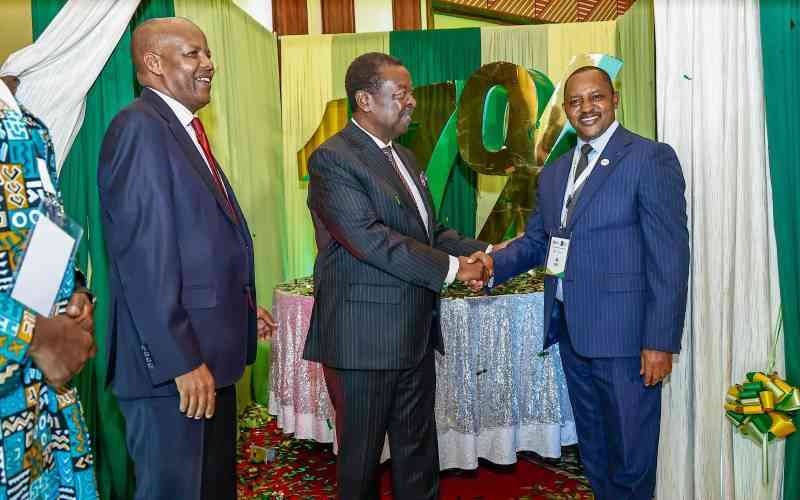
Senior government officials framed the higher contributions as a necessary pain for long-term security. Prime Cabinet Secretary Musalia Mudavadi, who declared the 17 per cent return at the AGM, urged citizens to view the NSSF as a critical, non-political institution for national development.
“Rome was not built in a day. Institutions of nature like NSSF, don’t come overnight. It takes time, it takes building, it takes savings, it takes patience,” Mudavadi said.
Stay informed. Subscribe to our newsletter
He challenged the fund to consider commercial investments in major infrastructure, like an airport, mirroring global pension fund investments. Koros made a plea for higher savings, calculating that a worker consistently saving for 30 years could retire with a pot of Sh35 million, compared to a current average payout of just over Sh200,000.